Woke rating
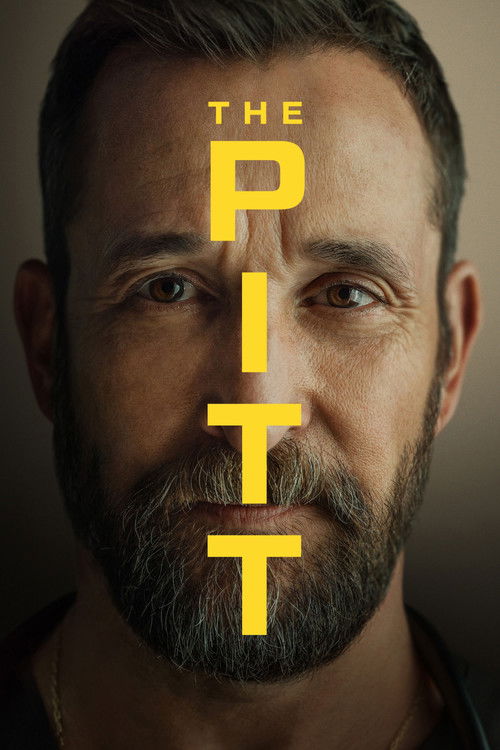
The Pitt
Mild
The opening hours of this real-time ER drama are a medical procedural first; the messaging is a running complaint about hospital money and staffing, plus a stray line or two about race.
R. Scott Gemmill's hospital drama follows Dr. Robinavitch ('Robby', Noah Wyle), the attending physician in a crowded Pittsburgh emergency department, through one shift in real time, an hour per episode. These first two hours, from about 7 to 9 in the morning, bring in new medical students and interns on the anniversary of the death of Robby's predecessor, and fill up with cases: a subway accident, a triathlete whose kidneys have failed, a four-year-old who ate cannabis gummies, a college student's overdose, and a family arguing over their father's do-not-intubate order.
Most of the messaging is about the hospital itself. In the first hour Robby tells the administrator that the hospital keeps admitted patients waiting downstairs because it is cheaper than staffing beds upstairs, that nurses would line up if they were paid a living wage, and that he could go to the media about patients arresting in the waiting room. The theme returns with rats in the department and patients parked in hallwaysa patient moved to a hallway who is later found without a pulse. Race comes up directly in one line, when Mel is told that a family facing a child-welfare inquiry will be fine because they are white. A possible hate crime against a Nepali woman is a passing police thread, and a sickle-cell patient first brought in as a drug-seeker gets an apology and a short lesson in empathy.
What keeps the score low is that the cases come first. Each is a medical puzzle or a family drama, the difficult relatives and the administrator have ordinary motives, and the mixed staff and a patient's wife are shown without comment. These are only two of the season's fifteen hours: a pregnant teenager due back for the abortion pill mifepristone is mentioned but has not yet appeared, so later episodes could move the score.
Score breakdown
Each category is scored 0 to 3: 0 absent or presence only, 1 brief, 2 recurring or plot-relevant, 3 central or dominant. Timestamps refer to the film's running time.
| Category | Score | What we saw |
|---|---|---|
| Content | ||
| A Race and ethnicity | 1 | Race is raised directly once, as a claim that child-welfare and police outcomes depend on a family's race. A possible hate crime against a Nepali woman is a police thread with no answer yet.
|
| B Gender and feminism | 0 | Women hold most of the senior roles and one resident is a single mother, all without comment. A teenage boy's list of girls he wants to hurt is a suspense thread with no gender commentary so far. |
| C Sexuality and gender identity | 0 | A patient's wife sits at her bedside (S01E02 0:40:10), with no comment. There is no LGBTQ+ theme. |
| D Power and systems | 2 | The overcrowded, understaffed department is the show's premise, and the first episode argues it outright: the hospital is said to save money by keeping patients boarding in the ED and to underpay its nurses. The theme recurs in both episodes. Scored 2, not 3, because the critique is about patient care in general rather than the oppression of a group, and the administrator's side (a national nursing shortage, a tight budget) is at least voiced.
|
| E Cultural and historical revision | 0 | An original series. No established characters or history are recast. |
| F Religion portrayal | 0 | Islam is not portrayed. Characters with South Asian and Iranian names (Mohan, Javadi, Shamsi) have no religion shown or discussed. |
| Treatment | ||
| G Antagonist coding | 0 | No villain is defined by a demographic or ideology. The administrator is a budget-minded foil with a stated motive, and the difficult relatives, the cannabis-gummy mother and the Spencer children, act out of fear and grief. |
| H Didacticism | 1 | A few lines state a point directly: Robby's argument with the administrator, the remark about white families, and a short lecture on believing patients in pain. Most of the time the episodes show rather than tell.
|
| I Message over story | 0 | The story leads. Each thread is a medical case or a family drama, and the staffing complaint grows out of the setting rather than bending it. |
| J Left-leaning politics framed as good | 1 | A few left-leaning points get passing approval: a living wage for nurses, the environmental crisis and gun violence listed among what troubles young people, and the remark that white families are treated leniently. Each is a line, not a theme.
|
How the number is reached
- Categories A to J add up to 5 of 30, which gives 1.5 (5 ÷ 30 × 10, rounded to the nearest 0.5).
- No counterweight: None applies. The administrator's counterpoints are voiced but rebutted each time (S01E01 0:15:24, 0:16:27), and the race remark is put down to cynicism by its speaker but goes unchallenged (S01E02 0:37:16). There is little messaging to complicate.
- Final rating 1.5, mild.
Considered, scored 0
- A mixed staff and patient population (Black, Latino, South Asian, Middle Eastern and white characters), shown without comment.
- Women in most senior roles (the charge nurse, a senior resident, the surgeon, the administrator), and a resident who is a single mother (S01E02 0:20:01).
- The sickle-cell patient's race: she is Black, but the dialogue puts her poor treatment down to unfamiliarity with the disease, never to race (S01E02 0:28:43, 0:40:22).
- The same patient's wife, Ondine, at her bedside (S01E02 0:40:10).
- A pregnant teenager due back for mifepristone, mentioned twice as a work item (S01E01 0:04:49, 0:25:14); she does not appear in these episodes.
- An 18-year-old's list of girls he wants to hurt, played as suspense with no commentary so far (S01E01 0:46:20).
- Unhoused patients (a man with scurvy, a burned mother who may be unhoused), treated as medical cases (S01E01 0:35:37, S01E02 0:31:48).
- Crude remarks by patients ('Fruitcake', 'pasty white'), played as comedy (S01E02 0:10:18, 0:21:19).
Evidence and confidence
Confidence: Medium. Full English subtitles (the embedded English track) and 35 frames sampled every three minutes. Both of the owner's 2 episodes were reviewed (S01E01 and S01E02), but they are only the first two hours of the first season's fifteen, so the rating reflects the opening of the show only. No gaps in the dialogue; the one stretch without subtitles (S01E02 0:46:55 to 0:48:05) is a wordless scene.
Category F definition: As in the rubric: Islam shown as a peaceful and tolerant religion, aligned with human rights, in a way that works as a corrective message.
Noted, not scored: Mel says all doctors should spend time at the VA because of what veterans have sacrificed (S01E02 0:06:29).
Episodes reviewed: S01E01, S01E02.
Rubric version 1. Reviewed 18 November 2026.