Woke rating
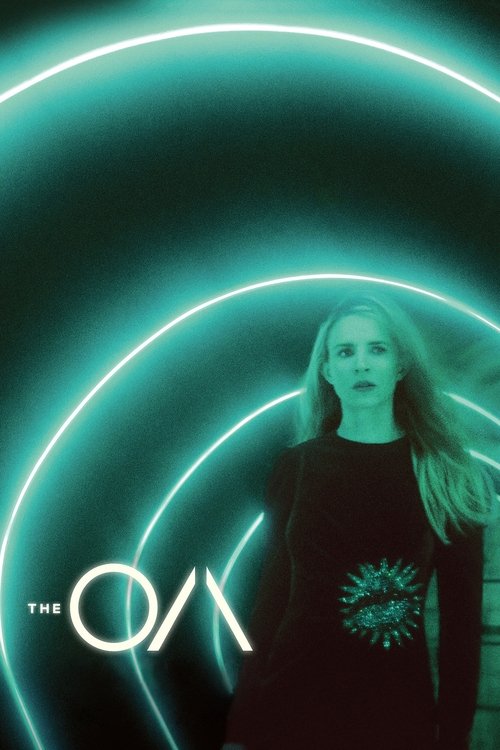
The OA
None or negligible
A mystical drama about a returned captive and the misfits she gathers, with only passing lines about a trans teenager, gay classmates and race; its real subjects are death, faith and captivity.
The OA, created by Brit Marling and Zal Batmanglij, follows Prairie Johnson (Marling), a blind adoptee who turns up in her Michigan town after seven years missing, now able to see and calling herself the OA. She recruits four teenage boys and a schoolteacher to meet her at night in an unfinished house, where she tells them her story: a childhood in Russia, her adoption, and years held with other captives by a scientist obsessed with near-death experiences. Alongside it run the listeners' own troubled lives, and the season builds toward a mission she says they must help her complete.
The OA, created by Brit Marling and Zal Batmanglij, follows Prairie Johnson (Marling), a blind adoptee who turns up in her Michigan town after seven years missing, now able to see and calling herself the OA. She recruits four teenage boys and a schoolteacher to meet her at night in an unfinished house, where she tells them her story: a childhood in Russia, her adoption, and years held with other captives by a scientist obsessed with near-death experiences. Alongside it run the listeners' own troubled lives, and the finale brings a shooting in the school cafeteria while leaving open whether her story was true.
The messaging that registers is incidental. Buck, the youngest listener, is a trans boy: he buys testosterone from Steve, who threatens to cut off his supply, and his parents argue over whether to call their child 'her' or 'him'. Steve, the group's bully, is called out by a chorus singer for mocking a gay friend of his, and the teacher, BBA, later tells him flatly that people are gay. Buck and French, the scholarship student, agree that character clauses assume kids like them will drift into crime, and a donor patronises French about 'the demographic'. The show is also wary of institutions that manage misfits: doctors diagnosed the young Prairie as psychotic and medicated her for years, and Steve's parents threaten him withhand him over to a reform school.
What keeps the score at the bottom of the scale is that none of this is argued. Each moment is a line or two inside a scene about something else, no one makes a speech about identity, and Buck's transition never drives the plot. The show's subjects are death, the soul, captivity and what Prairie calls the 'invisible self', and its spirituality is earnest rather than political. The villain is driven by his obsession with proving an afterlife, not marked by any group, and no political side is taken.
Score breakdown
Each category is scored 0 to 3: 0 absent or presence only, 1 brief, 2 recurring or plot-relevant, 3 central or dominant. Timestamps refer to the film's running time.
| Category | Score | What we saw |
|---|---|---|
| Content | ||
| A Race and ethnicity | 1 | Race and class come up twice, briefly, around French: Buck says scholarship character clauses assume kids like them will slide into crime, and a donor tells French to go into politics given 'the demographic'. Neither is developed, and no interracial couple is shown.
|
| B Gender and feminism | 0 | No gender message. The heroine leads and her guide in the afterlife is a woman, but the captor imprisons men and women alike and nothing is framed in terms of sex (see zeroed). |
| C Sexuality and gender identity | 1 | Buck is a trans boy, and his transition surfaces in a few short lines across the season: buying testosterone, a sibling's offhand label, his parents' argument over pronouns. Gay classmates come up in Steve's mockery, which the show treats as bullying, and in BBA's retort. Scored 1: recurring but always brief, never argued, and it drives no plot.
|
| D Power and systems | 1 | Institutions that handle misfits are shown as heavy-handed: a hospital that wants Prairie committed, doctors who diagnosed and medicated her as a child, and the reform school Steve's parents threaten him withuse. None of it is framed as oppression of a group, and the FBI's victim counsellor is portrayed warmly.
|
| E Cultural and historical revision | 0 | An original series. No established characters, history or source material are recast. |
| F Religion portrayal | 0 | Islam does not come up. The FBI counsellor Elias Rahim has a Muslim name, but his faith is never mentioned. |
| Treatment | ||
| G Antagonist coding | 0 | The captor, Hap, is a white male doctor, but he is defined by a personal obsession with proving life after death, admits to guilt and is given a detailed motive. The lesser antagonists, a colleaguea colleague who kills his subjects for profit and the reform-school men, are individuals, not types. |
| H Didacticism | 0 | No one lectures. The few direct lines about race and sexuality are casual one-liners in conversation, counted under A and C; the OA's speeches are about the soul, captivity and the 'invisible self'. |
| I Message over story | 0 | The story leads. The identity moments sit inside scenes about other things and never steer the plot, which runs on the captivity story and the group's nightly meetings. |
| J Left-leaning politics framed as good | 0 | No political side is taken. Religious belief is treated with respect (BBA and the OA talk earnestly about heaven and angels, S01E07 0:17:07), and no conservative figure or position is cast as the problem. |
How the number is reached
- Categories A to J add up to 3 of 30, which gives 1.0 (3 ÷ 30 × 10, rounded to the nearest 0.5).
- No counterweight: None applies. The scored moments are brief and unargued, so there is no real message for the show to complicate.
- Final rating 1.0, none or negligible.
Considered, scored 0
- A mixed group of misfits, including French (Alfonso Sosa) and Buck Vu, shown without comment on their backgrounds.
- No interracial couple appears in the dialogue or frames. Homer's coerced night with Renata, a guitarist in Cuba (S01E05 0:41:43), is a seduction under duress rather than a couple, and nothing marks it as interracial.
- The FBI victim counsellor Elias Rahim, who has a Muslim name; religion never comes up (S01E04 0:28:52, S01E07 0:07:18).
- The Statue of Liberty poem read in full (S01E02 0:20:17), a clue in Prairie's search for her father, with no point made about immigration.
- The counsellor's remark that victims are mainly women and children (S01E04 0:29:07), and a throwaway question about feminism at Renata's concert (S01E05 0:05:30).
- Jaye's frank talk about sex as practice for real love (S01E01 0:52:38), character rather than cause.
- Ali's guess that Asheville is a 'Christian boot camp', which Jesse corrects (S01E04 0:19:09), and Rachel's memory of a hateful hometown, left unexplained (S01E03 0:50:58).
- A colleague's advice to Hap to turn a profitLeon's advice to Hap to destroy the evidence and turn a profit (S01E06 0:10:23), individual villainy rather than a critique of capitalism.
- The finale's violenceThe school shooting in the finale (S01E08 0:40:53), which carries no comment on guns.
Evidence and confidence
Confidence: Medium. Full English subtitles from the embedded tracks for all 8 episodes the owner has (the whole of Part I; Part II was not available), with the forced track translating the Russian scenes in S01E01 and S01E02, and 128 frames sampled every three minutes. S01E08 has no frames, so its scenes were judged from the dialogue alone, and a few Spanish lines in the Cuba scenes of S01E05 are untranslated.
Category F definition: As in the rubric: Islam shown as a peaceful and tolerant religion, aligned with human rights, in a way that works as a corrective message.
Episodes reviewed: S01E01, S01E02, S01E03, S01E04, S01E05, S01E06, S01E07, S01E08.
Rubric version 1. Reviewed 18 November 2026.