Woke rating
The Gentlemen
None or negligible
Guy Ritchie's caper about a duke running a cannabis empire is cynical about everyone and carries no progressive message; its only points are a recurring interracial couple shown without comment and a House of Lords for sale played for laughs.
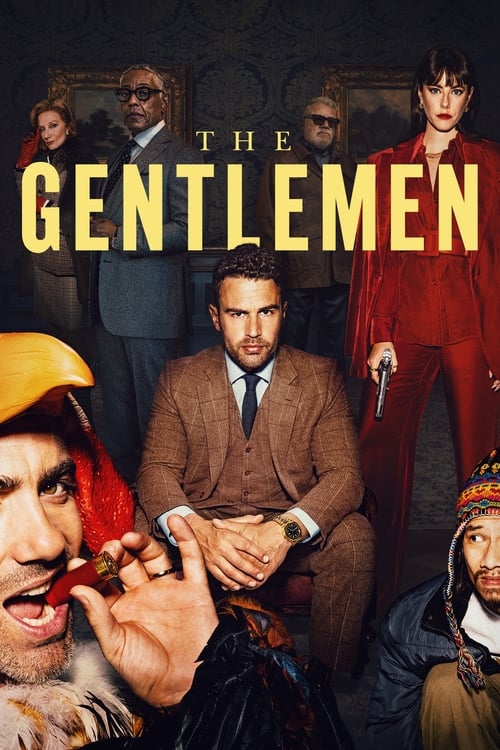
Guy Ritchie's Netflix spin-off of his 2019 film follows Eddie Horniman, the Duke of Halstead, who runs a cannabis business hidden under aristocratic estates with Susie Glass while her father Bobby serves a prison sentence. Season 2 sends Eddie into the House of Lords to steer a bill to decriminalise cannabis behind Bobby's back, into business with an Italian Mafia boss and his goddaughter, the Contessa Bella, and into a family drama as his brother Freddy comes home from rehab newly devout. Susie, meanwhile, is courted by an old flame who wants her in the cocaine trade. The season builds to an attack on the family and a hunt for whoever ordered it.
Guy Ritchie's Netflix spin-off of his 2019 film follows Eddie Horniman, the Duke of Halstead, who runs a cannabis business hidden under aristocratic estates with Susie Glass while her father Bobby serves a prison sentence. Season 2 sends Eddie into the House of Lords to steer a bill to decriminalise cannabis behind Bobby's back, into business with an Italian Mafia boss and his goddaughter, the Contessa Bella, and into a family drama as his brother Freddy comes home from rehab newly devout. Susie, meanwhile, is courted by an old flame, Joe, who wants her in the cocaine trade and turns out to be lying to her. When the bill fails, Bobby has Eddie beaten and left for dead; Eddie marries Bella, she dies when her seaplane is bombed, raiders try to snatch Charly's baby from Halstead, and the culprits turn out to be Freddy and his Bible-quoting mentor, John Dixon.
Progressive messaging is almost absent. The one point under race is a couple the rubric counts on sight: Eddie's sister Charly and Nanny Asante, a Black army officer and the King's Equerry, who have a baby son and recur through the season (Nanny ends up fighting beside the gamekeeper to save the boy); race is never mentioned. The rest is caper material: a peer is bribed and then framed to secure Eddie's seat, the hereditary peers are said to follow the money, and a farm worker who leads a go-slow over a colleague's breakdown is answered with a gun to his head. Lord Hawthorne, the gay peer who makes Jack's company part of his price, is a comic figure, not a cause.
What keeps the score near zero is that the series is cynical about everyone and no speech pushes a social message. The decriminalisation bill is a gangster's scheme to corner a legal market, its harms are shown through laced weed that drives users mad, and the news gives both sides; the strike leader is a figure of fun who robs the farm once sacked. If anything the series leans the other way: Eddie opens the season vowing to undo generations of apology and shame, a financier preaches kingship and dangerous manhood to him, and the humour is cheerfully un-PC.
Score breakdown
Each category is scored 0 to 3: 0 absent or presence only, 1 brief, 2 recurring or plot-relevant, 3 central or dominant. Timestamps refer to the film's running time.
| Category | Score | What we saw |
|---|---|---|
| Content | ||
| A Race and ethnicity | 2 | An interracial couple, counted as the rubric requires: Eddie's white sister Charly and Nanny Asante, a Black army officer and the King's Equerry, parents of the baby Tarquin. They appear in most episodes, so 2 for a recurring supporting couple; race is never mentioned.
|
| B Gender and feminism | 0 | No gender message. Susie runs the family business day to day and holds her own among men without comment, a woman is Bishop of Sussex, and Charly and her mother keep their nerve in a crisisCharly runs down one of the raiders. Susie's line about disobeying the patriarchy is a joke about her father. |
| C Sexuality and gender identity | 0 | No LGBTQ+ message. Lord Hawthorne is gay and his interest in Jack is a running joke; Jack says he has no problem with it, it is just not for him. A gag about sex changes is a throwaway. |
| D Power and systems | 1 | Westminster is for sale through the first half of the season and a workers' go-slow is broken at gunpoint, but both play as caper comedy with the criminals as heroes. No group is cast as the victim of a system.
|
| E Cultural and historical revision | 0 | An original series spun off from Guy Ritchie's 2019 film, with its own characters; season 2 continues season 1's cast. Nothing is recast or revised. |
| F Religion portrayal | 0 | Islam does not feature. Gulf royals appear as rich contacts at a shoot and in a falconry deal, and a cook's grandmother is joked to have been in the Taliban. |
| Treatment | ||
| G Antagonist coding | 0 | No villain is defined by a group. The rival gangsters (an Italian fixer, a Japanese hitman, Albanian, Irish and Peruvian dealers) are genre types driven by greed, and the season's hidden enemy has personal motives too, and the hidden enemy, John Dixon, is a Bible-quoting coke dealer who wants Halstead and the drug business for Freddy, the brother he believes God sent him (S02E08 0:38:44, 0:39:09). The other Christians, a bishop, a priest and a christening, are treated straight. |
| H Didacticism | 0 | No speeches state a social message. The nearest are the go-slow leader's grievances and demands (S02E03 0:08:49), played for laughs, and Eddie's case for decriminalisation (S02E03 0:06:14, S02E04 0:04:08), made to sell a business plan. The most sermon-like speeches are a financier's on kingship and manhood, which carry no progressive message. |
| I Message over story | 0 | The story leads throughout: a twisting crime plot with nothing bent toward a message. |
| J Left-leaning politics framed as good | 0 | No political side is framed as good. The decriminalisation bill is a criminal scheme whose harms are shown, and the news gives both sides (S02E04 0:42:11); the strike is mocked; the Conservatives are named only as a voting bloc (S02E04 0:02:26). The monarchy, the aristocracy and the Church are treated with affection, corrupt peers and all. |
How the number is reached
- Categories A to J add up to 3 of 30, which gives 1.0 (3 ÷ 30 × 10, rounded to the nearest 0.5).
- Counterweight −0.5: The series complicates what little social critique it has. The go-slow leader is a figure of fun who admits he thought gangsters would listen to reason (S02E03 0:22:35), had been skimming weed all along and helps a friend's crew rob the farm once sacked (0:23:35); a boss reports the socialist agitation stamped out (0:47:40), and a thought that he should have been paid more is teased as bleeding-heart liberalism (0:31:41). The case for decriminalisation is a gangster's plan to corner the legal market (S02E02 0:05:41), laced weed from the farms drives users mad (S02E03 0:29:32), and the news gives both sides (S02E04 0:42:11). And the man buying the Lords is the hero.
- Final rating 0.5, none or negligible.
Considered, scored 0
- A mixed cast of gangsters (Italian, Japanese, Albanian, Irish, Peruvian) and Gulf royals courted as business contacts (S02E01 0:08:45, S02E04 0:12:25), all genre types shown without comment.
- Lord Hawthorne, a gay peer who wants Jack's company (S02E01 0:21:40), and Jack's reply that he has no problem with it, it is just not his taste (S02E02 0:10:58): running comedy, not advocacy.
- Freddy's joke that he has changed only figuratively, not by a sex change (S02E02 0:14:12).
- A woman as Bishop of Sussex (S02E04 0:03:07), shown without comment.
- Susie's joke about disobeying the patriarchy, meaning her father (S02E03 0:38:07).
- The family fortune's roots in trade with India, told as family history (S02E03 0:03:11).
- Eddie's confession, in which he tells a priest that more people have died through the alibi of God than through heroin (S02E06 0:36:22): character work for a killer, and the priest is treated with respect (0:49:21).
Evidence and confidence
Confidence: Medium. Full English subtitles from the embedded track for all eight episodes (S02E06 also has a forced track for its Italian lines), and 149 frames sampled every three minutes, the last few of each episode mostly end credits, plus about a dozen frames taken from the source to check the couples. All 8 of the owner's 8 episodes were reviewed: the whole of season 2. Season 1 is not among the owner's files and was not reviewed, so the rating reflects season 2 only. Wordless stretches, such as the opening of S02E05 (0:00:52 to 0:04:27) and long action scenes in S02E07, are covered by the frames only.
Category F definition: As in the rubric: Islam shown as a peaceful and tolerant religion, aligned with human rights, in a way that works as a corrective message.
Noted, not scored: Some of the series leans the other way. Eddie opens the season vowing to win back an estate whose decline he describes as apologies, then shame, then contraction (S02E01 0:02:24), and the financier Stanley Johnston's sermons cast the crown as the union of masculine and feminine (S02E02 0:01:16) and say a harmless man is not a complete man (S02E02 0:03:31), words that replay in Eddie's head at a killing (0:46:01). The humour is often un-PC and unapologetic: a restaurateur insists his Japanese-Pakistani fusion only sounds racist (S02E05 0:19:02), and his cook's grandmother is joked to have been in the Taliban (S02E05 0:32:54).
Episodes reviewed: S02E01, S02E02, S02E03, S02E04, S02E05, S02E06, S02E07, S02E08.
Rubric version 1. Reviewed 18 November 2026.