Woke rating
1923
Mild
Taylor Sheridan's Yellowstone prequel is mostly a drought-and-range-war western with an African romance on the side; its Indian boarding-school storyline is a harsh portrait of forced assimilation, but the messaging stays inside that one strand.
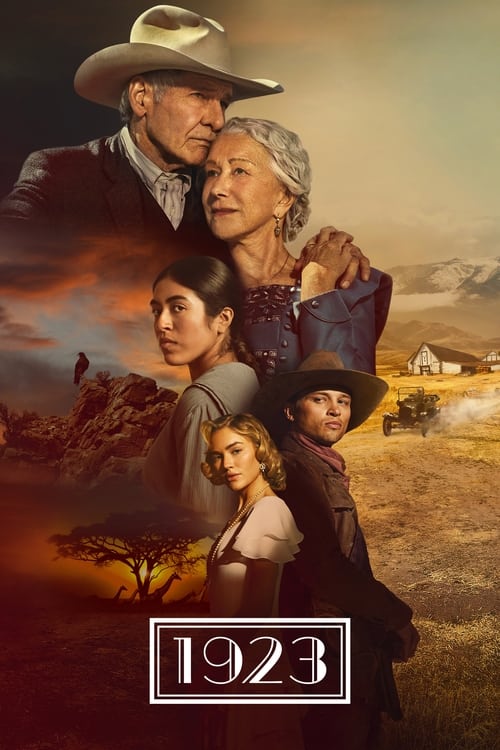
1923 follows Jacob and Cara Dutton (Harrison Ford and Helen Mirren) as they try to hold their Montana ranch through drought, locusts and a post-war cattle slump, while a quarrel with the sheepherder Banner over grazing grows into a range war. Two other strands run alongside: Jacob's nephew Spencer, a war veteran hunting man-eaters in East Africa, falls for Alexandra, an Englishwoman engaged to someone else; and Teonna, a Native girl, is held at a government boarding school run by a priest and nuns.
Nearly all the messaging sits in Teonna's storyline. The school beats her over one wrong word, humiliates the girls at bath time, shuts her in a hot box and forbids her own language, and one nun's attentions at bath time are plainly predatory. Sister Mary spells out the programme herself: she is the bridge from the extinct civilisation of Teonna's people and has sworn to kill the Indian in her. Teonna's grandmother, meanwhile, is turned away by a superintendent who uses the letter of the law to keep the child at the school. This depicts a real historical policy and is told through what happens to Teonna rather than through speeches by the heroes, but the clergy are drawn as one-note villains.
What keeps the score low is that the other two strands carry almost no message. The Dutton storyline is a range-war western that admires ranch life, family duty and self-reliance; its heroes are hard men who take the law into their own handswho hang Banner's men in the woods, and the sheepherder they fight has a real grievance. The Africa strand is an adventure romance in which colonial life is mostly backdrop, apart from Spencer's anger at a camp manager's indifference toward an African guide killed in the hunt. Only three of the owner's seven episodes could be reviewed, so later episodes could shift the balance.
Score breakdown
Each category is scored 0 to 3: 0 absent or presence only, 1 brief, 2 recurring or plot-relevant, 3 central or dominant. Timestamps refer to the film's running time.
| Category | Score | What we saw |
|---|---|---|
| Content | ||
| A Race and ethnicity | 2 | Teonna's storyline shows the boarding school trying to strip a Native girl of her language and identity, with the aim stated outright, and the reservation superintendent keeping her there. It recurs in two of the three episodes but is one strand of three.
|
| B Gender and feminism | 1 | Women's lot comes up in a few lines, none framed as a cause: Cara insists the wedding is the bride's day, the school drills Native girls in housewifery as part of its programme, and Alexandra calls her engagement a property deal before breaking awayrunning off with Spencer. Cara's own advice to Elizabeth endorses the ranch wife's life.
|
| C Sexuality and gender identity | 0 | No LGBTQ+ content. Both young couples sleep together before marriage and Cara jokes about it, shown as romance rather than advocacy. A nun's predatory washing of Teonna (S01E02 0:31:06) is presented as abuse. |
| D Power and systems | 2 | The government boarding school, run by clergy, is shown as an institution of cruelty toward Native children, and the reservation superintendent as a wall of rules. Plot-relevant in two of three episodes. Other institutions (the sheriff, the stockmen's meeting, the British protectorate) appear without critique.
|
| E Cultural and historical revision | 0 | An original story in the Yellowstone family saga. No established character is recast with another sex or ethnicity, and the boarding school is a period depiction of a documented policy, not a revision. |
| F Religion portrayal | 0 | Islam does not feature. Religion appears mainly as the Catholic-run boarding school, which falls outside this category's definition and is scored under A, D and G. |
| Treatment | ||
| G Antagonist coding | 1 | In Teonna's strand the priest and nuns are cruel and drawn with little motive beyond their mission to civilise her, and she is their victim. The series' main antagonist is different: Banner is a sheepherder with a real grievance, set against wealthy white ranchers who are ruthless themselves.
|
| H Didacticism | 1 | The assimilation agenda is stated outright, but only by the villain who holds it; the heroes do not lecture about it. The other speeches are about ranch life, conquest and greed, not identity.
|
| I Message over story | 0 | The story leads. Teonna's strand runs apart from the Dutton plot in these episodes but is told as drama, not bent toward a point; the range war and the Africa romance follow their own logic. |
| J Left-leaning politics framed as good | 0 | No contemporary political causes appear. The Church is seen here mainly through the boarding school, already scored above, and the series treats ranch life, marriage and family duty with admiration. |
How the number is reached
- Categories A to J add up to 7 of 30, which gives 2.5 (7 ÷ 30 × 10, rounded to the nearest 0.5).
- Counterweight −0.5: the main antagonist is given a real grievance: drought and locusts have stripped his grazing, and he finds Jacob has fenced high grass he says no cattle could graze (S01E01 0:13:43, 0:41:24). The white ranching heroes are hard men who deal out their own justicewho hang Banner's men in the woods, which the sheriff condemns (S01E03 0:07:37). And Jacob's campfire speech treats conquest as the history of every civilisation rather than the sin of one group (S01E02 0:16:36).
- Final rating 2.0, mild.
Considered, scored 0
- African guides, porters and crowds in the Kenya scenes (S01E01 frames 0:04:30, 0:43:30, 0:46:30), shown without comment.
- Irish and Scottish sheepmen trading ethnic slurs at the town meeting (S01E01 0:11:08), a feud between white immigrant groups.
- Temperance campaigners outside the soda shop (S01E01 0:08:35), period colour.
- The confiscated sheep driven to the reservation as a gift, and the thanks sent back to Dutton (S01E02 0:23:42), plain story.
- Premarital sex for both young couples (S01E03 0:14:35, 0:41:04) and Cara's bawdy jokes (S01E01 0:34:08, 0:40:09), shown without a message.
- Cara's musing that razor makers invented a need and that greed will kill us all (S01E03 0:41:51), and the family's scepticism of the electricity salesman (S01E03 0:07:14): anti-consumerist asides from a traditionalist angle, not framed as oppression of a group.
- Spencer and Alexandra's talk of Darwin and the footprints of early man (S01E03 0:21:49).
- No interracial couple is shown in the dialogue or frames.
Evidence and confidence
Confidence: Medium. Full English subtitles (the embedded English track) and 55 frames sampled every three minutes for the three episodes reviewed. Only 3 of the owner's 7 episodes were reviewed (S01E01 to S01E03): the files for S01E05 to S01E08 were damaged and could not be read, and S01E04 is not among the owner's files. Season 2 was not reviewed, so the rating reflects the opening of season 1 only. A few words Teonna speaks in her own language appear not to be subtitled (S01E01 0:19:45).
Category F definition: As in the rubric: Islam shown as a peaceful and tolerant religion, aligned with human rights, in a way that works as a corrective message.
Noted, not scored: Traditional values are framed favourably: Cara tells Elizabeth that the ranch life, in which the cattle always come first, brings a freedom few can conceive (S01E01 0:37:15), and Jacob teaches that a ranch's greatest enemy is other men who would take what you built rather than build it themselves (S01E02 0:16:10).
Episodes reviewed: S01E01, S01E02, S01E03.
Rubric version 1. Reviewed 17 November 2026.