Woke rating
Wood Job!
None or negligible
A warm Japanese comedy about a city slacker who signs up for a year of forestry work in a remote mountain village, with no progressive messaging: its themes are hard work, belonging and tending a forest for the generations to come.
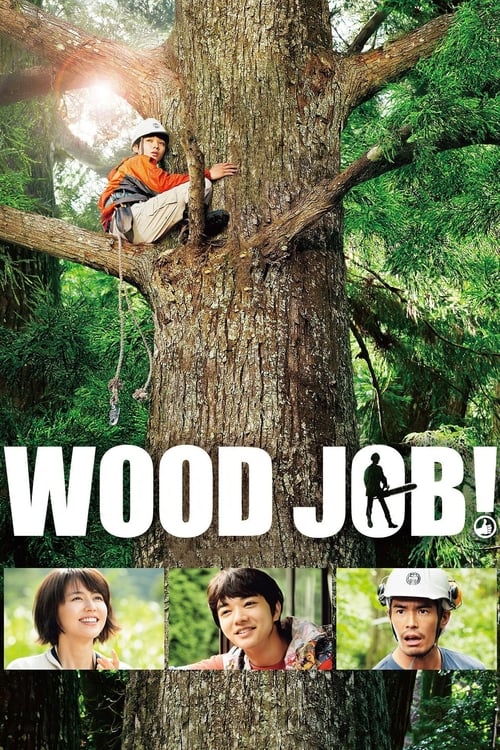
Shinobu Yaguchi's adaptation of Shion Miura's novel follows Yuki Hirano (Shota Sometani), who fails his university entrance exams, is dropped by his girlfriend and signs up for a forestry trainee programme mostly because of the pretty woman on the brochure. After a month of basic training he is posted to Nakamura Lumber in Kamusari, a village two hours from the nearest town with no phone signal, where the hot-headed tree-feller Yoki (Hideaki Ito) rides him hard and the woman from the brochure, the village teacher Naoki (Masami Nagasawa), wants nothing to do with another city boy who will leave after a year.
There is very little here for the rubric to find. The villagers gossip that a single woman past a certain age is an old maid, the men call forestry a man's job, and at the village festival the women wait at the foot of the mountain; all of it is local colour, played for laughs and never questioned. Yuki's line that forestry is 'green' and good for the planet is a slacker's excuse, and the forestry lessons are about thinning, safety and planting trees that only the next generations will harvest. The last act builds to the village's Great Festival and whether the outsider can earn a place in it.
There is very little here for the rubric to find. The villagers gossip that a single woman past a certain age is an old maid, the men call forestry a man's job, and at the village festival the women wait at the foot of the mountain; all of it is local colour, played for laughs and never questioned. Yuki's line that forestry is 'green' and good for the planet is a slacker's excuse, and the forestry lessons are about thinning, safety and planting trees that only the next generations will harvest. When a village boy goes missing in the woods on a taboo day, Yuki finds him and is bitten by a viper; the elders then accept him into the Great Festival, where he rides the giant sacred log down the mountain. He leaves at the end of his year, but the closing scenes show him back in Kamusari, his name on the door beside Yoki's.
The score stays at zero because nothing is argued. The only friction is between city and country, and the film sides with the village, its customs and its long view; the one group it pokes fun at is a party of city tourists studying 'slow life'. There are no villains defined by a group, no speeches about society, and no institutions framed as oppressors.
Score breakdown
Each category is scored 0 to 3: 0 absent or presence only, 1 brief, 2 recurring or plot-relevant, 3 central or dominant. Timestamps refer to the film's running time.
| Category | Score | What we saw |
|---|---|---|
| Content | ||
| A Race and ethnicity | 0 | Race never comes up. The cast is entirely Japanese, and no interracial couple appears in the dialogue or the sampled frames. |
| B Gender and feminism | 0 | Traditional gender attitudes are shown without comment: Yuki calls forestry a man's work (0:04:31), the villagers call the unmarried Naoki an old maid (0:40:59, 0:49:43), and women wait below during the festival (1:35:11). None of it is critiqued or argued. |
| C Sexuality and gender identity | 0 | No LGBTQ characters or themes. Sexual content is limited to bawdy village jokes, a married couple trying for a baby (0:31:22) and the fertility symbolism of the festival. |
| D Power and systems | 0 | No institution is criticised. The trainee programme and the village council are shown as well-meaning, and the lumbermen's refusal to clear the mountain for quick money (0:58:29) is about stewardship for their children, not a critique of capitalism. |
| E Cultural and historical revision | 0 | Adapted from Shion Miura's novel, credited at 1:53:05. No established characters or history are recast to carry a message. |
| F Religion portrayal | 0 | Islam does not appear. Religion is the village's mountain-goddess folk belief: a taboo day in the woods (1:18:51) and a Shinto-style prayer at the festival (1:36:05). |
| Treatment | ||
| G Antagonist coding | 0 | There are no real villains. The friction comes from the gruff Yoki, a council member who doubts that an outsider should join the festival (1:16:18) and Naoki's distrust of city men, each with a personal reason. |
| H Didacticism | 0 | No speeches carry a social message. The didactic moments are forestry lessons (0:08:50, 0:10:37) and a remark in the truck about planting for the next generations (0:58:43), which fall outside the rubric. |
| I Message over story | 0 | The story is a simple coming-of-age comedy, and none of its turns bends toward a message. |
| J Left-leaning politics framed as good | 0 | No political positions are argued. The forestry is about craft and continuity rather than climate, and Yuki's 'good for the planet' remark (0:04:35) is an offhand excuse, not a theme. |
How the number is reached
- Categories A to J add up to 0 of 30, which gives 0.0 (0 ÷ 30 × 10, rounded to the nearest 0.5).
- No counterweight: There is no progressive messaging to mock or complicate.
- Final rating 0.0, none or negligible.
Considered, scored 0
- An all-Japanese cast in a remote village, shown without comment.
- The forestry brochure that uses a pretty woman to recruit young men (0:08:20), played as a joke on Yuki.
- Village gossip that it is a crime to be single past a certain age (0:41:02), the old maid jibe (0:49:43) and children teasing Naoki that she will never marry (1:19:51), local colour with no commentary.
- Women waiting below while the men climb the mountain at the festival (1:35:11), shown as custom.
- Yuki's 'green' and 'good for the planet' excuse for choosing forestry (0:04:32), a throwaway line.
- Lessons on thinning to prevent landslides (0:09:26), practical forestry rather than environmental advocacy.
Evidence and confidence
Confidence: Medium. Full English subtitles from the embedded track, and 116 frames sampled once a minute. A few lines of thick mountain dialect are deliberately subtitled as garbled English (0:29:35, 1:10:06), as the hero cannot follow them; they are jokes, not missing dialogue. The festival climax is mostly wordless and is covered by the sampled frames.
Category F definition: As in the rubric: Islam shown as a peaceful and tolerant religion, aligned with human rights, in a way that works as a corrective message.
Noted, not scored: The film warmly endorses tradition, continuity and family: the programme hopes trainees will settle and raise families in the village (0:15:01), Yuki is told the ancestors' trees will not be sold off for money because the forest belongs to the next generations (0:58:35), and the village's mountain-goddess festival, a fertility rite that prays for children and crops (1:40:48), is the film's climax. A visiting city group studying 'slow life' is gently mocked (1:09:44, 1:12:34).
Rubric version 1. Reviewed 18 November 2026.