Woke rating
What About Bob?
None or negligible
A Bill Murray and Richard Dreyfuss comedy about a clingy patient who follows his psychiatrist on holiday, with no progressive messaging: its phobia gags, Tourette's routines and vain-doctor satire are slapstick, not statements.
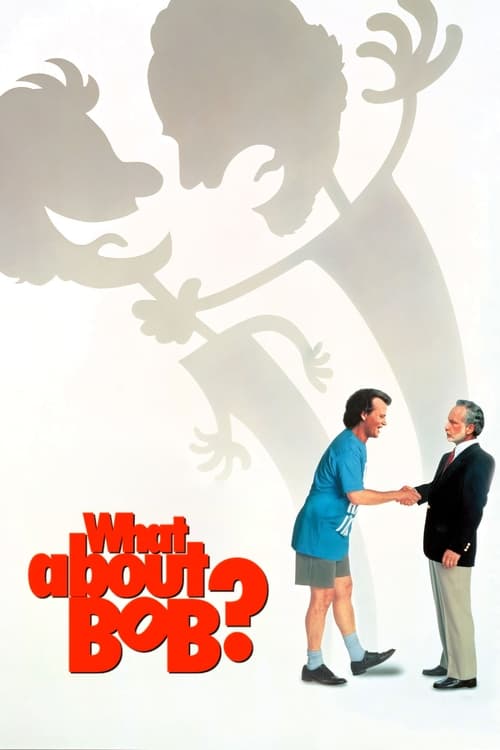
Frank Oz's comedy stars Richard Dreyfuss as Leo Marvin, a self-important New York psychiatrist with a new book, Baby Steps, and a Good Morning America interview on the way, and Bill Murray as Bob Wiley, a multiphobic patient referred to him the day Leo leaves for a month at his lake house in New Hampshire. Bob tracks him down, settles in nearby, and charms Leo's wife and children while Leo slowly comes apart.
The places where the rubric might look are all part of the farce. A local couple curse Leo as the rich man who outbid them for their dream house; Leo's daughter says Bob listens and is fun while her father does not; Leo tries to have Bob locked up in a psychiatric hospital, where a colleague sees through it; and Bob's fear of Tourette's syndrome turns into a game of shouted insults with Leo's son. The last act escalates Leo's breakdown.
The places where the rubric might look are all part of the farce. A local couple curse Leo as the rich man who outbid them for their dream house; Leo's daughter says Bob listens and is fun while her father does not; Leo tries to have Bob locked up in a psychiatric hospital, where a colleague sees through it; and Bob's fear of Tourette's syndrome turns into a game of shouted insults with Leo's son. In the last act Leo ties Bob up in the woods with explosives as 'death therapy', Bob takes it as a breakthrough and escapes, the lake house blows up, Leo goes catatonic, and he snaps out of it only when Bob marries his sister Lily.
The score stays at zero because none of this carries a message. The family is a conventional one, the conflict is one man's vanity against another man's neediness, and the institutions in the story (psychiatry, television, a mental hospital) are the setting for jokes about Leo's ego rather than critiques of a system. With no messaging, there is nothing for a counterweight to offset.
Score breakdown
Each category is scored 0 to 3: 0 absent or presence only, 1 brief, 2 recurring or plot-relevant, 3 central or dominant. Timestamps refer to the film's running time.
| Category | Score | What we saw |
|---|---|---|
| Content | ||
| A Race and ethnicity | 0 | Race never comes up. A Black elevator attendant (0:06:30) and bus passengers (0:20:30) appear without comment, and no interracial couple is shown in the dialogue or the sampled frames; the closing weddingBob and Lily's wedding (1:34:30) is a white couple. |
| B Gender and feminism | 0 | Faye Marvin is a warm, sensible wife who sides with Bob against her husband (0:48:58), and the hospital director who overrules Leo is a woman (1:17:20), but gender is never argued; the family conflict is about a father who does not listen. |
| C Sexuality and gender identity | 0 | No LGBTQ theme. Bob's aside that he freezes up around attractive people, 'not a guy' (0:39:33), and a psychiatrist's sex joke (1:16:58) are passing gags. |
| D Power and systems | 0 | Psychiatry is the butt of the jokes through Leo's vanity, and he tries to have Bob committed (1:13:48), but the hospital director sees through him (1:17:20); this is satire of one man's ego, not a critique of an institution as an oppressor. |
| E Cultural and historical revision | 0 | An original screen comedy. Nothing in the material recasts an established character or history to carry a message. |
| F Religion portrayal | 0 | Islam does not feature, and religion appears only as a church weddingBob and Lily's church wedding (1:34:36). |
| Treatment | ||
| G Antagonist coding | 0 | Leo is the comic antagonist because of his pride and his obsession with his book and his TV interview (0:22:56, 1:00:32), not because of any group he belongs to. |
| H Didacticism | 0 | No speeches carry a social message. Leo's 'baby steps' (0:12:37) and 'vacation from my problems' (0:32:31) lectures are self-help patter the film mocks. |
| I Message over story | 0 | The plot is a run of escalating set-pieces between Bob and Leo, and nothing in it bends toward a message. |
| J Left-leaning politics framed as good | 0 | No political positions are argued. Siggy's gloomy line about all the horror in the world (0:29:11) is a running joke about his teenage morbidity. |
How the number is reached
- Categories A to J add up to 0 of 30, which gives 0.0 (0 ÷ 30 × 10, rounded to the nearest 0.5).
- No counterweight: There is no progressive messaging to mock or complicate.
- Final rating 0.0, none or negligible.
Considered, scored 0
- The Gutmans' grudge against Leo, who 'swooped down' with his money and bought the house they had saved for (0:27:40), a running joke rather than a point about class.
- Anna telling her mother that Bob is sensitive and listens while her father does not (0:42:46), a family-comedy beat about Leo's ego.
- Leo's attempt to have Bob committed (1:13:48) and the female hospital director who turns the tables on him (1:17:20), played as farce.
- A Black elevator attendant and bus passengers shown without comment (0:06:30, 0:20:30).
Evidence and confidence
Confidence: Medium. The file has no English text subtitles, so the dialogue comes from a Whisper transcript of the English audio, which covers the whole film but garbles some names (Lake Winnipesaukee, Siggy) and runs some lines together; the panicky stretch after the diving scene is partly garbled (0:47:34 to 0:48:09). 99 frames sampled once a minute.
Category F definition: As in the rubric: Islam shown as a peaceful and tolerant religion, aligned with human rights, in a way that works as a corrective message.
Noted, not scored: Much of the humour runs against today's sensitivities rather than for them: Bob fakes Tourette's syndrome to ward it off (0:10:14) and teaches it to Leo's son as a game of shouted obscenities (0:59:23, 1:03:39), and Leo's breakdownLeo's straitjacket taunts (1:15:26) and explosive 'death therapy' (1:28:03) plays mental illness for laughs.
Rubric version 1. Reviewed 18 November 2026.