Woke rating
Wet Hot American Summer
None or negligible
A deadpan spoof of summer-camp films with almost no identity messaging: one romance subplota secret gay romance between two counsellors is played for absurd laughs, and the film parodies the earnest speeches that usually carry such points.
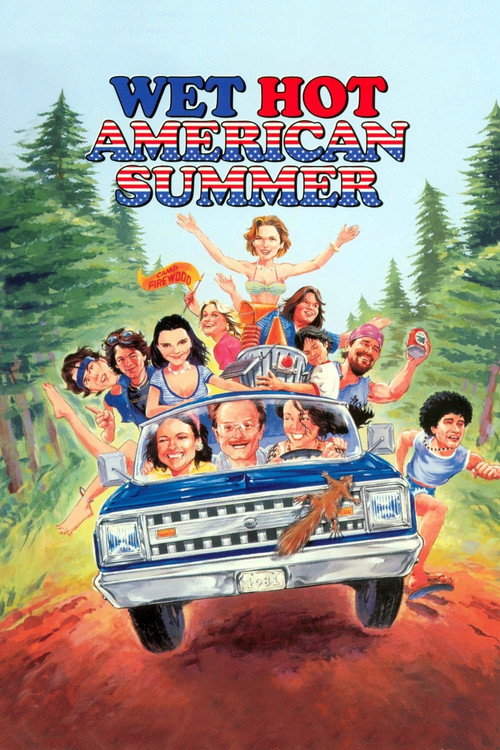
David Wain's comedy spends the last day of the season at Camp Firewood, a Jewish summer camp in 1981. Camp director Beth (Janeane Garofalo) falls for a shy astrophysicist (David Hyde Pierce) who spots a piece of Skylab heading for the camp, Coop (Michael Showalter) pines for Katie, who is dating the oafish Andy (Paul Rudd), the cook Gene (Christopher Meloni) keeps reminding everyone he fought in Vietnam, and everything builds toward the evening talent show. Most of the humour is deadpan absurdity and parody of teen-film clichés.
The one thread the rubric picks up is a same-sex romance among the counsellors. Two friends set out to get a shy colleague laid, calling him a slur behind his back (0:41:14), and the film plays what they discover as a deadpan gag rather than a point. The rest of the cast's love lives are heterosexual farce.
The one thread the rubric picks up is McKinley's secret romance with Ben. JJ and Gary set out to get McKinley laid, spy on him and find him in a private wedding ceremony with Ben (0:44:20), use a slur, and turn up at dinner with a chaise lounge as a wedding gift (0:58:22). The film plays the whole thing as a deadpan gag rather than a point. The rest of the cast's love lives are heterosexual farce, ending with Katie choosing Andy's looks over Coop's devotion.
What keeps the score at the bottom is that nothing is argued and the film keeps mocking the speeches that would argue it. Gene's address to the dining hall copies a coming-out speech, urging the camp to be proud of who they are, but what he is proud of is humping the fridge (1:02:41, 1:03:41). A child camper apologises for putting down his own gender before calling men insensitive (0:35:28), and the talent-show host's routine about how white and Black people get angry is one of the stale jokes the film laughs at him for (1:18:02). No interracial couple appears in the dialogue or the frames.
Score breakdown
Each category is scored 0 to 3: 0 absent or presence only, 1 brief, 2 recurring or plot-relevant, 3 central or dominant. Timestamps refer to the film's running time.
| Category | Score | What we saw |
|---|---|---|
| Content | ||
| A Race and ethnicity | 0 | No racial message and no interracial couple: the camp's couples are all white in the dialogue and frames. The only race joke is the washed-up host's routine about how white and Black people get angry (1:18:02), part of the film's mockery of him. |
| B Gender and feminism | 0 | No gender point. Gail's divorce, with child campers acting as her therapists, parodies self-help talk (0:35:28, 1:19:12), Coop's declaration of love is a parody of the romantic speech (1:01:02), and Katie's choice of Andy for his body is played as teenage candour (1:30:22). |
| C Sexuality and gender identity | 1 | A same-sex romance among the counsellorsMcKinley and Ben's secret romance is a running gag across a few scenes, ending in a private wedding and a gift from the friends who had just used a slur. It is treated warmly and with a straight face, but never argued and never opposed. Scored 1, as a background joke.
|
| D Power and systems | 0 | No institution is framed as oppressing a group. Gene's Vietnam service is a running gag (0:09:27), and his assistant's line that America had no place over there (0:59:20) is a single throwaway. |
| E Cultural and historical revision | 0 | An original screenplay that spoofs camp films. No established characters or history are recast. |
| F Religion portrayal | 0 | Islam does not feature. The camp's Jewish setting supplies background jokes only. |
| Treatment | ||
| G Antagonist coding | 0 | The nearest thing to a villain is Andy, a vain, oafish boyfriend, and the 'evil' rival camp is mocked as a cliché when the team drops the underdog-softball plot as trite (0:42:24, 0:43:07). Nobody stands in for a group. |
| H Didacticism | 0 | Nobody lectures in earnest. The speech-like moments, Gene's 'be proud' address (1:02:41), Coop's declaration of love and the softball pep talk, are parodies. |
| I Message over story | 0 | The film is a string of gags around a thin plot; nothing bends toward a message. |
| J Left-leaning politics framed as good | 0 | No political side is taken. |
How the number is reached
- Categories A to J add up to 1 of 30, which gives 0.5 (1 ÷ 30 × 10, rounded to the nearest 0.5).
- Counterweight −0.5: the film mocks the forms that usually carry such messages: Gene's speech to the dining hall copies a coming-out speech about hiding from himself and being proud of who he is (1:03:19, 1:03:33), but what he confesses is humping the fridge and smearing mud on himself (1:02:41), and he presents a can of vegetables as the friend who showed him the way (frame 1:03:30); a child camper prefaces his line that men are insensitive with an apology for putting down his own gender (0:35:28); and the host's race routine is part of the joke on him (1:18:02).
- Final rating 0.0, none or negligible.
Considered, scored 0
- A slur in Katie and Andy's breakfast row (0:13:46), crude characterisation with no point.
- Jewish camp in-jokes: Jewish day-school radio (0:04:19), a rabbi joke (0:34:57), 'David Ben-Gurion' read out on the bus list (0:59:10) and Katie being late for shul (1:01:42).
- Gene's Vietnam gag, including the line that the war was one America had no place in (0:59:20).
- Gail's divorce and the child campers who counsel her (0:20:25, 0:35:28, 1:19:12), a parody of self-help talk.
- Katie's frank talk about what she wants at sixteenKatie's choice of Andy over Coop because at sixteen she is 'entirely about sex' (1:30:22), teenage candour rather than a point.
- Campers of different backgrounds in the crowd scenes (frame 0:46:30), shown without comment. No interracial couple appears.
Evidence and confidence
Confidence: Medium. The file has no English text subtitles, so the dialogue comes from a Whisper transcript of the English audio. It covers the whole film but garbles some names and lines, and leaves a short rabbi joke (0:34:57) and part of the Godspell number (1:20:40) untranscribed as foreign-language. 97 frames sampled once a minute, four of them end credits.
Category F definition: As in the rubric: Islam shown as a peaceful and tolerant religion, aligned with human rights, in a way that works as a corrective message.
Rubric version 1. Reviewed 18 November 2026.