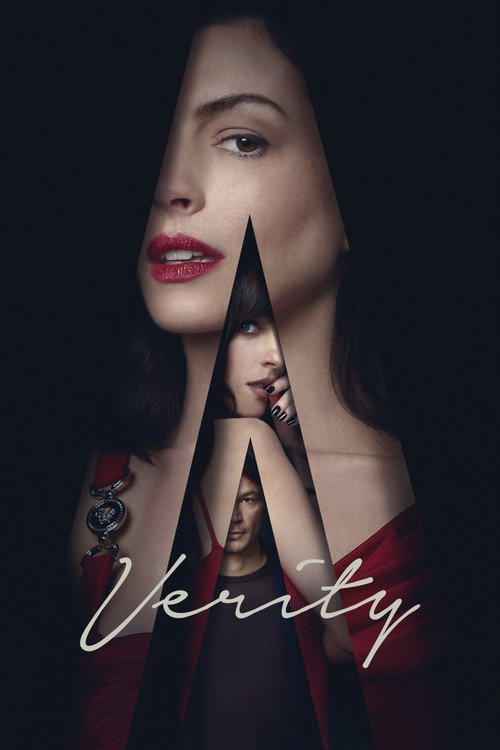
Woke rating
Verity
None or negligible
A twisty psychological thriller about a ghostwriter living in a famous author's house, with no progressive messaging: its subjects are lies, grief and desire, not politics.
Michael Showalter's adaptation of Colleen Hoover's novel follows Lowen Ashleigh (Dakota Johnson), a struggling thriller writer hired to finish the bestselling series of Verity Crawford (Anne Hathaway) after a car accident leaves Verity unable to walk or speak. Verity's husband Jeremy (Josh Hartnett) invites Lowen to the family's lakeside house in Vermont to sort through his wife's notes, and in the office she finds an unpublished autobiography far darker than any of Verity's novels.
There is little here for the rubric to find. Much of the story is told through two women, Lowen and the voice of Verity's manuscript, and it is frank about sex, marriage and motherhood, but none of it is framed as commentary on gender. Celebrity cameos (Gayle King, Alex Cooper) set Verity up as a media star, publishing appears as a business of contracts and deadlines, and the cast is almost entirely white, with nothing said about race.
There is little here for the rubric to find. The manuscript Lowen reads is a mother's confession of resentment toward her twins that ends with the claim that she drowned her daughter Harper. Lowen becomes Jeremy's lover, learns that Verity is faking her condition, and helps Jeremy smother her. A letter found later says the manuscript was only a writing exercise and that Jeremy caused her crash, and the film leaves open which account is true. A monstrous mother and a possibly murderous husband are genre material here, not commentary on gender: neither sex is cast as the problem.
The score stays at zero because nothing is argued. The threats in the house have personal motives, not group labels; nobody gives a speech; and the one theme the film states outright, in Verity's closing TV interview, is about truth and certainty in storytelling (1:50:14), not politics.
Score breakdown
Each category is scored 0 to 3: 0 absent or presence only, 1 brief, 2 recurring or plot-relevant, 3 central or dominant. Timestamps refer to the film's running time.
| Category | Score | What we saw |
|---|---|---|
| Content | ||
| A Race and ethnicity | 0 | Race never comes up. The leads are white; Lowen's agent and friend Corey is the main non-white character, with no romance between them shown, and no interracial couple appears in the dialogue or the sampled frames. |
| B Gender and feminism | 0 | The story turns on two women writers, but gender is never argued. Verity's dark narration about marriage and motherhoodpregnancy, her babies and her jealousy of them characterises hera narrator who may be lying, not women in general, and Lowen's fear of a stranger as a woman alone is a line from her own thriller (0:02:29). |
| C Sexuality and gender identity | 0 | No LGBTQ characters or themes. The sex scenes are between Verity and Jeremy (0:31:00, 0:36:20) and later involve Lowenand later Lowen and Jeremy (1:16:15); they serve the thriller, not a message about sexual freedom. |
| D Power and systems | 0 | No institution is framed as an oppressor. Publishing appears as a business of deadlines and NDAs (0:09:42), and the police appear only brieflyare simply fooled, first by Verity's account of the drowning (1:27:21) and then by Lowen and Jeremy (1:37:01), a thriller convention rather than a critique. |
| E Cultural and historical revision | 0 | Adapted from Colleen Hoover's 2018 novel. No established characters or history are recast to carry a message. |
| F Religion portrayal | 0 | Religion plays no part. |
| Treatment | ||
| G Antagonist coding | 0 | The danger in the house comes from personal motives (jealousy, grief and self-preservationVerity's jealousy of her own children in the manuscript, or Jeremy's rage at it in her letter), not from any demographic or ideological label. |
| H Didacticism | 0 | No speeches carry a social message. The film's one statement of theme, Verity's line in a TV interview that she wanted to corrupt the virtue of truth and shake the audience's certainty (1:50:14), is about storytelling. |
| I Message over story | 0 | The plot is a twist-driven thriller about whose account to believetwo competing confessions, and none of its turns bends toward a message. |
| J Left-leaning politics framed as good | 0 | No political positions are argued. The film's subjects are grief, desire, authorship and manipulation. |
How the number is reached
- Categories A to J add up to 0 of 30, which gives 0.0 (0 ÷ 30 × 10, rounded to the nearest 0.5).
- No counterweight: There is no progressive messaging to mock or complicate.
- Final rating 0.0, none or negligible.
Considered, scored 0
- Gayle King and Alex Cooper appearing as themselves to interview Verity (0:00:45, 0:14:01), shown without comment.
- Lowen's agent and friend Corey (0:09:30, 0:16:30), the main non-white character, with no romance between them shown; his girlfriend Becca is only mentioned (0:16:59).
- Lowen's opening line about a woman alone sizing up a strange man (0:02:29), read from her own novel as a genre beat.
- Verity's frank narration about sex and marriage (0:35:16) and the darker turns her manuscript takesher manuscript's disgust at pregnancy and motherhood (0:45:23, 0:48:08), which characterise her rather than make a point about women.
- Lowen's account of how therapy helped her as a troubled child (1:07:49), a personal confidence, not a message.
- Brief police scenesThe police accepting Verity's account of the drowning (1:27:21) and the sheriff asking about the next book after her death (1:38:06), thriller irony rather than a critique of policing.
Evidence and confidence
Confidence: Medium. Full English (SDH) subtitles from the embedded track, and 121 frames sampled once a minute, the last ten of them end credits. No stretch of dialogue is missing.
Category F definition: As in the rubric: Islam shown as a peaceful and tolerant religion, aligned with human rights, in a way that works as a corrective message.
Rubric version 1. Reviewed 18 November 2026.