Woke rating
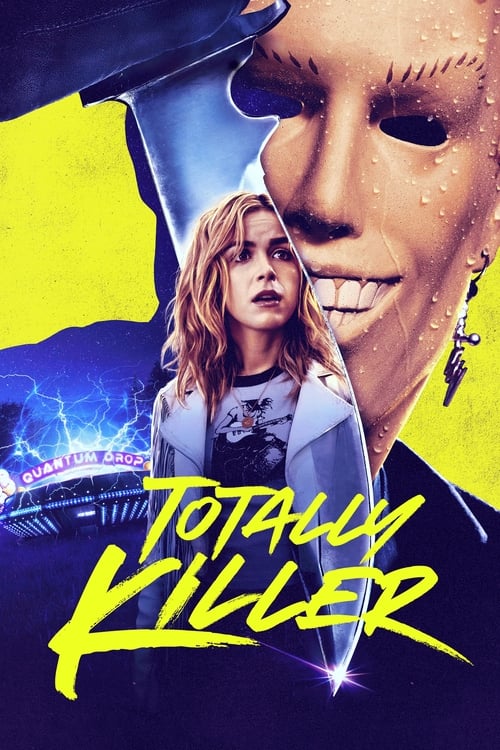
Totally Killer
Mild
A time-travel slasher comedy whose Gen Z heroine keeps tutting at 1980s sexism, fat jokes and homophobia, though the film laughs at her corrections as often as it backs them.
Nahnatchka Khan's horror comedy follows Jamie (Kiernan Shipka), a 17-year-old whose mother is murdered on Halloween by the masked Sweet 16 Killer, who first struck in 1987. Fleeing the killer, Jamie stumbles into her best friend's science-fair time machine, lands in 1987, poses as an exchange student from Canada and tries to stop the original murders with the help of her teenage mother's circle and a young inventor. It is a slasher whodunit crossed with Back to the Future.
The messaging comes through the culture-clash comedy. Jamie meets gym shorts she likens to a Hooters uniform, a coach who runs dodgeball like a war, a jock who says women should not drive and girls who call a dead classmate 'Fat Trish', and she answers with modern one-liners: unwanted touch, women should lift each other up, gay people are amazing. A brief remark about racism and an aside about men showing emotion complete the pattern, and two interracial pairings appear without comment. None of it becomes a speech, and none of it drives the plot, which runs on grief and revenge.
The messaging comes through the culture-clash comedy. Jamie meets gym shorts she likens to a Hooters uniform, a coach who runs dodgeball like a war, a jock who says women should not drive and girls who call a dead classmate 'Fat Trish', and she answers with modern one-liners: unwanted touch, women should lift each other up, gay people are amazing. A brief remark about racism and an aside about men showing emotion complete the pattern, and two interracial pairings appear without comment, Marisa and Randy, and Doug and Trish. None of it becomes a speech, and none of it drives the plot, which turns on Trish's death after a night of bullying and on a podcaster's hunger for fame.
What keeps the score low is that the film makes Jamie's corrections part of the joke. Her plea for female solidarity is answered with a flash and a laugh, her rush to say gay people are amazing comes right after she blurts out 'Gross!', and her tree-planting petition is a trick the popular girls mock. The 1980s teenagers are crude but given sympathy, and the villain has a personal motive rather than a demographic labelturns out to be two men with personal motives: Doug, avenging his girlfriend, and Chris Dubasage, who wants fame and resents his father.
Score breakdown
Each category is scored 0 to 3: 0 absent or presence only, 1 brief, 2 recurring or plot-relevant, 3 central or dominant. Timestamps refer to the film's running time.
| Category | Score | What we saw |
|---|---|---|
| Content | ||
| A Race and ethnicity | 2 | Three brief touches across the film: a throwaway line about 1980s racism, and two interracial pairings shown without comment, a hook-up between Marisa and Randy and a couple from the past whose story matters to the plotDoug and Trish, whose romance turns out to be the original killer's motive. Each is in the background, but together they recur.
|
| B Gender and feminism | 2 | The clash between 1980s sexism and Jamie's modern manners is a running joke from gym class to the finale, but it is played for laughs, often at Jamie's expense, and is never the film's point.
|
| C Sexuality and gender identity | 1 | One scene, played as a joke on Jamie's overcorrection; the phrase then recurs as a gag.
|
| D Power and systems | 0 | The 1987 sheriff waves off Jamie's warnings and laughs at the idea of DNA, but as period comedy about small-town policing, not a critique of police as oppressors of a group. |
| E Cultural and historical revision | 0 | An original story that riffs openly on Back to the Future and 1980s slashers. No established characters or history are recast. |
| F Religion portrayal | 0 | Islam does not feature, and religion plays no part in the story. |
| Treatment | ||
| G Antagonist coding | 0 | The killer iskillers are defined by personal grievance, not by demographic or ideology: Doug avenges his girlfriend Trish, who died after a night of the Mollys' bullying, and Chris kills for podcast fame and out of resentment of his father. |
| H Didacticism | 1 | No speeches. The message comes in short, on-the-nose one-liners, mostly Jamie's, and each is undercut by the scene around it.
|
| I Message over story | 0 | The plot is a whodunit and a time-travel puzzle, and none of its turns bends toward a message. |
| J Left-leaning politics framed as good | 1 | In the background, today's manners are the yardstick the 1980s fail. Environmentalism appears only as two jokes, one admiring and one mocked; no politics are argued and nothing conservative is put down.
|
How the number is reached
- Categories A to J add up to 7 of 30, which gives 2.5 (7 ÷ 30 × 10, rounded to the nearest 0.5).
- Counterweight −0.5: The film makes Jamie's corrections part of the joke: her call for female solidarity is answered with a flash and a laugh (0:38:25), her 'gay people are amazing' follows her own blurted 'Gross!' (1:01:35), and her environmental petition is a trick the others mock (0:57:40). The 1980s teens are crude but treated with sympathy (0:46:30), and the killer has a personal motivethe killers have personal motives: Doug's grief for Trish (1:27:28) and Chris's craving for fame (1:33:56).
- Final rating 2.0, mild.
Considered, scored 0
- A racially mixed 1987 cast (Sheriff Lim and his daughter Kara, Marisa Song, Heather Hernandez, the inventor Lauren Creston and her daughter Amelia), shown without comment.
- Lauren and Amelia Creston as gifted inventors who build the time machine; their talent is shown, not argued.
- The 1987 sheriff's scoffing at Jamie's warning and at DNA (0:28:11, 1:12:27), played as period comedy.
- Frank teen talk about sex, alcohol and weed, part of the 1980s teen-comedy pastiche rather than a message.
- The film's anti-bullying thread (Trish's death after the Mollys' cruelty sets the killings in motion), which is not tied to identity.
- Jamie's self-defense training and rape alarm, which stem from her parents' fear of the killer (0:04:48).
Evidence and confidence
Confidence: Medium. Full English SDH subtitles and the forced track for a few Spanish lines; 105 frames sampled once a minute, plus about 30 targeted frames from the source around the party door, the cabin and the locket scene to check couples. The frames do not show what Jamie is reacting to when she remarks on the racism of 1987 (0:23:13) or calls a stranger's shirt problematic (0:21:51).
Category F definition: As in the rubric: Islam shown as a peaceful and tolerant religion, aligned with human rights, in a way that works as a corrective message.
Rubric version 1. Reviewed 17 November 2026.