Woke rating
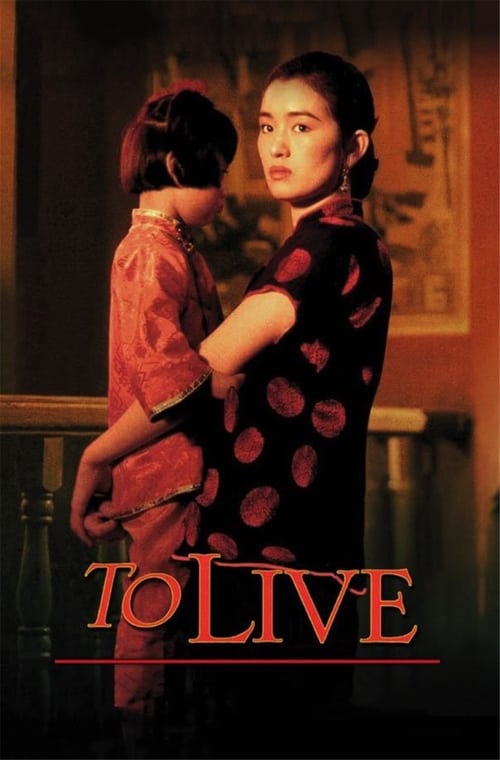
To Live
None or negligible
A Chinese family epic spanning four decades of upheaval with no progressive messaging to speak of; its politics are a quiet, ironic look at Maoist campaigns, which this scale does not score.
Zhang Yimou's adaptation of Yu Hua's novel follows Fugui (Ge You), a rich man's son who gambles away the family house in the 1940s, and his wife Jiazhen (Gong Li) through four decades of upheaval: the civil war, land reform, the Great Leap Forward and the Cultural Revolution. It is a family chronicle told through meals, quarrels, a shadow-puppet troupe and the small accidents of ordinary life.
Politics is everywhere, but not the kind this scale measures. Each new campaign arrives with officials, slogans and promises, and the family goes along with all of it: they hand over their iron, keep a safe class label, and sing to Mao at a wedding. The film rarely comments; it lets the consequences speak, and those consequences reach the family more than once. That is a critique of a communist state's campaigns, which cuts against left-wing politics and is noted rather than scored.
Politics is everywhere, but not the kind this scale measures. Each new campaign arrives with officials, slogans and promises, and the family goes along with all of it: they hand over their iron, keep a safe class label, and sing to Mao at a wedding. The film rarely comments; it lets the consequences speak. The man who won the house is shot after being labelled a landlord, Youqing dies when the exhausted boy is sent to the school's steel drive, friends are purged as capitalist roaders, and Fengxia bleeds to death in a ward run by Red Guard nursing students after the doctors have been locked away. That is a critique of a communist state's campaigns, which cuts against left-wing politics and is noted rather than scored.
Nothing else registers. Jiazhen is strong-willed and Fengxia is deaf and mute, but neither is used to make a point about gender or disability. No one delivers a speech on a progressive theme, no villain is coded by group, and the local officials are sympathetic men who suffer under the same campaignsChunsheng, whose jeep killed Youqing, and the town chief are sympathetic men who are themselves purged. With every category at zero, the rating is 0.
Score breakdown
Each category is scored 0 to 3: 0 absent or presence only, 1 brief, 2 recurring or plot-relevant, 3 central or dominant. Timestamps refer to the film's running time.
| Category | Score | What we saw |
|---|---|---|
| Content | ||
| A Race and ethnicity | 0 | Race is not a subject. The cast is entirely Chinese, and no interracial couple appears in the dialogue or the sampled frames. |
| B Gender and feminism | 0 | Jiazhen is the family's moral anchor: she walks out over Fugui's gambling (0:15:35), comes back once he has stopped (0:22:25), and later stands up to him for beating their son (0:59:33). This is marriage and family drama, not a point about gender, and the film gives its hardships no gendered framing. |
| C Sexuality and gender identity | 0 | No LGBTQ characters or themes. The only sexual content is the bawdy lyric of an old shadow-play song in the opening gambling-house scene (0:04:42). |
| D Power and systems | 0 | No institution is framed as oppressing a group in the sense this scale measures. The state's campaigns are shown doing harm, often through class labels such as landlord, capitalist roader and reactionary academic authority, but this is a critique of a communist state's class politics, which runs against the positions the scale measures. It is noted under notScored, as in other reviews of films about communist regimes. |
| E Cultural and historical revision | 0 | Adapted from Yu Hua's novel. No established characters are recast, and each historical period is introduced with a plain caption (0:28:48, 0:51:42, 1:21:50). |
| F Religion portrayal | 0 | Islam is not portrayed. Religion appears only as folk belief: Fengxia's baby is given a lowly nickname so that the underworld's runners cannot find him in the register of names (1:57:14). |
| Treatment | ||
| G Antagonist coding | 0 | No villains coded by group. Long Er, who wins the house, has a personal motive: he simply wanted it (0:13:46). The officials around the family are sympathetic, and several later fall victim to the same campaigns.Chunsheng, whose jeep kills Youqing (1:13:01), and the town chief are sympathetic friends, and both are later purged as capitalist roaders (1:43:17, 1:49:01). |
| H Didacticism | 0 | No character lectures on a progressive theme. The film's speeches are Maoist slogans, such as the wedding song to Mao (1:33:52) and Erxi's staged denunciation of a doctor (1:53:10), presented with quiet irony; the film never states its own view. |
| I Message over story | 0 | The story leads throughout. Events follow from the characters and the times, and nothing is bent to make a point. |
| J Left-leaning politics framed as good | 0 | No left-leaning position is framed as good. Communist promises of plenty are voiced by the town chief and by Fugui himself (0:52:58, 1:11:54) and treated with irony: when Fugui tells the same chicken-to-ox story to his grandson at the end, communism has dropped out of it (2:09:24). |
How the number is reached
- Categories A to J add up to 0 of 30, which gives 0.0 (0 ÷ 30 × 10, rounded to the nearest 0.5).
- No counterweight: None applies: there is no progressive messaging to mock or complicate.
- Final rating 0.0, none or negligible.
Considered, scored 0
- An all-Chinese cast, shown without comment.
- Fengxia, left deaf and mute by a childhood fever (0:45:45), and Erxi, lame from a factory injury (1:25:37, 1:25:52): both treated with tenderness, as characters rather than a message about disability.
- Jiazhen leaving Fugui over his gambling (0:15:35) and defending Youqing against his father (0:59:33): family drama, not a statement about gender.
- Young Red Guard nursing students running the maternity ward (1:51:36), part of the film's picture of the Cultural Revolution rather than a point about women.
Evidence and confidence
Confidence: Medium. Full Chinese subtitles from the embedded track (there is no English track), translated while reading, and 132 frames sampled once a minute. The few gaps in the dialogue (for example 0:38:15 to 0:40:19 and 2:03:39 to 2:04:22) are wordless scenes covered by the sampled frames.
Category F definition: As in the rubric: Islam shown as a peaceful and tolerant religion, aligned with human rights, in a way that works as a corrective message.
Noted, not scored: The film's politics run the other way: it views Maoist campaigns with quiet irony, from the land-reform trial and execution of Long Er (0:48:22) and the Great Leap Forward's iron drive and canteen promises (0:52:36, 1:08:08) to the burning of shadow puppets as 'four olds' (1:23:11), purges of officials as capitalist roaders (1:43:17, 1:49:01) and doctors locked away as reactionary academic authorities (1:51:55).. Youqing dies after being sent, exhausted, to the school's steel drive (1:13:01), Chunsheng's wife kills herself after he is denounced (1:45:39), and Fengxia dies in childbirth with only students on hand while the one doctor brought out of detention is incapacitated (2:01:29).
Rubric version 1. Reviewed 18 November 2026.