Woke rating
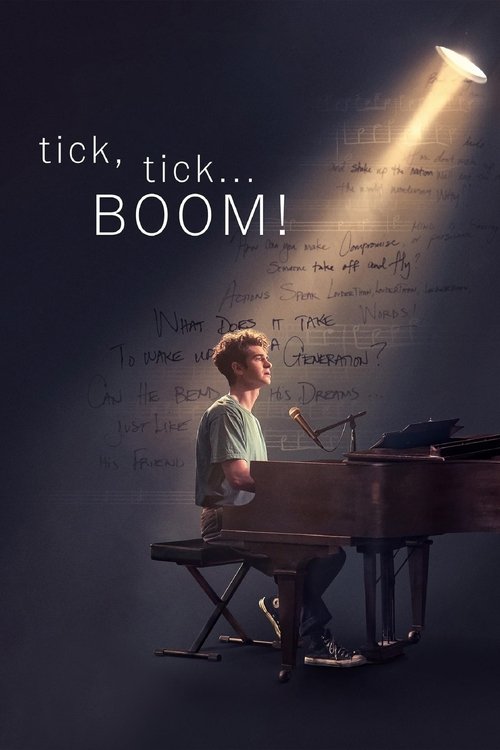
tick, tick... BOOM!
Mild
A musical biopic of the Rent composer in which the AIDS epidemic among his friends and an interracial central romance carry most of the score, while the politics come in one news clip and one angry outburst and the film stays about art, money and time.
Lin-Manuel Miranda's adaptation of Jonathan Larson's autobiographical stage monologue is set in January 1990, a week before Jon (Andrew Garfield) turns 30. He waits tables at a SoHo diner while racing to write the missing song for the first workshop of Superbia, the futuristic rock musical he has worked on for eight years. His girlfriend Susan, a dancer, is weighing a teaching job outside the city; his childhood friend Michael has given up acting for a well-paid job in advertising. The story is framed by Larson performing his monologue on stage, and many scenes turn into musical numbers.
The AIDS epidemic is the film's backdrop. A young waiter at the diner has HIV and lands in hospital, Jon has been to three friends' funerals in a year, and a TV news clip shows Senator Jesse Helms saying there would be no new cases if drug users and gay men stopped their activities. Michael, who is gay, answers Jon's sneering at his comfortable life by blaming Helms and the Moral Majority for the fact that he cannot marry or have children while half their friends are dying. The last act gives the epidemic a more personal turn. Separately, the central couple, Jon and Susan, is interracial, which the rubric counts on sight; race never comes up between them.
The AIDS epidemic is the film's backdrop. A young waiter at the diner has HIV and lands in hospital, Jon has been to three friends' funerals in a year, and a TV news clip shows Senator Jesse Helms saying there would be no new cases if drug users and gay men stopped their activities. Michael, who is gay, answers Jon's sneering at his comfortable life by blaming Helms and the Moral Majority for the fact that he cannot marry or have children while half their friends are dying. After the workshop fails to sell the show, Michael tells Jon he is HIV-positive, and Jon's memories of their friendship and their friends' funerals lead into the film's emotional climax. Separately, the central couple, Jon and Susan, is interracial, which the rubric counts on sight; race never comes up between them.
What keeps the score mild is that the politics are confined to a news clip and one outburst. The epidemic is mostly shown through friends rather than argued, and it gives the film's ticking clock its weight instead of replacing the story, which is about craft, ambition, money and a self-absorbed artist neglecting the people around him. The film does not flatter Jon's own idealism: his contempt for advertising is cut short by Michael, who calls it self-righteous.
Score breakdown
Each category is scored 0 to 3: 0 absent or presence only, 1 brief, 2 recurring or plot-relevant, 3 central or dominant. Timestamps refer to the film's running time.
| Category | Score | What we saw |
|---|---|---|
| Content | ||
| A Race and ethnicity | 3 | Race is never a theme, but the central romance is interracial, which the rubric counts on sight: Susan, played by the mixed-race Alexandra Shipp, and Jon, who is white. Scored 3 because theirs is the film's central romance. Michael's single complaint about casting directors calling him by generic Latino names adds a line but cannot raise the score.
|
| B Gender and feminism | 0 | Susan's complaint that Jon treats her as 'the girlfriend' to his artist is an ordinary relationship conflict, and her choice about the jobto take the job is her own career decision. Nothing is framed as a point about gender. |
| C Sexuality and gender identity | 2 | The AIDS epidemic among gay friends recurs throughout and becomes personal in the last actdrives the climax through Michael's diagnosis, and Michael ties it to his inability to marry or have children. Scored 2, not 3: it is the backdrop that sharpens Jon's story rather than the film's main subject, and it is mostly shown through friends rather than argued.
|
| D Power and systems | 1 | Advertising and consumer marketing are lightly satirised in one focus-group scene, and Michael blames the people who run the country for his situation. Scored 1: it is brief, and Jon's anti-system line is cut off and rebuked in the same scene.
|
| E Cultural and historical revision | 0 | A biopic adapted from Larson's own autobiographical stage show, which the film says is true except for the parts he made up. The material gives no evidence that any established character was recast. |
| F Religion portrayal | 0 | Islam is not portrayed. |
| Treatment | ||
| G Antagonist coding | 0 | There is no villain: Jon's obstacles are time, money, an indifferent agent and the theatre business. Helms and the Moral Majority are named as the force behind Michael's plight, which is counted under J. |
| H Didacticism | 1 | One outburst states the political message directly; the rest is carried by story and song.
|
| I Message over story | 0 | The story leads. The AIDS thread is set up from the first act and Michael's diagnosis grows out of it, and nothing bends to serve a message. |
| J Left-leaning politics framed as good | 1 | The conservative politicians of the day are framed as callous and responsible for gay men's suffering, in the news clip and Michael's outburst. Brief, and in period.
|
How the number is reached
- Categories A to J add up to 8 of 30, which gives 2.5 (8 ÷ 30 × 10, rounded to the nearest 0.5).
- Counterweight −0.5: The film punctures its hero's idealism: Michael calls Jon's contempt for advertising self-righteous and says he is writing musicals in his living room, not saving the rainforest (1:06:59), and points out that not everyone has Jon's options (1:07:17). The America-is-genocide answer in the focus group is played as a joke (1:02:46), and Jon is shown as self-absorbed toward the people he says he cares about (0:56:46, 1:06:28).
- Final rating 2.0, mild.
Considered, scored 0
- Michael's and the diner friends' sexuality and backgrounds as such: a mixed group of friends shown without comment.
- Susan's 'artist and girlfriend' complaint (0:56:56) and the quip 'Men!' after watching Sondheim's Sunday in the Park (0:33:10): relationship banter, not a gender point.
- Superbia, Jon's musical within the film, is a dystopian satire of a rich elite filming their lives for a screen-addicted public (0:47:34); it is shown as his work, not as the film's argument.
- Jewish details, such as challah at the diner (0:40:28) and the Kaddish (1:32:04), shown without comment.
- Michael is Latino in the film (0:10:50); the material says nothing about the real friend he is based on, so no recast was counted.
Evidence and confidence
Confidence: Medium. Full English subtitles from the embedded track, plus 121 frames sampled once a minute (the last eleven are end credits). The subtitle track covers the spoken dialogue only: the lyrics of the musical numbers, a large share of the running time (for example 0:03:48 to 0:05:25, 0:35:17 to 0:39:01 and 1:32:57 to 1:39:33), are not transcribed, so the songs were judged only from the frames and the dialogue around them.
Category F definition: As in the rubric: Islam shown as a peaceful and tolerant religion, aligned with human rights, in a way that works as a corrective message.
Rubric version 1. Reviewed 18 November 2026.