Woke rating
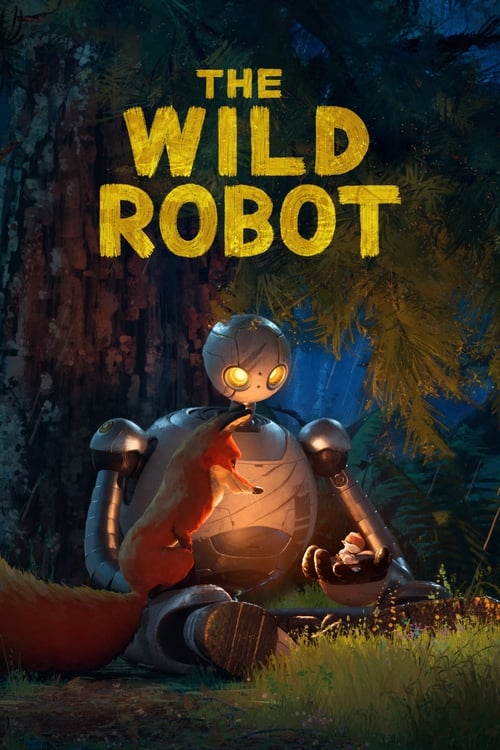
The Wild Robot
None or negligible
An animated family adventure about a robot raising an orphaned gosling on a wild island, whose lessons are kindness and motherhood; a cold tech company is its only political edge, and a light one.
Chris Sanders' DreamWorks film, adapted from Peter Brown's children's novel, follows Roz (Lupita Nyong'o), a helper robot washed up on a wild island. After an accident wipes out a goose's nest, she takes the last gosling, Brightbill, as her task, and with a fox called Fink (Pedro Pascal) she has to teach him to eat, swim and fly before the autumn migration.
What edge there is comes from Universal Dynamics, the company that built Roz. Its ad sells a pristine, preplanned human life, a fellow robot tells Roz she has become defective and must go back to be fixed, and the company plays a bigger part late in the story.
What edge there is comes from Universal Dynamics, the company that built Roz. Its ad sells a pristine, preplanned human life, a fellow robot tells Roz she has become defective and must go back to be fixed, and in the last act the company sends a retrieval robot that sets the forest alight, takes Roz aboard to strip out her memories for their data and promises to keep coming, until the island's animals fight it off together and Roz chooses to go back on her own terms.
What keeps the score near zero is that the film's lessons are kindness, motherhood and cooperation between natural enemies, told through the story rather than argued, with no identity politics anywhere. The company is a faceless backdrop and a late obstaclefinal obstacle, not a political target, and Roz is its own product.
Score breakdown
Each category is scored 0 to 3: 0 absent or presence only, 1 brief, 2 recurring or plot-relevant, 3 central or dominant. Timestamps refer to the film's running time.
| Category | Score | What we saw |
|---|---|---|
| Content | ||
| A Race and ethnicity | 0 | Race never comes up. The cast is animals and robots; the few humans appear in the company's ad (frame 0:42:30), shown without comment, and no human couple is shown. |
| B Gender and feminism | 0 | Roz is a mother figure and Pinktail a harried mother of seven, but nothing is framed in terms of sex. Fink shares the parenting, and the one line about 'a mom skill' (0:53:45) is a joke. |
| C Sexuality and gender identity | 0 | No LGBTQ characters or themes. Roz and Fink raise Brightbill as friends, with no romance. |
| D Power and systems | 1 | Universal Dynamics is drawn as a cold, controlling corporation: its ad sells a preplanned life, and it becomes the threat late on, and in the last act its retrieval robot burns the forest and tries to wipe Roz's memories because her data is valuable. Scored 1: it is a backdrop and a latefinal-act obstacle, not a critique of capitalism or of the oppression of a group, and Roz herself is the company's product.
|
| E Cultural and historical revision | 0 | An adaptation of Peter Brown's children's novel. Nothing in the material suggests characters or story recast to carry a message. |
| F Religion portrayal | 0 | Religion does not appear, and Islam is not portrayed. |
| Treatment | ||
| G Antagonist coding | 1 | The last-act threat is defined by the company it serves, with no motive beyond collecting its propertyThe last-act villain, the retrieval robot Vontra, is the company's instrument, unfeeling, inflexible and morally neutral by its own description, with no motive beyond collecting corporate property. Scored 1: the company is a faceless backdrop rather than a political target, and the island's own antagonists, the predators and the bullying geese, act from hunger and instinct and are partly redeemed.
|
| H Didacticism | 0 | No lecture states a social message. Roz's plea for a truce, that to survive they must become more than they were programmed to be (1:11:41), and the closing story's line that kindness is a survival skill (1:32:05) carry the film's moral, which is about kindness, not politics. |
| I Message over story | 0 | The story leads: eat, swim and fly by autumn, the migration and the winter drive every turn, and the company's part grows out of Roz's search for a way homethe company's arrival grows out of the transmitter Roz has carried since the start. |
| J Left-leaning politics framed as good | 0 | No left-leaning politics are named or framed as good. The contrast between the wild island and a planned, corporate human world is scored under D, and no environmental cause is argued. |
How the number is reached
- Categories A to J add up to 2 of 30, which gives 0.5 (2 ÷ 30 × 10, rounded to the nearest 0.5).
- No counterweight: None applies: there is little messaging to complicate., though Roz is the company's own product and chooses to go back to it to put things right (1:28:42).
- Final rating 0.5, none or negligible.
Considered, scored 0
- Roz raising Brightbill as an adoptive mother with Fink's help, and Pinktail's reply that nobody has the programming to be a mother (0:19:10): a family story with no comment on family structure.
- Brightbill mocked as a runt and told he does not belong (0:37:06, also 0:37:15), and Fink's advice to fly like himself, not like them (0:57:06): a be-yourself theme with no identity coding.
- Roz's truce speech among predators and prey (1:11:37) and the closing moral that kindness is a survival skill (1:32:05): universal values, not a political message.
- The human world in the company's ad, a gleaming planned city (frame 0:42:30), and robots tending farmland along the migration route (frames 1:03:30, 1:04:30), shown without comment.
Evidence and confidence
Confidence: Medium. Full English subtitles from the embedded track, songs included, and 102 frames sampled once a minute. Several stretches have no dialogue (for example 0:10:20 to 0:13:01, 0:40:48 to 0:42:16 and 1:00:22 to 1:01:29) and were judged from the frames; the last five minutes are credits.
Category F definition: As in the rubric: Islam shown as a peaceful and tolerant religion, aligned with human rights, in a way that works as a corrective message.
Noted, not scored: Motherhood is the film's moral centre: Fink tells Roz that kids need to feel safe and loved (0:29:55), and the story turns on whether Brightbill will accept her as his motherBrightbill tells Roz he loves her and calls her Mom (1:23:49).
Rubric version 1. Reviewed 18 November 2026.