Woke rating
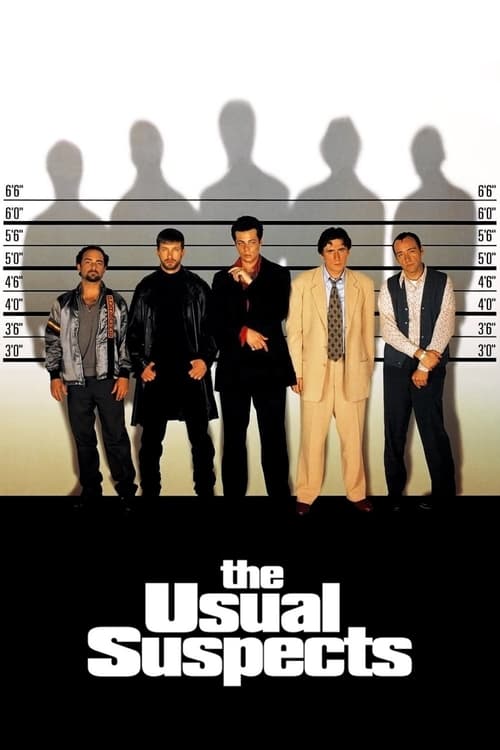
The Usual Suspects
None or negligible
A twisting 1990s crime thriller about five crooks, a mythical crime lord and an interrogation, with no progressive messaging: its cops, crooks and villains are drawn by greed, fear and pride, not by group.
Bryan Singer's thriller opens with a burning ship in San Pedro harbour and two survivors. One of them, Verbal Kint (Kevin Spacey), a small-time con man with a limp, is questioned by the customs agent Dave Kujan (Chazz Palminteri), who wants to know whether the ex-cop turned thief Dean Keaton (Gabriel Byrne) is really dead. Verbal's story goes back six weeks to a New York police lineup where he, Keaton, McManus (Stephen Baldwin), Fenster (Benicio del Toro) and Hockney (Kevin Pollak) first meet, and on to a lawyer called Kobayashi (Pete Postlethwaite), who says they all owe a debt to the legendary Keyser Söze.
The places the rubric might look are all genre material. The crooks complain that the police lean on them and never let an ex-con go straight, and their first job hits a ring of corrupt NYPD officers, but the film itself undercuts the grievance. Verbal's cerebral palsy earns him insults, the dialogue is full of crude slurs, and Keaton's girlfriend is a top criminal lawyer, all without comment. Söze's legend, told in flashback, is a story about ruthlessness, not about any group.
The places the rubric might look are all genre material. The crooks complain that the police lean on them and never let an ex-con go straight, and their first job hits a ring of corrupt NYPD officers, but Kobayashi reveals that Söze arranged the lineup, and the final scenes show that Verbal built much of his story from scraps on Kujan's notice board. Verbal's cerebral palsy earns him insults. The dialogue is full of crude slurs, and Keaton's girlfriend is a top criminal lawyer, all without comment. Söze's legend, told in flashback, is a story about ruthlessness, not about any group.
The score is zero because nothing is argued. The film has no speeches about society, no villain who stands for a race, sex, faith or politics, and no couple or casting choice that the rubric counts on sight. Its concerns are the puzzle, the con and the myth of a criminal no one has seen.
Score breakdown
Each category is scored 0 to 3: 0 absent or presence only, 1 brief, 2 recurring or plot-relevant, 3 central or dominant. Timestamps refer to the film's running time.
| Category | Score | What we saw |
|---|---|---|
| Content | ||
| A Race and ethnicity | 0 | Race is never a theme. Ethnic jibes such as 'Guats from Argentina' (0:51:04) and an agent's crude crack about the Hungarian survivor's speech (0:21:21) are the characters' own talk, and Jack Baer, the FBI agent, appears without comment (frame 0:51:30). No interracial couple appears in the dialogue or the sampled frames; Keaton and Edie are both white. |
| B Gender and feminism | 0 | Edie Finneran is introduced as a heavyweight criminal lawyer and Keaton's way out (0:12:50), and the other crooks mock him as a lawyer's wife (0:12:58). She is a small part, and nothing is said about women as such. |
| C Sexuality and gender identity | 0 | No LGBTQ characters or themes. Holding-cell jokes about a strip search (0:13:57), a jibe about two partners 'honeymooning' (0:35:12) and a homophobic one-liner on the pier (1:17:53) are tough-guy banter, not commentary. |
| D Power and systems | 0 | The crooks say the police lean on them and trample their rights (0:09:37) and will never let Keaton go straight (0:23:33), and their first job exposes a ring of corrupt NYPD officers (0:31:17). This is criminals' grievance and genre plotting, not a point about policing: the narrator is a con man, and the film later casts doubt on the grievanceKobayashi reveals that Söze, not the police, arranged the lineup (0:54:40). |
| E Cultural and historical revision | 0 | An original screenplay. Nothing is recast or revised. Kobayashi, a lawyer with a Japanese name played by an Englishman and called 'some limey' (0:49:21), is part of the plot's puzzle, not a casting statement. |
| F Religion portrayal | 0 | Islam does not appear. Religion comes up only in Verbal's remark that he believes in God and fears only Söze (1:01:57), and in the 'devil' imagery around Söze. |
| Treatment | ||
| G Antagonist coding | 0 | The villains are a faceless crime lord, his lawyer and rival gangs, defined by power, fear and money. Söze's legend gives him a personal motive, a revenge on the Hungarian gang that attacked his family (1:00:04), and his reported Turkish and German origins (0:59:01) are told as rumour, not as a point about either group. |
| H Didacticism | 0 | No speeches carry a social message. The film's set pieces are Kujan's interrogation and Verbal's telling of the Söze legend (0:59:25). |
| I Message over story | 0 | The story is a crime puzzle built around an interrogation, and none of its turns bends toward a message. |
| J Left-leaning politics framed as good | 0 | No political positions are argued. Kobayashi's list of Söze's past schemes, including steel bound for a Pakistani reactor in breach of UN rules (0:53:29) and gun parts rerouted to Belfast (0:54:09), is crime plotting, not politics. |
How the number is reached
- Categories A to J add up to 0 of 30, which gives 0.0 (0 ÷ 30 × 10, rounded to the nearest 0.5).
- No counterweight: There is no progressive messaging to mock or complicate.
- Final rating 0.0, none or negligible.
Considered, scored 0
- The crooks' complaints of police harassment and abused rights (0:09:37, 0:23:33, 1:03:40), told by a con man to a cop and undercut when Kobayashi says Söze set up the lineup (0:54:40).
- The 'New York's Finest Taxi Service', a ring of corrupt NYPD officers exposed by the gang's first job (0:31:17), with 50 more officers going down afterwards (0:34:20): a heist target, not a point about policing.
- Verbal's cerebral palsy (0:23:11) and the insults it draws, from 'the gimp' (0:14:18) and 'Peg Leg' (1:05:36) to Kujan telling him he was chosen for being a stupid cripple (1:35:38).
- Crude slurs and ethnic jibes in the dialogue (0:21:21, 0:51:04, 1:17:53), in character and not taken up.
- Edie Finneran as a top criminal lawyer and Keaton's reason to go straight (0:12:50, 0:37:38), with no point made about her sex.
- Jack Baer, the FBI agent played by a Black actor (frame 0:51:30), shown without comment.
- The Söze legend: a crime lord whose wife and children are attacked by a Hungarian gang (1:00:04) and who wipes them out, a myth about ruthlessness rather than about any group.
Evidence and confidence
Confidence: Medium. The file has no English text subtitles, so the dialogue comes from a Whisper transcript of the English audio. It covers the whole film but garbles names (Kujan comes out as 'Cuyen' or 'Coyon', Söze as 'Kaiser Susie' or 'Sozey', Verbal sometimes as 'Virgil') and some fast exchanges. The Hungarian survivor's words in the hospital (0:40:14 to 0:41:13) come through mostly via the interpreter, and the Spanish and other foreign-language shouting on the ship (1:15:45, 1:21:27) was not transcribed. 106 frames sampled once a minute.
Category F definition: As in the rubric: Islam shown as a peaceful and tolerant religion, aligned with human rights, in a way that works as a corrective message.
Rubric version 1. Reviewed 18 November 2026.