Woke rating
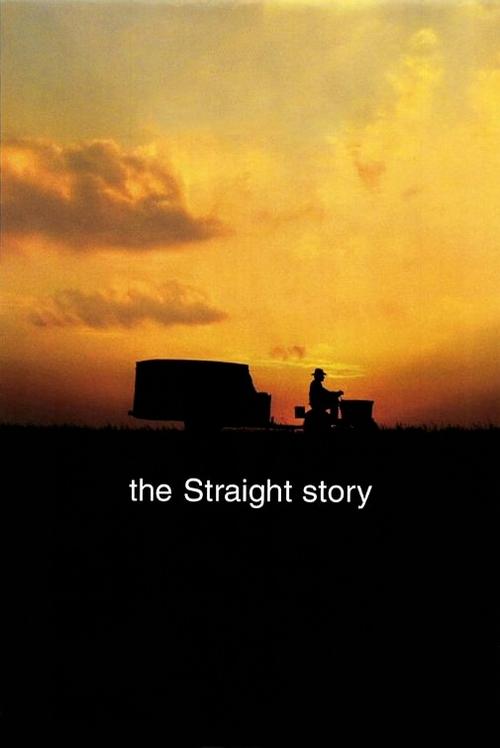
The Straight Story
None or negligible
A gentle road film about an old man riding a lawn mower across Iowa to see his estranged brother, with no progressive messaging: its values are family, reconciliation and the kindness of strangers.
David Lynch's film follows Alvin Straight (Richard Farnsworth), a 73-year-old widower in Laurens, Iowa, with bad hips and failing eyes, who lives with his daughter Rose (Sissy Spacek). When he hears that his brother Lyle, to whom he has not spoken in ten years, has had a stroke, he sets off for Mount Zion, Wisconsin, 370 miles away, on a 1966 riding mower towing a home-made trailer, because he cannot drive and will not be driven.
There is nothing here for the rubric to find. The people Alvin meets on the way, a pregnant runaway, a woman who keeps hitting deer, a pack of cyclists, a retired John Deere man and his wife, bickering twin mechanics, a fellow veteran and a priest, are drawn as individuals, not types. Rose's disability and the loss of her children to the State, and Alvin's memories of the Second World War, are told as personal sorrow, not as arguments.
What the film does stand for, quietly, is family, reconciliation, sobriety and the decency of small-town and rural people. Those values are noted below but not scored; the progressive score is zero, and there is nothing for a counterweight to offset.
Score breakdown
Each category is scored 0 to 3: 0 absent or presence only, 1 brief, 2 recurring or plot-relevant, 3 central or dominant. Timestamps refer to the film's running time.
| Category | Score | What we saw |
|---|---|---|
| Content | ||
| A Race and ethnicity | 0 | Race never comes up. The small-town Iowa and Wisconsin cast is almost entirely white, and no interracial couple appears in the dialogue or the sampled frames. |
| B Gender and feminism | 0 | Rose keeps the house running and her father defends her as capable (0:45:36); the runaway's fear is about her family (0:44:33). Neither is framed around gender. |
| C Sexuality and gender identity | 0 | No LGBTQ characters or themes. |
| D Power and systems | 0 | Alvin says the State took Rose's children after a fire she had no part in, judging her unfit because of the way she is (0:46:14). It is one line of family grief, not a critique of institutions; the doctor, the volunteer firefighters and the townspeople are all shown helping him (0:10:15, 1:04:16). |
| E Cultural and historical revision | 0 | Based on Alvin Straight's own journey (the credits thank the Straight family, frame 1:51:30). Nothing is recast or revised to carry a message. |
| F Religion portrayal | 0 | Islam does not appear. Religion appears only as a friendly priest (1:32:23) and a preacher who once helped Alvin stop drinking (1:16:23). |
| Treatment | ||
| G Antagonist coding | 0 | There are no villains. Even the twin mechanics who overcharge him settle fairly once he haggles (1:25:34). |
| H Didacticism | 0 | No speeches carry a social message. Alvin's homilies are about family, age and brothers (0:46:52, 0:55:15, 1:25:56). |
| I Message over story | 0 | The story is a slow, straight-line journey that bends toward nothing but its destination. |
| J Left-leaning politics framed as good | 0 | No political positions are argued. Rural life, neighbourliness and an old soldier are shown with affection, and the war is remembered as personal loss, not as a political point. |
How the number is reached
- Categories A to J add up to 0 of 30, which gives 0.0 (0 ÷ 30 × 10, rounded to the nearest 0.5).
- No counterweight: There is no progressive messaging to mock or complicate.
- Final rating 0.0, none or negligible.
Considered, scored 0
- A largely white small-town and rural cast, shown without comment.
- Rose's disability (0:45:36), shown with affection rather than as a message.
- Alvin's account of the State taking Rose's children (0:46:14), personal grief rather than a critique of institutions.
- Alvin's memories of the Second World War, including the German dead (1:19:01) and his confession that he shot his own scout (1:21:23), about guilt and loss rather than politics.
- A pregnant teenage runaway who fears her family's anger (0:44:33), handled as a family story.
Evidence and confidence
Confidence: Medium. Full English subtitles from the embedded dialogue track, and 112 frames sampled once a minute. The film has long wordless stretches on the road (for example 0:26:41 to 0:31:44 and 1:27:34 to 1:32:23); the sampled frames cover them.
Category F definition: As in the rubric: Islam shown as a peaceful and tolerant religion, aligned with human rights, in a way that works as a corrective message.
Noted, not scored: The film quietly champions family: Alvin tells the pregnant runaway her family will not want to lose her or the baby (0:45:01) and uses a bundle of sticks to show that a family cannot be broken (0:47:16); she leaves a tied bundle of sticks behind when she goes (frame 0:49:30). Sobriety, self-reliance, thrift and making peace with a brother are the film's values (1:16:23, 1:36:53), a priest says 'amen' to Alvin's aim (1:37:13), and the kindness of rural strangers is shown throughout.
Rubric version 1. Reviewed 18 November 2026.