Woke rating
The Interview
Mild
A crude buddy comedy about a CIA plot against Kim Jong-un whose satire is aimed at a dictatorship, with only a few joking lines about sexism and American meddling and an interracial romance on the side.
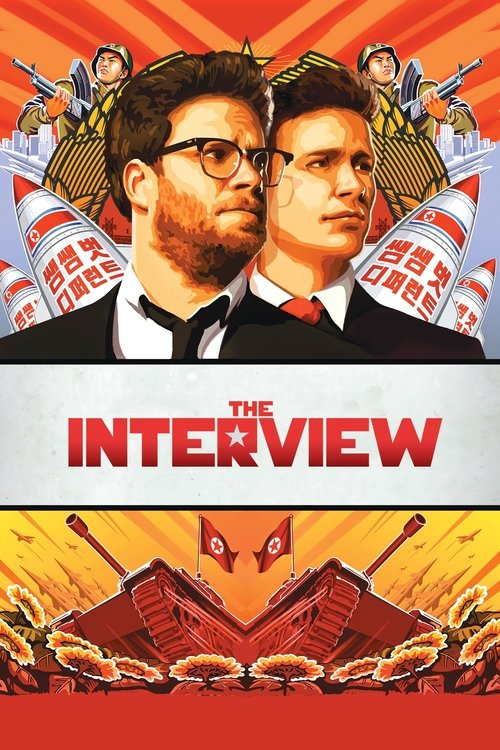
Seth Rogen and Evan Goldberg's comedy follows Dave Skylark (James Franco), the vain host of a celebrity gossip show, and his producer Aaron Rapaport (Seth Rogen), who wants to do real news. When they learn that Kim Jong-un (Randall Park) is a fan, they land an interview in Pyongyang, and CIA agent Lacey (Lizzy Caplan) recruits them to poison him. Most of the running time goes on drug, sex and toilet jokes, Lord of the Rings references, and Dave's growing bromance with the dictator.
The messaging is thin and scattered. Aaron suspects the CIA of using Lacey as a honeypot, and Dave and Lacey call that sexist in a gag the film then turns around. A running joke about whether margaritas are gay ties Kim's posturing to a father who called his sons too feminine. A few lines jab at American meddling abroad, and Kim's scripted interview answers include talking points about US hypocrisy. Aaron falls for Sook (Diana Bang), Kim's head of propaganda, an interracial romance the rubric counts on sight.
The messaging is thin and scattered. Aaron suspects the CIA of using Lacey as a honeypot, and Dave and Lacey call that sexist in a gag the film then turns around. A running joke about whether margaritas are gay ties Kim's posturing to a father who called his sons too feminine, and Dave uses it on air to make Kim cry. A few lines jab at American meddling abroad, Sook argues that killing Kim would change nothing, and Kim's interview answers include talking points about US hypocrisy. Aaron falls for Sook (Diana Bang), Kim's head of propaganda, who turns out to hate him and stays behind to steer the revolution, an interracial romance the rubric counts on sight.
What keeps the score low is that the film's target is a totalitarian state, not the West or any group at home. The anti-American talking points belong to the dictator and are shown up as propaganda, the progressive-sounding lines are mostly set-ups for jokes, and the ethnic and gay jokes that run through the film land on the characters telling them rather than making a point.
Score breakdown
Each category is scored 0 to 3: 0 absent or presence only, 1 brief, 2 recurring or plot-relevant, 3 central or dominant. Timestamps refer to the film's running time.
| Category | Score | What we saw |
|---|---|---|
| Content | ||
| A Race and ethnicity | 2 | Race carries no message; the ethnic jokes are listed under 'zeroed'. The score comes from the rubric's on-sight rule: Aaron, who is white and Jewish, and Sook, who is North Korean, are the film's only romance. Scored 2, not 3: it is a side thread of a buddy comedy, a few scenes and a goodbye, not the central story.
|
| B Gender and feminism | 1 | One running gag about the CIA using an attractive agent as bait. The objection that it is sexist is stated, but the joke is that the honeypot is real and Sook later works Aaron the same way. Sook's competence is not framed as a point about women.
|
| C Sexuality and gender identity | 1 | Gay jokes recur, and one thread carries a faint point: Kim's machismo comes from a father who called his sons too feminine, and Dave mocks the idea that liking sweet drinks is gay. It is played for laughs and works as a jab at Kim's insecurity rather than as advocacy.
|
| D Power and systems | 1 | A few swipes at American interventionism, each brief and most of them undercut: one comes from Dave while Kim is fooling him, and the rest are the dictator's own propaganda. The film's real target, the North Korean regime, is not a progressive theme and is noted under 'notScored'.
|
| E Cultural and historical revision | 0 | An original comedy. Kim Jong-un, a real person, is played by a Korean-American actor, and no established character or history is recast to make a point. |
| F Religion portrayal | 0 | Islam does not feature. Bin Laden is named once in a list of big interview gets (0:19:25). |
| Treatment | ||
| G Antagonist coding | 0 | The villain is a dictator with his own motives: fear of seeming weak, a cruel father and the wish to prove himself (0:57:42, 1:09:04). He is not coded as a Western out-group, and his antisemitic crack is part of his villainy. |
| H Didacticism | 1 | A couple of lines state a progressive point directly, each brief and mostly a set-up for a joke.
|
| I Message over story | 0 | The story leads. The turn from assassination to interviewSook's case for exposing Kim on air instead of killing him is set up as a plot twist, not a message, and the film does not stick to itstill ends with the heroes firing a tank shell at Kim (1:39:52, 1:40:05). |
| J Left-leaning politics framed as good | 0 | No left-leaning cause is promoted and no conservative value is mocked. The film's politics are aimed at a communist dictatorship, and the jabs at US policy are counted under D. |
How the number is reached
- Categories A to J add up to 6 of 30, which gives 2.0 (6 ÷ 30 × 10, rounded to the nearest 0.5).
- Counterweight −0.5: the film undercuts the few messages it voices: the complaint that the honeypot idea is sexist is a set-up for showing that it is true, the anti-American talking points come from the dictator and are exposed as propaganda, and Dave's swipe at American meddling comes while he is being fooled.the complaint that the honeypot idea is sexist is a set-up for showing that it is true (0:27:30, 1:45:12); the anti-American talking points come from the dictator and are exposed with the fake food in the grocery store (1:12:41, 1:26:23); Dave's swipe at American meddling comes while Kim is fooling him and is answered at once (1:01:28); and Sook's argument against killing Kim is followed by the heroes firing a tank shell at him anyway (1:40:05).
- Final rating 1.5, mild.
Considered, scored 0
- Ethnic jokes: Aaron takes the North Korean caller for Dave doing a terrible Asian accent (0:14:48), Dave greets his Korean hosts with 'konnichiwa' (0:36:46), Kim says Jews are bad luck (1:07:40), and Dave's parting line about going to America, 'where they don't eat doggies' (1:44:26). Each lands on the speaker's ignorance or villainy.
- Dave's speech that different faces are 'same same' inside (0:36:25), a joke on his cluelessness.
- Other gay jokes: Dave's 'honey-dick' theory (0:30:34) and a crack about Ellen DeGeneres (1:19:21).
- Kim's claim that Katy Perry has a strong message for young women (0:53:46), a cover for being a fan.
- A mixed staff in the CIA command centre (frame 0:45:30), shown without comment.
Evidence and confidence
Confidence: Medium. The file has no English text subtitles, so the dialogue comes from a Whisper transcript of the English audio. It covers the whole film but garbles some names (Skylark often comes out as 'Skylar', Aardvark as 'Art Bark') and a few lines. Korean dialogue is marked only as foreign speech; the film burns in its own subtitles for it (frames 0:01:30, 1:35:30), which were read only where a sampled frame caught them, so most of Kim's grief scene (1:04:30) and the Korean shouting during the escape (1:36:30 to 1:39:40) were not followed line by line. 112 frames sampled once a minute, the last several of them end credits.
Category F definition: As in the rubric: Islam shown as a peaceful and tolerant religion, aligned with human rights, in a way that works as a corrective message.
Noted, not scored: The satire's main target is a communist dictatorship: its personality cult, fake abundance, prison camps and nuclear threats are mocked throughout (0:33:22, 1:12:41, 1:18:41), Kim's talking points against America are framed as propaganda, and the heroes are flown home by US special forcesNavy SEALs extract the heroes, and the narration credits a camera and some questions with starting a revolution (1:43:57, 1:47:03).
Rubric version 1. Reviewed 18 November 2026.