Woke rating
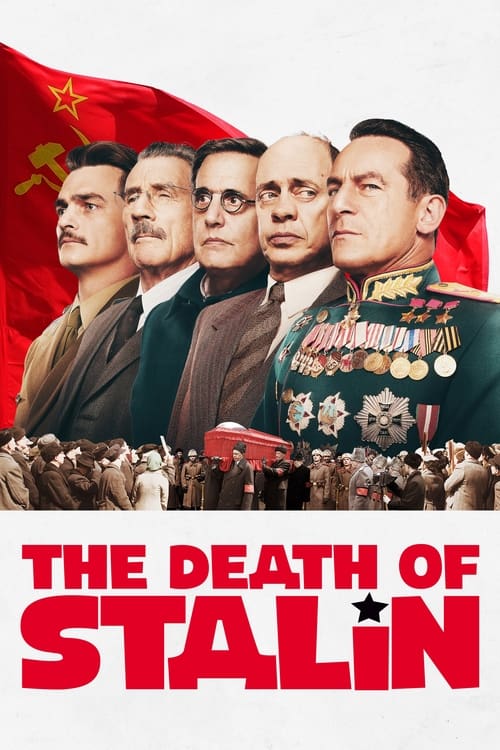
The Death of Stalin
None or negligible
A black comedy about the scramble for power after Stalin's death that satirises a communist dictatorship and carries no progressive identity messaging.
Armando Iannucci's black comedy covers the days after Joseph Stalin's stroke in March 1953, as his inner circle (Khrushchev, Beria, Malenkov, Molotov and later Marshal Zhukov) scramble to fill the vacuum while organising the funeral. British and American actors play the Soviet leaders in their own accents, and the jokes come from panic, pettiness and bureaucratic farce.
The film's target is the communist dictatorship itself. Night arrests run off lists, the secret police torture prisoners and prey on their wives, the best doctors are in the Gulag, troops fire on mourners, and every leader who now talks of reform signed the death lists. None of this is framed through race, sex or identity. It is Stalin's terror as history, so it is noted rather than scored. The few women in the story, the defiant pianist Maria Yudina and Stalin's daughter Svetlana, are characters, not points about gender.
The film's target is the communist dictatorship itself. Night arrests run off lists, the secret police torture prisoners and prey on their wives, the best doctors are in the Gulag, troops fire on mourners, and every leader who now talks of reform signed the death lists. The power struggle ends with Beria shot after a summary trial, by colleagues who signed the same lists. None of this is framed through race, sex or identity. It is Stalin's terror as history, so it is noted rather than scored. The few women in the story, the defiant pianist Maria Yudina and Stalin's daughter Svetlana, are characters, not points about gender.
The score stays at zero because nothing in the film argues a progressive position. Its 'liberalisation' is a cynical bid for public support that both rivals want credit for, the funeral promise of bread and peace is a slogan picked over sausages, and the one sympathetic believer is a Christian pianist, while the party bosses sneer at the bishops. The crude sexual jokes and the slurs from Stalin's drunken son mock the speakers, not any group.
Score breakdown
Each category is scored 0 to 3: 0 absent or presence only, 1 brief, 2 recurring or plot-relevant, 3 central or dominant. Timestamps refer to the film's running time.
| Category | Score | What we saw |
|---|---|---|
| Content | ||
| A Race and ethnicity | 0 | Race is not a theme. White British and American actors play the Soviet figures, and no interracial couple appears in the dialogue or the sampled frames. The slurs in Vasily's drunken outburst (1:07:29) mock him. |
| B Gender and feminism | 0 | No gender message. Beria's abuse of prisoners' wives (0:18:29) is shown as one of his crimes, and Yudina's defiance of Stalin (0:15:50) is a historical figure's courage, not a statement about women. |
| C Sexuality and gender identity | 0 | No LGBTQ+ characters or themes. The sexual content is crude banter (0:28:11, 1:00:55) and a drunk's slurs (1:07:29), none of it a message. |
| D Power and systems | 0 | State terror is the film's whole subject, but the state is Stalin's communist dictatorship and its victims are everyone, the leaders included. Criticism of a communist regime is not the progressive critique of institutions the category measures; it is noted under notScored. |
| E Cultural and historical revision | 0 | A loose, compressed retelling of real events, from Stalin's collapse to the power struggle that followedthe fall of Beria, based on a French graphic novel. The liberties serve the comedy, not a message, and no character is recast with another sex or a visibly different race. |
| F Religion portrayal | 0 | Islam does not feature. Religion appears as Yudina's Christian faith and the bishops at the funeral, noted under notScored. |
| Treatment | ||
| G Antagonist coding | 0 | The antagonists are the Soviet leaders, each with a personal motive: survival, ambition, fear and, for the winners, revenge. Being communist party bosses is not the out-group coding the category measures, and the film mocks all of them alike. |
| H Didacticism | 0 | No speech states a progressive message. Khrushchev's charge that Beria jailed, beat, raped and killed half the nation (1:11:14) is an insult in a power struggle from a man who signed the lists himself (0:56:26), and the funeral speeches are played for laughs (1:27:54). |
| I Message over story | 0 | The story leads: a farce driven by panic and plotting. Its liberties with history serve the jokes, not a point. |
| J Left-leaning politics framed as good | 0 | No left-leaning position is framed as good. Communism is the source of the horror, and the reform agenda is shown as a cynical bid for popularity (0:56:39). |
How the number is reached
- Categories A to J add up to 0 of 30, which gives 0.0 (0 ÷ 30 × 10, rounded to the nearest 0.5).
- No counterweight: There is no progressive messaging to mock or complicate.
- Final rating 0.0, none or negligible.
Considered, scored 0
- White British and American actors playing Russian and Georgian historical figures in their own accents; not a change of sex or visible race, so not counted as a recast.
- Beria's abuse of women, from prisoners' wives (0:18:29) to Khrushchev's charge that he raped those he jailed (1:11:16) and the rape counts read at his trial (1:34:41), shown as part of his crimes rather than a point about gender.
- Maria Yudina, the pianist who refuses to play again for Stalin's recording (0:09:54) and slips him a note calling him a tyrant (0:15:50), a historical figure's defiance rather than a statement about women.
- Vasily's drunken outburst at the lying-in-state, with antisemitic and homophobic slurs (1:07:29), which mocks him.
- The doctors jailed for treason (0:23:28, 0:27:30), shown as regime paranoia with no comment on who they were.
Evidence and confidence
Confidence: Medium. The file has no English text subtitles, so the dialogue comes from a Whisper transcript of the English audio, checked against 106 frames sampled once a minute. The transcript mishears many names (Beria often comes out as 'Barry') and garbles some fast cross-talk, and one short line in another language (0:11:23) was not transcribed. The last seven minutes are end credits.
Category F definition: As in the rubric: Islam shown as a peaceful and tolerant religion, aligned with human rights, in a way that works as a corrective message.
Noted, not scored: The film is a satire of a communist dictatorship: night arrests run off lists (0:04:50), threats of torture (0:21:57) and the abuse of prisoners' wives (0:18:20), the best doctors in the Gulag or dead (0:27:30), and NKVD troops firing on mourners (1:13:48, 1:15:54, where 1,500 are dead). Its leaders all signed the death lists (0:56:26, 1:19:24). Liberal reform is shown as a power play: Beria's freeze on arrests is called a bid to buy public support (0:56:39), Khrushchev is furious that the idea was his (1:14:33), and the funeral promise of bread and peace was picked over sausages (1:27:58). Christian faith is treated with sympathy: Yudina prays for Stalin's end and for God to forgive him (0:16:11) and is confident of everlasting life (1:15:14), while the party bosses sneer at the bishops (1:05:59).
Rubric version 1. Reviewed 18 November 2026.