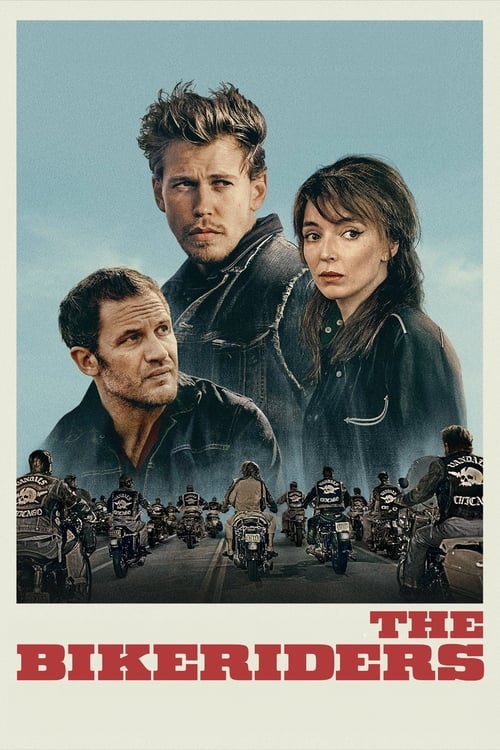
Woke rating
The Bikeriders
None or negligible
Jeff Nichols's portrait of a 1960s Chicago motorcycle club, told through one woman's memories, with no progressive messaging: its subjects are belonging, loyalty and how the club changed.
Inspired by Danny Lyon's 1968 photo book of the same name, the film has a young photographer, Danny (Mike Faist), recording interviews with Kathy (Jodie Comer). She tells him how she met Benny (Austin Butler), a reckless young rider in the Vandals, a Chicago club that its founder Johnny (Tom Hardy) started after watching Marlon Brando on TV (0:20:01). Her account runs from the mid-1960s into the early 1970s, as the club grows into chapters across the Midwest and Benny is torn between her and Johnny.
The rubric finds little here. The club is an almost entirely white, working-class, male world whose women are wives and girlfriends, and Kathy's first night among the bikers ends with handprints all over her slacks. Some of the men sneer at 'pinko' college boys and draft-card burners; this is period colour, voiced by characters the film likes, and nobody answers it. As the club grows, new members bring drugs and a harder kind of violence that eventually reaches Kathy herself.
The rubric finds little here. The club is an almost entirely white, working-class, male world whose women are wives and girlfriends, and Kathy's first night among the bikers ends with handprints all over her slacks. Some of the men sneer at 'pinko' college boys and draft-card burners; this is period colour, voiced by characters the film likes, and nobody answers it. As the club grows, new members bring drugs and a harder kind of violence: at a party they try to drag Kathy upstairs, and that night, together with Johnny's handling of a member who wants out, turns Benny away from the club. A kid from the Milwaukee chapter later kills Johnny and turns the Vandals into a criminal gang, and Benny ends up working at a garage in Florida with Kathy.
The score stays at zero because nothing is argued. The film watches the men with affection and some irony, gives Kathy the sharpest tongue in it, and tells the club's changethe club's slide into a criminal gang as a story about loyalty, age and belonging, not as a point about masculinity or any political side.
Score breakdown
Each category is scored 0 to 3: 0 absent or presence only, 1 brief, 2 recurring or plot-relevant, 3 central or dominant. Timestamps refer to the film's running time.
| Category | Score | What we saw |
|---|---|---|
| Content | ||
| A Race and ethnicity | 0 | Race never comes up. The club and its circle are almost entirely white in the dialogue and the sampled frames. One brief shot of a biker with a dark-haired woman at a drive-in (frame 0:22:30) is too small and dark to show whether they are an interracial couple, and the pair do not reappear. |
| B Gender and feminism | 0 | Kathy is the narrator and the film's sharpest voice, and the men's treatment of women is shown plainly: catcalls and groping on her first night (0:05:32, 0:08:51) and a frightening party scene lateran attempt by new members to drag her upstairs (1:22:03). It is told as her experience and as a sign of the club's decay, not argued as a point about men or patriarchy. |
| C Sexuality and gender identity | 0 | No LGBTQ characters or themes. The only reference is a jibe: Benny bristles when Johnny says he is propped up in bed like the queen (0:48:46). |
| D Power and systems | 0 | No institution is criticised. The police appear in a newspaper report of Benny's wild ride (0:17:42), a member later joins themCockroach quits the club to become a motorcycle cop (1:19:03, 1:44:07), and one biker's rejection by the army as an 'undesirable character' (1:00:53) is told as his grievance, not the film's. |
| E Cultural and historical revision | 0 | Inspired by a photo book about a real Chicago club, with the club renamed and the story fictionalised. Nothing is recast to carry a message. |
| F Religion portrayal | 0 | Islam is not portrayed. Religion comes up only in passing, as the motorcycle blessing on Saint Christopher's Day (1:10:28). |
| Treatment | ||
| G Antagonist coding | 0 | The threats are rival bikers, a bar's regulars who beat Benny over his colours (0:41:04), and the club's own new membersthe club's own new members and the kid who challenges Johnny (1:34:51), driven by ambition, drugs and pride, not coded by a demographic or ideological group. |
| H Didacticism | 0 | No speeches carry a social message. One biker's rant about his 'pinko' college-boy brother (0:33:05 to 0:34:31) and another's story of being turned down for Vietnam (0:59:01 to 1:01:29) are character monologues, and they lean the other way. |
| I Message over story | 0 | The story follows Kathy's memories of the club, and none of its turns bends toward a message. |
| J Left-leaning politics framed as good | 0 | No left-leaning politics are framed as good. Where the bikers' politics show, they are anti-'pinko' and pro-military, and the film neither endorses nor mocks them. 'Masters of War' plays over a revenge raid (0:46:28) as soundtrack, not commentary. |
How the number is reached
- Categories A to J add up to 0 of 30, which gives 0.0 (0 ÷ 30 × 10, rounded to the nearest 0.5).
- No counterweight: None applies: there is no progressive messaging to complicate.
- Final rating 0.0, none or negligible.
Considered, scored 0
- An almost entirely white club, shown without comment, and a brief, unclear shot of a biker with a dark-haired woman at a drive-in (frame 0:22:30).
- The catcalls and groping on Kathy's first night (0:05:32 to 0:08:58) and the attempt to drag her upstairs (1:22:03), which she recounts to Benny (1:26:56), told as her experience and as a mark of the club's decline.
- Kathy as narrator and the strongest voice in the film, shown rather than argued; her remark that every woman thinks she can change a man (1:06:38) is wry, not a thesis.
- The 'queen' jibe (0:48:46).
- 'Masters of War' on the soundtrack (0:46:28).
Evidence and confidence
Confidence: Medium. Full English subtitles from the embedded track, and 116 frames sampled once a minute. The HDR frames are dark and washed out, so one brief shot of a biker and a woman at a drive-in (frame 0:22:30) could not be read clearly. The closing stretch is mostly songs over the last scenes and the credits (from 1:48:58), which the frames cover.
Category F definition: As in the rubric: Islam shown as a peaceful and tolerant religion, aligned with human rights, in a way that works as a corrective message.
Noted, not scored: Bikers voice working-class contempt for 'pinko' college boys (0:33:10, 0:34:23) and draft-card burners (1:01:24), and one says he always wanted to fight in Vietnam (0:59:28); the film presents this as period colour and leaves it unanswered.
Rubric version 1. Reviewed 18 November 2026.