Woke rating
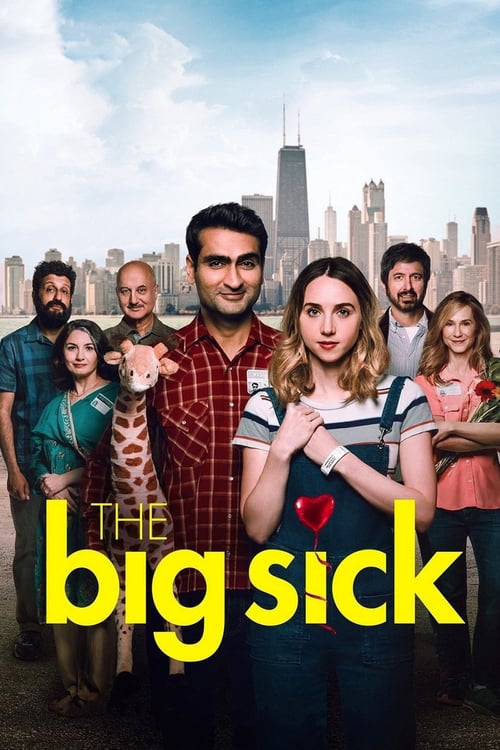
The Big Sick
Mild
An autobiographical romantic comedy whose central interracial romance and culture-clash plot carry most of its score, while it treats both families with affection, lets the traditional side argue back and keeps clear of politics.
Michael Showalter's comedy is based on how Kumail Nanjiani and Emily V. Gordon, who wrote it together, got together. Nanjiani plays himself, a Pakistani-born stand-up and Uber driver in Chicago who falls for a psychology student, Emily (Zoe Kazan), while his mother keeps arranging for single Pakistani women to 'drop in' at family dinners. When Emily falls ill and is put into a medically induced coma, he spends the long hospital wait with her parents, Beth and Terry (Holly Hunter and Ray Romano), who know he has hurt her.
Most of the score comes from the couple and the culture clash. Kumail is Pakistani-American and Emily is white, and their romance is the film, which the rubric counts on sight. His family expects him to marry a Pakistani Muslim, a cousin has been cut off for marrying a white woman, and the gap between the American life he lives and the one his parents want for him drives the plot. One scene at a comedy club has a heckler tell him to go back to ISIS, and Beth makes the man admit it is because of how Kumail looks. Late in the film Kumail tells his parents where he stands on prayer and marriage.
Most of the score comes from the couple and the culture clash. Kumail is Pakistani-American and Emily is white, and their romance is the film, which the rubric counts on sight. His family expects him to marry a Pakistani Muslim, a cousin has been cut off for marrying a white woman, and the gap between the American life he lives and the one his parents want for him drives the plot. One scene at a comedy club has a heckler tell him to go back to ISIS, and Beth makes the man admit it is because of how Kumail looks. Late in the film Kumail tells his parents he has not prayed in years, does not know what he believes and loves Emily; his father says he is not his son and the family cuts him off. He moves to New York, and Emily, recovered, turns up at his show.
The score stays low because this is a personal story, not an argument. Nobody speaks about race or religion in general terms for long, and there is no politics. The traditional side gets its say: his mother lists what the family gave up to come to America, his father tells him the American dream is not doing whatever he wants, and his brother's arranged marriage is shown as a happy one. Kumail is a liar for much of the film, Emily's own parents have a marriage under strain from Terry's affair, and the film mocks Kumail's earnest one-man show about Pakistan as well as the pressures of his family.
Score breakdown
Each category is scored 0 to 3: 0 absent or presence only, 1 brief, 2 recurring or plot-relevant, 3 central or dominant. Timestamps refer to the film's running time.
| Category | Score | What we saw |
|---|---|---|
| Content | ||
| A Race and ethnicity | 3 | Race is never the subject of a speech, but the central romance is between a Pakistani-American man and a white woman, which the rubric counts on sight and scores 3 as the central couple. The family's objection to white partners and one racist heckling scene add to it.
|
| B Gender and feminism | 1 | One scene gives a woman's view of the arranged-marriage round: a young Pakistani woman complains about being paraded and judged. Elsewhere women are written as individuals without a point being made.
|
| C Sexuality and gender identity | 0 | No LGBTQ+ content. Emily and Kumail's sex life and her divorce are shown as part of the story, not argued for. |
| D Power and systems | 0 | No institution is framed as oppressing a group. The hospital is criticised for its ranking and its vague answers, and Kumail shouts about a 'corporate entity' at a fast-food window, but both are personal frustration. |
| E Cultural and historical revision | 0 | An original screenplay drawn from the writers' own lives, with Nanjiani playing himself. Nothing established is recast. |
| F Religion portrayal | 1 | Islam is the family's faith and is shown warmly, and a few scenes push back on the Muslim-as-terrorist idea. The film does not, however, present the faith as tolerant of choice: the family's rule that a good Muslim marries a Pakistani girl is the obstacle, and breaking it costs Kumail his family for a time.
|
| Treatment | ||
| G Antagonist coding | 1 | There is no real villain; the obstacles are illness and family tradition, and both families get motives. The only antagonist defined by prejudice alone is the heckler, a white frat-boy type who appears in one scene.
|
| H Didacticism | 1 | Two heated scenes state the theme directly, both in character and both answered by the other side.
|
| I Message over story | 0 | The story leads. The romance, the illness and the stand-up career drive it, and the culture clash grows out of the characters. |
| J Left-leaning politics framed as good | 1 | The film sides with personal choice over religious and family tradition: arranged marriage and religious duty are what Kumail must break away from. It gives the parents love and a voice, and no political cause is promoted.
|
How the number is reached
- Categories A to J add up to 8 of 30, which gives 2.5 (8 ÷ 30 × 10, rounded to the nearest 0.5).
- Counterweight −0.5: The traditional side gets a fair hearing and the film pokes fun at its own side: Kumail's mother speaks of what the family gave up (1:23:14) and his father tells him the American dream is not doing whatever he wants (1:25:50), and the father's warm farewell softens the break (1:54:06); Beth's own family fought her marriage to Terry (1:06:57), so family opposition is not pinned on one culture; Kumail's earnest one-man show about Pakistan is mocked (0:23:44, 0:24:05); and Emily's cry of misogyny turns out to cover a bathroom emergency (0:25:05).
- Final rating 2.0, mild.
Without category F (religion), the total is 7 of 30, giving 2.5, and 2.0 after the counterweight (mild).
Considered, scored 0
- The family's prayer, greetings and mosque memories, shown as part of their life without comment.
- Emily's casual first-night sex and her earlier divorce, shown rather than argued.
- A stand-up joke about mansplaining (0:04:06) and Kumail's joke that he can't tell 'Craig' from 'Greg' (0:32:18).
- Kumail's rant about a 'corporate entity' at a drive-through window (1:28:15), a breakdown rather than a critique.
- Mixed-race crowds at the clubs and the hospital, shown without comment.
Evidence and confidence
Confidence: Medium. Full English subtitles from the film's embedded track, and 120 frames sampled once a minute. A few short Urdu lines and a song at the family dinner (0:59:49 to 1:00:06) are not translated, and one doctor's explanation is marked inaudible (1:14:13); neither stretch looks to bear on the score.
Category F definition: As in the rubric: Islam shown as a peaceful and tolerant religion, aligned with human rights, in a way that works as a corrective message.
Noted, not scored: Tradition is also shown warmly: Kumail's brother says his arranged wife became his best friend (0:28:08), and his parents' arranged first date gave them their favourite song (1:54:56).
Rubric version 1. Reviewed 18 November 2026.