Woke rating
Song Sung Blue
None or negligible
A warm, sentimental true story about a Milwaukee couple's Neil Diamond tribute act, with no progressive messaging at all: its subjects are sobriety, marriage, family and second chances.
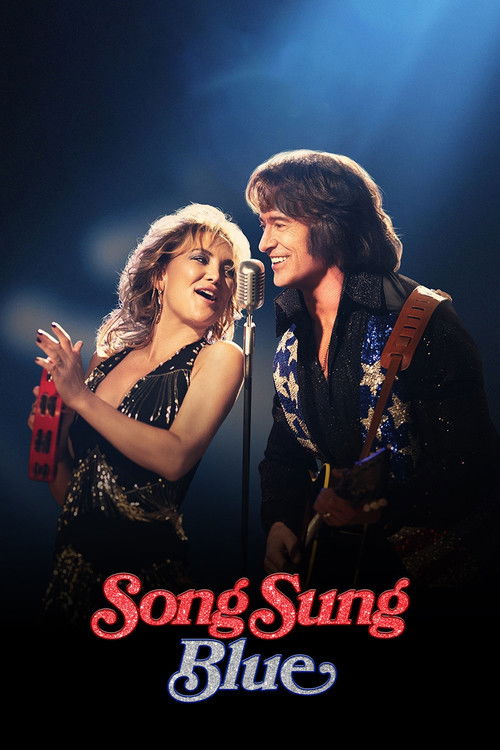
Craig Brewer's film, based on a true story, follows Mike Sardina (Hugh Jackman), a Milwaukee mechanic, Vietnam veteran and recovering alcoholic who sings in bars, and Claire Stengl (Kate Hudson), a divorced hairdresser who performs as Patsy Cline. They fall in love, marry and build Lightning & Thunder, a Neil Diamond tribute act, while raising a blended family and chasing bigger gigs.
There is almost nothing here for the rubric to find. The conflicts are money, artistic pride, family friction and a run of bad luck that tests the marriage. Race comes up only in passing jokes, such as Mike calling himself the only white man in an all-Black band, and the Black musicians, the Thai restaurant owner who hires Mike and the gospel choir at the big show are simply part of the world.
There is almost nothing here for the rubric to find. The conflicts are money, artistic pride and family friction, then the accident that costs Claire a leg, her depression and stay in a psychiatric unit, Rachel's teenage pregnancy, the comeback, and Mike's death on the night of their biggest show. Race comes up only in passing jokes, such as Mike calling himself the only white man in an all-Black band, and the Black musicians, the Thai restaurant owner who hires Mike and the gospel choir at the big show are simply part of the world.
The score is zero because nothing is argued. The only antagonists are hecklers and misfortune, no institution is blamed, and the speeches are AA shares, stage patter and a eulogy. The closing wordsMike's last recorded message to his AA group ask people to look out for each other and be grateful, which carries no politics.
Score breakdown
Each category is scored 0 to 3: 0 absent or presence only, 1 brief, 2 recurring or plot-relevant, 3 central or dominant. Timestamps refer to the film's running time.
| Category | Score | What we saw |
|---|---|---|
| Content | ||
| A Race and ethnicity | 0 | Race is never a theme. Mike's opening joke about being the only white man in an all-Black band (0:01:33) and a backstage quip about having no Little Richard impersonator (0:06:39) carry no message. No interracial couple appears: the leads are white, and Rachel's boyfriend, seen briefly (0:56:20), is white too. |
| B Gender and feminism | 0 | No gender message. Claire's story of an ex-husband who belittled her singing (0:24:00) is matched at once by Mike admitting he did the same to his own ex (0:24:22), and their quarrel over who runs the act (0:44:05) ends in a joking compromise. |
| C Sexuality and gender identity | 0 | No LGBTQ characters or themes. A biker heckler's anti-gay jibe at Mike (0:42:35) only sparks a brawl. |
| D Power and systems | 0 | Money troubles run through the film (a mortgage three months behind, 0:11:21; medical billsmedical bills after Claire's accident, 1:01:40), but they are played as hard luck. No system or institution is blamed. |
| E Cultural and historical revision | 0 | A dramatisation of a real couple's story. Nothing in the material suggests a character was recast with another sex or ethnicity to carry a message. |
| F Religion portrayal | 0 | Islam does not feature. Religion appears as the Serenity Prayer (0:38:58), a Christmas hymn (1:20:37) and a gospel number at the big show (1:50:34); the Neil Diamond song 'Soolaimon' is described as an Arabic call to celebration (0:29:31), with no comment on any faith. |
| Treatment | ||
| G Antagonist coding | 0 | There are no villains. The bikers who boo the act (0:41:49) and a grumpy Elvis impersonator are comic obstacles, not coded by group. |
| H Didacticism | 0 | No speeches carry a social message. The AA shares (0:03:00, 2:02:15) and the eulogyClaire's eulogy for Mike (1:56:43) are about recovery, love and gratitude. |
| I Message over story | 0 | A straightforward showbiz romance and family drama; none of its turns bends toward a message. |
| J Left-leaning politics framed as good | 0 | No political positions are argued or implied. |
How the number is reached
- Categories A to J add up to 0 of 30, which gives 0.0 (0 ÷ 30 × 10, rounded to the nearest 0.5).
- No counterweight: There is no progressive messaging to mock or complicate.
- Final rating 0.0, none or negligible.
Considered, scored 0
- Mike's joke that he is the only white man in an all-Black band, The Esquires (0:01:33), and a backstage quip about too many Elvis impersonators and no Little Richard (0:06:39).
- Black musicians, a Thai restaurant owner and his karaoke regulars who want Aaliyah and Usher (1:08:07), and a gospel choir at the big show (1:48:30), all shown without comment.
- Claire's account of an ex-husband who belittled her singing (0:24:00), answered by Mike's admission that he did the same (0:24:22): personal history, not a point about men.
- A biker heckler's anti-gay jibe (0:42:35), which only starts a fight.
- A scene about medical bills and insuranceThe hospital billing scene after Claire's accident (1:01:40), played as money worries, not a critique of the system.
Evidence and confidence
Confidence: Medium. Full English subtitles from the embedded track, song lyrics included, and 132 frames sampled once a minute, plus a few targeted frames (the opening club scene, the backing band and Rachel's boyfriend) to check for couples. The only gaps in the dialogue are music and silent stretches.
Category F definition: As in the rubric: Islam shown as a peaceful and tolerant religion, aligned with human rights, in a way that works as a corrective message.
Noted, not scored: Sobriety, marriage and family are treated with plain respect: Mike's AA meetings and the Serenity Prayer (0:38:58) frame the story, the wedding uses traditional vows (0:45:35), and a family crisis is met by pulling togetherRachel's unplanned pregnancy is carried to term for adoption (1:23:17), with no other option raised.
Rubric version 1. Reviewed 18 November 2026.