Woke rating
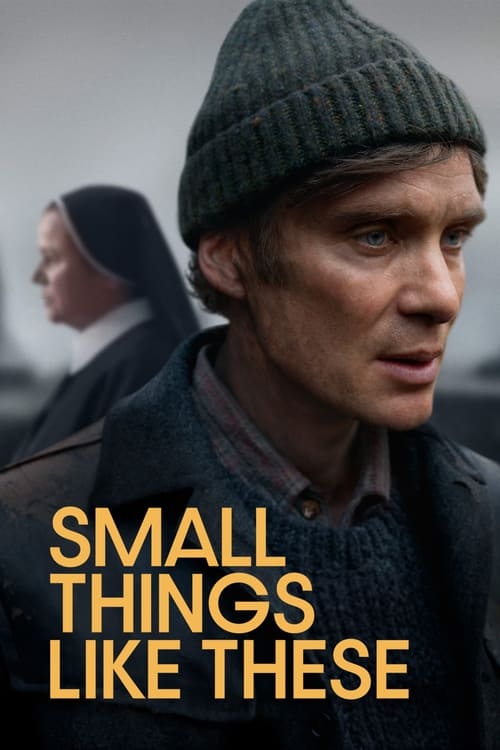
Small Things Like These
Mild
A quiet Irish drama about a coal merchant who sees what the local convent does to its young women; its critique of Church power and a town's silence is the whole subject, but it is shown rather than preached and the case for looking away gets a fair hearing.
Tim Mielants's adaptation of Claire Keegan's novella is set in a small town in south-east Ireland at Christmas 1985. Bill Furlong (Cillian Murphy), a coal merchant with a wife, Eileen, and five daughters, delivers fuel to the convent whose nuns run a laundry for young women and the school his girls attend. What he sees there stirs memories of his own childhood as the son of an unmarried mother, taken in by Mrs. Wilson, the well-off woman she worked for, and he grows quieter and more troubled as Christmas approaches.
The film is about the Magdalene laundries, and what scores here comes from that subject. A mother forces her pleading daughter through the convent door, a girl begs Bill to get her past the gate, and he finds a pregnant teenager locked in the coal shed whose baby, she has been told, will go to a good home. The Mother Superior, Sister Mary (Emily Watson), smooths things over with tea and a Christmas card with money in it, and a friendly publican warns him that the nuns have a hand in everything, his daughters' schooling included. The closing card dedicates the film to the women sent to these institutions and the children taken from them.
The film is about the Magdalene laundries, and what scores here comes from that subject. A mother forces her pleading daughter through the convent door, a girl begs Bill to get her past the gate, and he finds Sarah, a pregnant teenager, locked in the coal shed; her baby, she has been told, will go to a good home. The Mother Superior, Sister Mary (Emily Watson), has Sarah call it a game in front of him, then hands him a Christmas card with money in it, and a friendly publican warns him that the nuns have a hand in everything, his daughters' schooling included. On Christmas Eve Bill goes back, takes Sarah out of the convent and walks her through the town to his home. The closing card dedicates the film to the women sent to these institutions and the children taken from them.
What keeps the score in the mild band is restraint. There are almost no speeches: the institution's cruelty is seen through one man's silent looks, and the only argument in the film is a kitchen-table quarrel in which Eileen's case for looking away, to protect their own daughters, is given real weight. Bill's conscience is rooted in the charity once shown to his mother, faith and family life are drawn warmly, and no present-day politics are drawn in.
Score breakdown
Each category is scored 0 to 3: 0 absent or presence only, 1 brief, 2 recurring or plot-relevant, 3 central or dominant. Timestamps refer to the film's running time.
| Category | Score | What we saw |
|---|---|---|
| Content | ||
| A Race and ethnicity | 0 | Race never comes up. The cast is an all-white Irish one, and no interracial couple is shown. |
| B Gender and feminism | 2 | The victims of the convent are young women, mostly unmarried mothers, and their confinement and lost babies are the film's subject. Scored 2, not 3: it is not framed as a point about men, the jailers are nuns and the first girl is forced in by her own mother, and the story's focus is a man's conscience rather than the women themselves.
|
| C Sexuality and gender identity | 0 | No LGBTQ characters or themes. |
| D Power and systems | 3 | The Church-run convent is the film's subject from first scene to last: an institution that locks up young women, takes their babies and holds a town in line through its schools and money. Scored 3 because it is the dominant theme, though it is shown through Bill's eyes rather than argued.
|
| E Cultural and historical revision | 0 | An adaptation of Claire Keegan's novella, credited at the end. The Magdalene laundries are documented history, and no established character or event is recast. |
| F Religion portrayal | 0 | Islam does not feature. Religion here is Irish Catholicism, scored under D and G. |
| Treatment | ||
| G Antagonist coding | 1 | The antagonists are the nuns, above all Sister Mary, who are given almost no inner life beyond keeping the institution's control. Scored 1, not 2: Bill and his family are churchgoing Catholics too, Sister Mary is played as smooth and plausible rather than monstrous, and much of the pressure on Bill comes from kind neighbours and his own wife.
|
| H Didacticism | 1 | There are no speeches. The message is put into words only in Bill's few questions to Eileen and in the closing dedication card.
|
| I Message over story | 0 | The story leads. It is a slow character study that follows the novella, and its turns up to Bill's final choice grow out of his memories and conscience rather than bending toward a point. |
| J Left-leaning politics framed as good | 1 | The punitive Catholic order of 1980s Ireland, and the shame it attaches to unmarried mothers, is portrayed as cruel and the town's deference to it as fear. Scored 1: no political cause is argued, and the film's own moral language is Christian charity, with faith and family not mocked.
|
How the number is reached
- Categories A to J add up to 8 of 30, which gives 2.5 (8 ÷ 30 × 10, rounded to the nearest 0.5).
- Counterweight −0.5: The film gives the other side a fair hearing and does not make faith the villain: Eileen's case for looking away, that the girls are fed, housed and given a trade and that the family must protect what it has, is put with sympathy (0:43:53, 0:45:35); Mrs. Kehoe's warning comes as kindly advice from a friend (1:19:17); the first girl is forced in by her own mother (0:05:46); and Bill's goodness is traced to the charity Mrs. Wilson showed his unmarried mother (0:46:11).
- Final rating 2.0, mild.
Considered, scored 0
- An all-white Irish cast; race does not come up.
- Eileen's jibe that Bill was reared far from hardship and her resentment of Mrs. Wilson's big house, pension and farm (0:44:56, 0:46:23), a marital quarrel rather than a point about class.
- Bill's kindness to a poor boy whose father drinks, and Eileen's harder view of the father (0:08:35, 0:13:25), character rather than comment.
- Bill's childhood memories as the son of an unmarried mother (0:29:12, 0:47:43), and the hint that the farmhand Ned is his father (1:15:24), personal history told without comment.
- Teenage boys heckling Bill's daughters in the street (0:21:24), ordinary teasing.
Evidence and confidence
Confidence: Medium. Full English subtitles with sound descriptions from the embedded track, and 98 frames sampled once a minute (the last six are end credits), plus a handful of frames pulled from 1:31:25 to 1:32:25 to read the closing title cards. The film is sparing with words: long stretches, such as 1:19:57 to 1:24:36 and 1:26:50 to 1:31:27, have no dialogue and are covered only by the frames, which are dark and flat, as HDR sources are, but readable.
Category F definition: As in the rubric: Islam shown as a peaceful and tolerant religion, aligned with human rights, in a way that works as a corrective message.
Noted, not scored: Family and faith are drawn warmly: the Furlongs' Christmas rituals (0:22:40), Bill's devotion to his five daughters, and a goodness the film traces to the charity shown to his mother and to the Dickens line about honouring Christmas all year that he read as a boy (0:16:58).
Rubric version 1. Reviewed 18 November 2026.