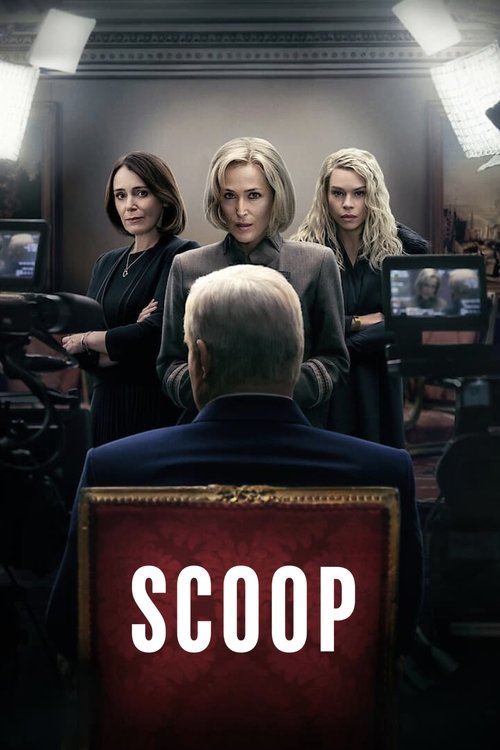
Woke rating
Scoop
None or negligible
A brisk newsroom drama about how Newsnight landed its 2019 Prince Andrew interview, with a light thread of women holding a powerful man to account and one short speech about misogyny, offset by digs at the BBC's own echo chamber.
Based on booker Sam McAlister's memoir, the film follows Sam (Billie Piper), a Newsnight booker worried about BBC job cuts, as she works a New York paparazzo and the Duke of York's private secretary Amanda Thirsk (Keeley Hawes) to win the prince's first interview about Jeffrey Epstein. Most of it is phone calls, negotiations and newsroom arguments; the last act restages the interview itself, with Gillian Anderson as Emily Maitlis and Rufus Sewell as Andrew.
The messaging runs through the framing of the team as women taking on a powerful man. Maitlis notes that three women in a studio would have been unthinkable when she started (0:22:08), the team half-jokingly pitch her to Andrew as a woman (0:49:04), and on the eve of the interview she says she let women down by not asking Bill Clinton about Monica Lewinsky, who got decades of misogyny while he got his life back (1:00:42). The paparazzo says Epstein got away with it because nobody cares about the girls and he is rich (0:23:42), and Sam reads Andrew as one of the 'men like that' who hate not being heard (1:03:10).
What keeps the score low is that the film sticks to a well-documented scandal and restages the interview's best-known answers, and it is as hard on the BBC as on the palace. Sam mocks the programme for mistaking the approval of North London dinner parties for news (0:19:20), and the editor, told that Sam is 'very Daily Mail' (0:20:28), says she wants different voices rather than an echo chamber (0:21:28). Andrew is given private moments and motives of his own (0:42:52, 0:43:56), the men on the Newsnight team are allies, and politics appears only as the day's news business.
Score breakdown
Each category is scored 0 to 3: 0 absent or presence only, 1 brief, 2 recurring or plot-relevant, 3 central or dominant. Timestamps refer to the film's running time.
| Category | Score | What we saw |
|---|---|---|
| Content | ||
| A Race and ethnicity | 0 | Race is not argued. A booking of Lupita Nyong'o to talk about colourism is newsroom business that the editor says is not news (0:10:29), and no interracial couple appears in the dialogue or the sampled frames. |
| B Gender and feminism | 2 | The team is framed as women taking on a powerful man, and Maitlis's motive is stated in terms of what women are owed. It recurs and colours the plot, but the film's main point is the journalism.
|
| C Sexuality and gender identity | 0 | No LGBTQ+ characters or themes appear. |
| D Power and systems | 1 | Brief lines frame wealth and rank as shields for abusers, and the film ends on a creed of holding the powerful to account. The target is one man's conduct and the palace's handling of it, not the monarchy as a system.
|
| E Cultural and historical revision | 0 | A dramatisation of real events from McAlister's memoir. The interview's best-known answers are restaged closely (1:17:32, 1:18:06, 1:19:15), and the real people at its centre are played by actors of the same sex and ethnicity. |
| F Religion portrayal | 0 | Islam does not come up. |
| Treatment | ||
| G Antagonist coding | 1 | The antagonist is an entitled, wealthy royal, and Sam once casts him as a type. But he is a real person defined by his own conduct, and the film gives him personal motives and some sympathy.
|
| H Didacticism | 1 | One short speech states the gender point directly, and the closing pep talk states the programme's mission. Neither runs long.
|
| I Message over story | 0 | The story leads throughout; it is a procedural built on a public event, and nothing bends to a message. |
| J Left-leaning politics framed as good | 0 | Politics appears only as news business (Brexit, Farage), and the film sides with a tabloid-minded outsider who mocks the programme's liberal echo chamber rather than framing left-leaning views as good. |
How the number is reached
- Categories A to J add up to 5 of 30, which gives 1.5 (5 ÷ 30 × 10, rounded to the nearest 0.5).
- Counterweight −0.5: The film turns a critical eye on its own side: Sam mocks Newsnight for talking to North London dinner parties (0:19:20), and the editor, told that Sam is 'very Daily Mail' (0:20:28), says she wants different voices, not an echo chamber (0:21:28). The women joke about using Maitlis's knees to unsettle Andrew (1:03:36), Andrew is humanised through memories of his mother (0:42:52), and Clinton is named alongside him (0:13:35, 0:57:15).
- Final rating 1.0, none or negligible.
Considered, scored 0
- Lupita Nyong'o booked to talk about colourism (0:10:07), argued over as a running-order question and never shown.
- A newsroom of mixed race and sex, shown without comment (frames 0:10:30, 1:09:30, 1:29:30).
- A Brexit politician grilled on air (0:26:01) and attempts to book Farage (0:09:57), routine news business.
- Epstein's famous friends: Clinton named several times (0:13:35, 0:57:15, 1:12:02) and Trump in a joke and a news montage (0:17:48, 0:44:42), with no partisan point.
- BBC job cuts (0:08:58) and Sam's sense of being a working-class outsider (0:37:11, 0:57:59), a workplace underdog story rather than a point about a system.
- Epstein's victims described as trafficked girls (0:22:57, 0:40:26), the facts of the case rather than a message.
Evidence and confidence
Confidence: Medium. Full English subtitles (an SDH track that also describes sounds and music), and 102 frames sampled once a minute. Music-only stretches, such as the opening stake-out (0:00:12 to 0:02:37) and the closing montage (1:35:05 to the credits), are covered only by the frames; the last seven frames are end credits.
Category F definition: As in the rubric: Islam shown as a peaceful and tolerant religion, aligned with human rights, in a way that works as a corrective message.
Noted, not scored: Sam's attack on Newsnight's North London echo chamber (0:19:20) and the editor's call for different voices (0:21:28) are a critique of liberal media habits.
Rubric version 1. Reviewed 18 November 2026.