Woke rating
Saturday Night
Mild
A backstage farce about the 90 minutes before the first Saturday Night Live, with a recurring thread about its one Black cast member being typecast and a woman writer refusing to be just the producer's wife, inside a comedy that mocks everyone in the building.
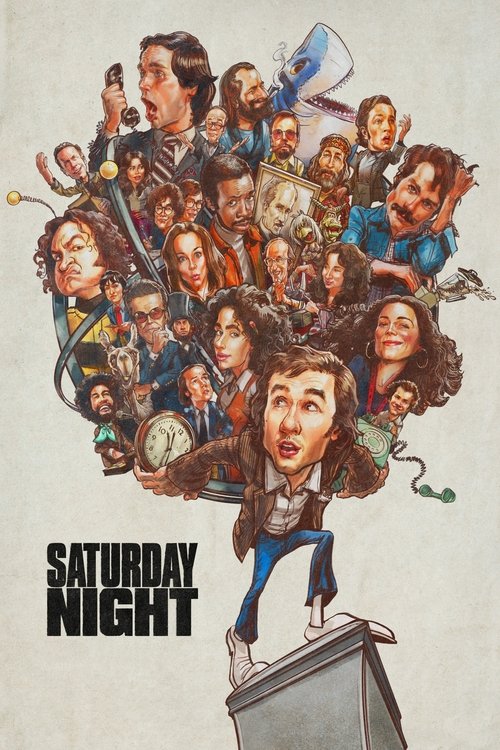
Jason Reitman's comedy plays out almost in real time on 11 October 1975, as Lorne Michaels tries to get his new late-night show, Saturday Night, on the air at 11:30. The lights fail, the lighting director quits, John Belushi will not sign his contract, the host hates the sketches, the censor is circling, and NBC's executives have a Johnny Carson rerun cued up in case it all falls apart.
The messaging sits in a few side threads. Garrett Morris, a Juilliard-trained playwright, keeps asking why he was hired and complains that he is there to play the butler, the shoeshine man and the pimp, and his sound-check song about shooting white people is cheered. Rosie Shuster, Lorne's wife and a writer on the show, tells Lorne that they are married but she is not his wife, and the question of whose surname she will use in the credits runs through the night. one of the actresses riffs on how commercials sell women, a rehearsal sketch has women in hard hats catcalling Dan Aykroyd in short shorts, and an NBC censor who calls herself a woman of God is baited by a writer with a blasphemous sketch pitch.
What keeps the score low is that none of this is the film's point. The story is the race to air, and each thread gets a scene or two between the fires. The film's irreverence runs in every direction: the opening auditions include a parody appeal for a white guilt fund, the young comedians are vain, cruel and high, Chevy Chase insults the affiliates to their faces, and the network man who has spent the night as an obstacle gets a fair hearing about the pressure he is under.
Score breakdown
Each category is scored 0 to 3: 0 absent or presence only, 1 brief, 2 recurring or plot-relevant, 3 central or dominant. Timestamps refer to the film's running time.
| Category | Score | What we saw |
|---|---|---|
| Content | ||
| A Race and ethnicity | 2 | Garrett Morris's sense that he was hired as a token and cast in stereotyped roles is a recurring thread, shown with sympathy, and the film ends it on his sound-check song rather than a resolution. No interracial couple appears.
|
| B Gender and feminism | 2 | Rosie Shuster's insistence on being seen as a writer rather than Lorne's wife recurs through the film and pays off in the credits, alongside a few women's-typecasting jokes and a role-reversal rehearsal sketch. It is character material, shown more than argued.
|
| C Sexuality and gender identity | 0 | No LGBTQ themes. Rosie's affair with Danny, which Lorne knows about (0:22:02), and the steady stream of sex jokes are shown without any message. |
| D Power and systems | 1 | NBC is a cynical corporate machine and the censors a nuisance, but as obstacles to a creative show, not as oppression of a group.
|
| E Cultural and historical revision | 0 | A dramatised true story, compressed and embellished for comedy. The real people are cast to type; nothing is recast to carry a message. |
| F Religion portrayal | 0 | Islam does not appear. The only religious figure is the Christian censor (see G). |
| Treatment | ||
| G Antagonist coding | 1 | The NBC censor, a self-described woman of God fighting vulgarity, sex, communism and hedonism, is the one antagonist defined by her conservatism, and she is a running punchline. The other obstacles, the network men, Carson and Milton Berle, have their own motives.
|
| H Didacticism | 1 | Garrett's complaint is the nearest thing to a statement of the theme, and it is a personal grievance in a single scene.
|
| I Message over story | 0 | The story leads: every scene serves the countdown to air, and the side threads never redirect it. |
| J Left-leaning politics framed as good | 1 | The young counterculture against the stuffy establishment is the film's frame, and its one religious conservative is a joke, but almost no actual politics is argued; the revolution talk is played for laughs.
|
How the number is reached
- Categories A to J add up to 8 of 30, which gives 2.5 (8 ÷ 30 × 10, rounded to the nearest 0.5).
- Counterweight −0.5: The film mocks everyone, its own side included: the opening auditions include a parody appeal to a 'White Guilt Relief Fund' (0:02:07); the comedians are vain, cruel and drug-addled (0:08:11, 1:11:51); O'Donoghue is told off for baiting the censor (0:36:41); Chevy's sneering at the Southern affiliates is shown as boorish (0:25:58); and Ebersol, the network man, is given a fair hearing about how hard he has fought for the show (1:17:05).
- Final rating 2.0, mild.
Considered, scored 0
- A mostly white 1975 cast and crew with Garrett Morris and Billy Preston's band, shown without comment.
- Rosie's relationship with Danny while married to Lorne (0:22:02, 1:05:39), shown without commentary on sexual freedom.
- Jewish-identity jokes about the writers' room (0:26:17), a 'funny gentile' (0:29:22) and Lorne's birth name (1:26:29).
- Heavy drug use backstage (0:17:24, 0:53:41, 1:35:28), shown as period colour rather than a message.
- The crude jokes aimed at Mr Rogers, the Muppets and Julia Child, which are shock comedy rather than social commentary.
Evidence and confidence
Confidence: Medium. Full English subtitles from the embedded British English track, including the song lyrics, and 109 frames sampled once a minute, the last several of them end credits. Several scenes are fast overlapping chatter that the subtitles condense, but no gaps in the dialogue were found.
Category F definition: As in the rubric: Islam shown as a peaceful and tolerant religion, aligned with human rights, in a way that works as a corrective message.
Rubric version 1. Reviewed 18 November 2026.