Woke rating
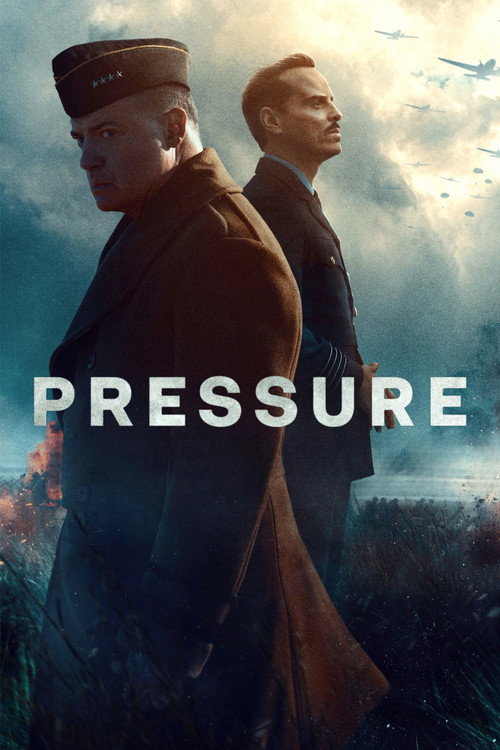
Pressure
None or negligible
A tense D-Day drama about the weatherman who had to tell Eisenhower when to invade, with almost no progressive messaging: Kay Summersby's wry independence is the only light thread, shown through character and true to the period.
The film covers the three days before D-Day at Southwick House, the Allied headquarters, where Group Captain James Stagg (Andrew Scott), the Scottish chief meteorological officer, must give General Eisenhower (Brendan Fraser) a forecast for the invasion. Stagg reads two Atlantic storms bearing down on Normandy; the American forecaster Colonel Irving Krick trusts historical analog charts that promise calm, sunny weather; Montgomery wants to go whatever the weather. Kay Summersby, Eisenhower's driver and aide, stands between the general and his staff.
The rubric finds little to work with. Kay gets a wry line about men and the word 'genius', a past as a Blitz ambulance driver, and a scene in which she tells her boss he is treating Stagg badly. A key weather reading comes from a woman at a remote Irish station, named once. Stagg's speech to the commanders, that the storms are real and ignoring them will cost lives, is about the forecast in front of them. The rest is the decision itself and its cost, with a personal crisis for Stagg running alongside.
The rubric finds little to work with. Kay gets a wry line about men and the word 'genius', a past as a Blitz ambulance driver, and a scene in which she tells her boss he is treating Stagg badly after the hospital where Stagg's wife is giving birth is bombed. A key weather reading comes from a woman at a remote Irish station, named once. Stagg's speech to the commanders, that the storms are real and ignoring them will cost lives, is about the forecast in front of them. Eisenhower postpones the invasion, Stagg finds a gap in the storms for Tuesday 6 June, the landings succeed at heavy cost, and Stagg is driven to the hospital, where his wife and newborn son are alive.
What keeps the score near zero is that the history is played straight. Kay's moments are character, not argument, and fit the period; Krick and Montgomery are rivals with professional reasons, not stand-ins for a group; and the prayer service before the invasion and Eisenhower's order of the day are treated with respect. With only one light thread, there is nothing for a counterweight to offset.
Score breakdown
Each category is scored 0 to 3: 0 absent or presence only, 1 brief, 2 recurring or plot-relevant, 3 central or dominant. Timestamps refer to the film's running time.
| Category | Score | What we saw |
|---|---|---|
| Content | ||
| A Race and ethnicity | 0 | Race never comes up. The staff and commanders in the dialogue and the sampled frames are British and American officers and servicewomen, shown without comment, and no interracial couple appears. |
| B Gender and feminism | 1 | A light thread: Kay Summersby is capable, wry and willing to push back at Eisenhower, with one quip about men. It is shown through character, never argued, and fits the period.
|
| C Sexuality and gender identity | 0 | No LGBTQ+ characters or themes. The closeness between Eisenhower and Kay (0:37:53, 1:18:42) is shown discreetly, without comment. |
| D Power and systems | 0 | Command is shown as fallible: Montgomery says he may have to sacrifice his whole advance brigade (0:26:34) and Eisenhower is haunted by the deaths in Exercise Tiger (0:36:43). These are wartime costs and personal failings, not a critique of the military as an oppressor of a group. |
| E Cultural and historical revision | 0 | Based on the real dispute over the D-Day forecast, adapted from David Haig's stage play; a closing card notes Stagg's Legion of Merit (1:34:30). No established character or history is recast to carry a message. |
| F Religion portrayal | 0 | Islam does not feature. Christian worship is shown respectfully in a hymn and prayer service before the invasion (1:05:38). |
| Treatment | ||
| G Antagonist coding | 0 | The enemy is the German army, seen only as a threat across the Channel. The rivals at home have professional motives: Krick trusts the analog method that served him in North Africa (0:22:32), and Montgomery fears the enemy will see through the deception if the invasion slips (0:25:54). |
| H Didacticism | 0 | No speeches carry a social message. Stagg's address to the commanders (0:57:43) argues the forecast, and Eisenhower's order of the day (1:20:21) is the historical text. |
| I Message over story | 0 | The story follows the forecast hour by hour to the decision, and none of its turns bends toward a message. |
| J Left-leaning politics framed as good | 0 | No political positions are argued. The film's frame is the Allied fight against Nazi tyranny (1:21:14), told without modern commentary. |
How the number is reached
- Categories A to J add up to 1 of 30, which gives 0.5 (1 ÷ 30 × 10, rounded to the nearest 0.5).
- No counterweight: There is too little progressive messaging to mock or complicate; the one light thread is not argued.
- Final rating 0.5, none or negligible.
Considered, scored 0
- The key reading from Blacksod Point, recorded by a Miss Maureen Sweeney (1:11:23), a historical detail named once, not framed as a point about women.
- Women staffing the signals office and the forecast room (frame 0:07:30, 0:47:28), shown without comment.
- Stagg's speech that the storms are real and that ignoring the evidence will cost countless lives (0:58:42), which is about a 1944 forecast; the film draws no modern parallel.
- Montgomery's readiness to sacrifice his advance brigade (0:26:34) and Eisenhower's guilt over Exercise Tiger (0:36:43), wartime costs rather than a critique of the military.
Evidence and confidence
Confidence: Medium. Full English subtitles from the embedded track, and 100 frames sampled once a minute. The frames come from an HDR source and look dark and washed out, so some faces and the night scenes are hard to make out (for example 0:50:30 to 0:52:30). The film opens with about two minutes without dialogue.
Category F definition: As in the rubric: Islam shown as a peaceful and tolerant religion, aligned with human rights, in a way that works as a corrective message.
Noted, not scored: Christian faith and patriotism are shown sympathetically: a hymn and a prayer for the nation's peace and the departed before the invasion (1:05:38, 1:07:12), and Eisenhower's order of the day, which speaks for liberty-loving people everywhere (1:20:54) and asks God's blessing on the undertaking (1:22:50).
Rubric version 1. Reviewed 18 November 2026.