Woke rating
Pineapple Express
None or negligible
A stoner action comedy with no identity messaging; its one political note is the hero's quick pitch for legalising marijuana, which the film itself pokes holes in.
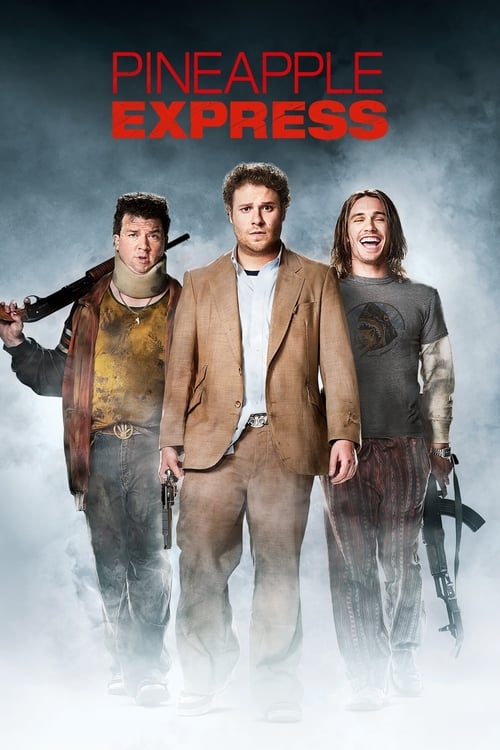
David Gordon Green's stoner action comedy follows Dale Denton (Seth Rogen), a process server who smokes his way through the working day, and his dealer Saul (James Franco). Waiting outside a house to serve papers, Dale sees the drug lord Ted Jones and a police officer kill a man, panics, and leaves behind a roach of Pineapple Express, a rare strain only Saul sells. The two go on the run, pursued by Ted's hitmen while Ted fights a turf war with an Asian gang, and the film is mostly chases, fights and the bickering friendship between the two leads.
The one piece of messaging comes in the opening minutes, when Dale phones a talk-radio show to say that if marijuana is not legal within five years he will lose faith in humanity, and that the current system only puts money in criminals' hands. It is never argued again. A black-and-white prologue in which the Army tests marijuana on a private in 1937 and then buries the project is a spoof of official secrecy, and the crooked officer on Ted's payroll is a genre villain, not a comment on the police.
What keeps the score at zero is that the film undercuts its own hero: the radio host cuts him off, his habit drags him into a murder plot, his girlfriend blames his 'addiction', and Dale admits they are not very functional when high. Race, sex and sexuality come up only as jokes, and the villains are a drug lord, his hired guns and a rival gang, all after money and turf.
Score breakdown
Each category is scored 0 to 3: 0 absent or presence only, 1 brief, 2 recurring or plot-relevant, 3 central or dominant. Timestamps refer to the film's running time.
| Category | Score | What we saw |
|---|---|---|
| Content | ||
| A Race and ethnicity | 0 | No race message and no interracial couple: Dale, Angie and her parents are white. The rival Asian gang are genre villains whom the characters describe by ethnicity in jokes, and the Black hitman Matheson and the Latina officer Carol appear without comment. |
| B Gender and feminism | 0 | No gender point. Carol is as ruthless as the men she works with, and Angie stands up to Dale, without any comment on women; a school liaison officer is a comic figure. |
| C Sexuality and gender identity | 0 | No LGBTQ+ content beyond jokes: the bromance gags between Dale and Saul, a crude line when Red and Saul make up, and Dale's jab that Angie will become a lesbian at college. Dale says weed makes sex better, but nothing is advocated. |
| D Power and systems | 0 | Ted has a corrupt police officer on his payroll and the prologue jokes about Army secrecy, but both are plot devices. No institution is shown oppressing a group, and a school officer who helps Dale suspects her own department (1:03:03). |
| E Cultural and historical revision | 0 | An original screenplay. Nothing is recast or revised. |
| F Religion portrayal | 0 | Islam does not appear. Red's line that he is into Buddhism (1:19:39) is a joke about reincarnation. |
| Treatment | ||
| G Antagonist coding | 0 | The villains are a drug lord, his crooked officer, two hitmen and a rival gang, all driven by money and turf. None is defined by a majority or ideological group. |
| H Didacticism | 1 | One scene states a position directly: Dale's call to a talk-radio show for legalising marijuana. Nothing else is argued.
|
| I Message over story | 0 | The story leads throughout: a chase comedy with nothing bent toward a message. |
| J Left-leaning politics framed as good | 1 | Legalising marijuana is the film's one political stance, voiced by its hero in the opening radio call. It is a cause of the left and of libertarians alike, the film never returns to it, and it later lets Dale concede the drug's downside, so 1.
|
How the number is reached
- Categories A to J add up to 2 of 30, which gives 0.5 (2 ÷ 30 × 10, rounded to the nearest 0.5).
- Counterweight −0.5: the film pokes holes in its hero's case: the radio host cuts Dale off (0:06:57), Angie blames the danger to her family on his addiction to marijuana (1:07:44), and Dale tells Saul the car chase and gunfire happened because they were high, adding that they are not very functional when high, which is all the time (1:09:33, 1:09:48).
- Final rating 0.0, none or negligible.
Considered, scored 0
- The rival Asian gang and Red's confusion over who counts as Asian (0:23:59, 0:47:11), genre villains and a joke, not a statement about race.
- Saul's bubby and the bar mitzvah bong from Tel Aviv (0:42:13), and Red's aside that Denton 'might have been a Jew' (0:48:53), played for laughs.
- Matheson, a Black hitman, the Latina officer Carol and a Black school liaison officer (frames 0:48:30, 0:56:30, 1:01:30), shown without comment.
- Bromance jokes between Dale and Saul (1:24:33, 1:25:49), a crude 'I want to be inside you' when Red and Saul make up (1:39:27) and Dale's jab that Angie will become a lesbian (1:08:31), comedy with no message about sexuality.
- The 1937 prologue in which the Army tests marijuana on a private and then buries the project (0:01:00 to 0:03:59), a spoof of official secrecy.
- Ted's crooked police officer (0:23:56, 0:53:19), a genre villain rather than a comment on the police.
Evidence and confidence
Confidence: Medium. The file has no English text subtitles, so the dialogue comes from a Whisper transcript of the English audio. It covers the whole film but garbles some names and lines (Saul sometimes comes out as 'Sal' or 'Salt'), repeats one line several times (1:41:40 to 1:41:53), and marks the rival gang's lines in an Asian language as untranslated (0:57:00, 1:26:42); one frame shows the film's own burned-in English subtitle for them (1:28:30). 112 frames sampled once a minute, the last four of them end credits.
Category F definition: As in the rubric: Islam shown as a peaceful and tolerant religion, aligned with human rights, in a way that works as a corrective message.
Rubric version 1. Reviewed 18 November 2026.