Woke rating
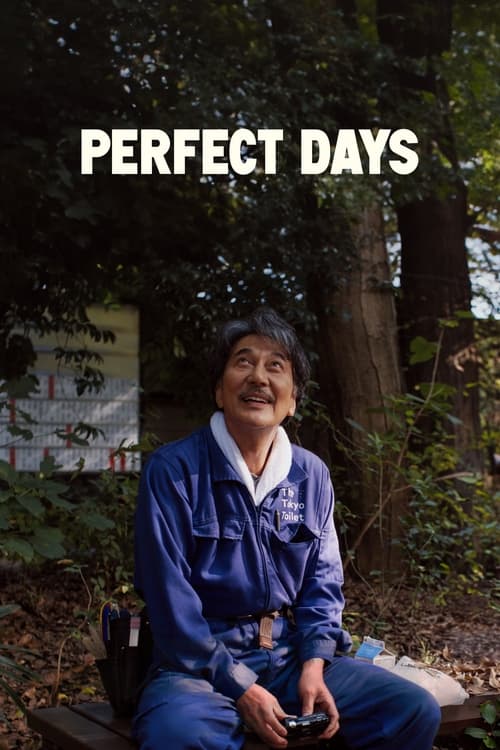
Perfect Days
None or negligible
A quiet, mostly wordless Tokyo drama about a contented public-toilet cleaner and his daily routine, with no social or political messaging.
Wim Wenders's Tokyo drama follows Hirayama (Koji Yakusho), a quiet, middle-aged man who cleans the city's architect-designed public toilets. Most of the film is his routine, mostly without words: watering seedlings at dawn, the drive to work with old rock and soul on cassette, lunch under the trees where he photographs the light through the leaves, the public bath, a cheap paperback before sleep. The routine is broken by his talkative young colleague Takashi and a visit from his teenage niece Niko.
There is nothing here for the rubric to score. Class shows up but is not argued. Takashi grumbles that you cannot even be in love without money (0:38:02), and a family visit hints at a more comfortable background Hirayama has left behind, without saying why. Bar banter about everyone being equal (1:08:03) is a joke about portion sizes.
There is nothing here for the rubric to score. Class shows up but is not argued. Takashi grumbles that you cannot even be in love without money (0:38:02). Hirayama's sister arrives in a chauffeured car, asks whether he really cleans toilets (1:32:48) and urges him to visit their father in his nursing home (1:32:29), but the film never explains the rift and draws no point from it. Bar banter about everyone being equal (1:08:03) is a joke about portion sizes.
The score is zero because the film observes and never argues. Its subjects are routine, music, books, trees and the people Hirayama meets, among them the bar owner's ex-husband, who is dying of cancer and asks Hirayama to look after her (1:50:23, 1:51:56). No one is cast as a villain, and the long wordless stretches leave no room for speeches.
Score breakdown
Each category is scored 0 to 3: 0 absent or presence only, 1 brief, 2 recurring or plot-relevant, 3 central or dominant. Timestamps refer to the film's running time.
| Category | Score | What we saw |
|---|---|---|
| Content | ||
| A Race and ethnicity | 0 | Race never comes up. The cast is Japanese, and no interracial couple appears in the dialogue or the sampled frames. |
| B Gender and feminism | 0 | Gender is not argued. The bar owner's banter with her regulars about fussy men and nagging wives (1:08:12, 1:08:55) is small talk. |
| C Sexuality and gender identity | 0 | No sexuality theme. Takashi's crush on Aya (0:35:04, 0:54:34) is the only romance. |
| D Power and systems | 0 | No institution is criticised. Takashi's complaint that love costs money (0:38:02) and a relative's comfortable lifethe sister's chauffeured car and her surprise at Hirayama's job (1:32:48) touch on class but stay character detail. |
| E Cultural and historical revision | 0 | An original story. No established characters or history are recast. |
| F Religion portrayal | 0 | Islam does not come up. A joke at a bar about respecting other people's teams and religions (0:26:14) is banter during a baseball game. |
| Treatment | ||
| G Antagonist coding | 0 | There are no villains. The only friction is family estrangement and a careless colleaguefamily estrangement and Takashi quitting without notice, which leaves Hirayama to cover his shift (1:36:14). |
| H Didacticism | 0 | No speeches carry a social message. The nearest thing to a statement is Hirayama telling Niko that the world is made of many worlds, some connected and some not (1:28:37), a remark about his family. |
| I Message over story | 0 | The film is a slice-of-life study, and nothing in it bends toward a message. |
| J Left-leaning politics framed as good | 0 | No political positions appear at all. |
How the number is reached
- Categories A to J add up to 0 of 30, which gives 0.0 (0 ÷ 30 × 10, rounded to the nearest 0.5).
- No counterweight: There is no progressive messaging to mock or complicate.
- Final rating 0.0, none or negligible.
Considered, scored 0
- Takashi's complaint that in this world you cannot even be in love without money (0:38:02), a young man's grumble about his own finances.
- A family visit that hints at a class gap, shown as family history rather than a point about inequality.The class gap between Hirayama and his sister, who arrives in a chauffeured car and asks whether he really cleans toilets (1:31:00, 1:32:48, frames 1:32:30, 1:33:30), shown as family history rather than a point about inequality.
- Bar banter about everyone being equal (1:08:03), a joke about portion sizes.
- Takashi's friend Dera-chan, who greets him by playing with his ears (0:55:14, frame 0:55:30), shown warmly and without comment.
- The architect-designed public toilets and The Tokyo Toilet uniforms (frames 0:08:30, 0:12:30), shown as setting.
- Hirayama's love of trees and the light through leaves (frames 0:15:30, 0:16:30), an aesthetic interest with no environmental message.
Evidence and confidence
Confidence: Medium. The dialogue comes from the embedded English subtitle track, flagged as forced, which holds the complete dialogue of this Japanese film. There is very little speech: the first line comes at 0:10:59, and long stretches are wordless. The 125 frames sampled once a minute cover those stretches; the last five are end credits. The English-language songs Hirayama plays on cassette are not transcribed.
Category F definition: As in the rubric: Islam shown as a peaceful and tolerant religion, aligned with human rights, in a way that works as a corrective message.
Rubric version 1. Reviewed 18 November 2026.