Woke rating
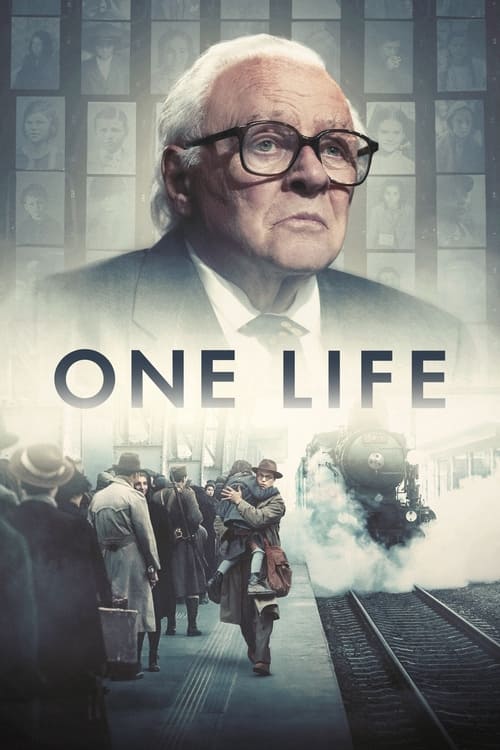
One Life
None or negligible
A gentle true-story drama about Nicholas Winton's rescue of children from Prague in 1939, whose plea for refugees is framed as ordinary British decency, with only brief nods to present-day politics.
James Hawes's film, based on a true story, moves between two times. In 1987 the elderly Nicholas Winton (Anthony Hopkins) is clearing out his house in Maidenhead before his first grandchild is born and cannot bring himself to throw away an old scrapbook. In the winter of 1938 the young stockbroker Winton (Johnny Flynn) goes to Prague, sees refugee families camped in the mud after the Sudetenland is handed to Hitler, and sets up a children's section with Doreen Warriner and Trevor Chadwick, while his mother Babette (Helena Bonham Carter) works the Home Office in London to get visas and foster homes for children taken out by train.
The messaging is light and mostly framed as plain decency. The film opens in 1987 with a TV news item about Tamil asylum seekers protesting their deportation, beside Winton grumbling about deregulation, and young Winton calls himself a European, an agnostic and a socialist. The British government's refusal of visas and the Home Office's red tape recur as obstacles, and two speeches, Babette's and Winton's to an official, argue directly that Britain owes these children a temporary home. The 1987 half is about memory and what Winton did with his scrapbook.
The messaging is light and mostly framed as plain decency. The film opens in 1987 with a TV news item about Tamil asylum seekers protesting their deportation, beside Winton grumbling about deregulation, and young Winton calls himself a European, an agnostic and a socialist. The British government's refusal of visas and the Home Office's red tape recur as obstacles, and two speeches, Babette's and Winton's to an official, argue directly that Britain owes these children a temporary home. The 1987 half is about memory and guilt over the ninth train, stopped when war broke out, and it ends with the BBC show That's Life! surprising Winton with the people he rescued.
What keeps the score near zero is that the cause is rescuing children from Nazi persecution, and the film presents it as what ordinary British people did, not as a partisan position. The officials who stall come round and help, Girl Guides, a magazine and foster families pay and take the children in, Babette's speech praises Britain's decency, and a rabbi's worry about separating Jewish children from their faith gets a fair hearing. The modern-politics hooks last a few seconds.
Score breakdown
Each category is scored 0 to 3: 0 absent or presence only, 1 brief, 2 recurring or plot-relevant, 3 central or dominant. Timestamps refer to the film's running time.
| Category | Score | What we saw |
|---|---|---|
| Content | ||
| A Race and ethnicity | 0 | The persecution of Jews is the historical backdrop, and Winton's Jewish ancestry comes up in one scene, but race and identity politics are not argued. No interracial couple appears. |
| B Gender and feminism | 0 | Babette, Doreen Warriner and Hana are capable women at the heart of the rescue (0:12:17, 0:26:51), shown as history, not argued as a point about gender. |
| C Sexuality and gender identity | 0 | No LGBTQ content. |
| D Power and systems | 1 | The British government's reluctance to admit refugees and the Home Office's paperwork recur as obstacles. It is drawn as red tape and caution rather than oppression of a group, and the officials come round and help.
|
| E Cultural and historical revision | 0 | Based on a true story and told straight; the opening cards set out the 1938 handover of the Sudetenland (0:01:10) and the closing cards give the real people's fates (1:41:12). No characters are recast by sex or ethnicity. |
| F Religion portrayal | 0 | Islam does not appear. Judaism appears through a rabbi's questions and a Hebrew saying (0:25:04), with no corrective message. |
| Treatment | ||
| G Antagonist coding | 0 | The villains are the Nazis, a historical enemy shown mostly through flags, soldiers and news of arrests, not a modern demographic or ideological out-group. The British officials who stall are not villains. |
| H Didacticism | 1 | Two speeches state the case for taking in refugee children directly, though both are pleas the situation calls for and appeal to British values rather than attack them.
|
| I Message over story | 0 | The story leads; it follows the historical rescue and Winton's later reckoning with it. |
| J Left-leaning politics framed as good | 1 | A few brief touches link the story to present-day politics and give the hero a left-leaning identity. They are passing lines, not a theme.
|
How the number is reached
- Categories A to J add up to 3 of 30, which gives 1.0 (3 ÷ 30 × 10, rounded to the nearest 0.5).
- Counterweight −0.5: The film gives the other side a hearing and credits Britain rather than blaming it: the Home Office official agrees to help (0:40:48, 1:08:27), Babette's plea is built on praise of British decency (0:28:33), Girl Guides, Picture Post and foster families fund and take in the children (0:42:44, 0:48:34), and the rabbi's concern about separating Jewish children from their families and faith is treated seriously (0:21:33).
- Final rating 0.5, none or negligible.
Considered, scored 0
- The Nazi persecution of Jews and the threat of invasion, the historical core of the story (0:18:25, 1:07:02), told as history.
- The rabbi's questions about Jewish foster homes and Winton's Jewish grandparents (0:21:43, 0:23:15), part of the real negotiation for the children's lists.
- Doreen Warriner, Hana and Babette as capable women driving the rescue (0:12:17, 0:14:14, 0:26:51), shown, not argued.
- The Netherlands closing its borders to Jewish refugees and appeasement of Hitler (0:35:51, 0:19:26), stated as historical fact.
- The Talmudic saying 'save one life, save the world' (0:57:30), the film's theme, with no political message attached.
- The fate of the children's familiesVera's account of her parents' deaths in the camps (1:28:39), told as history.
- Closing cards: over 6,000 people are alive today because of the rescue (1:41:36), and the studio audience in the film is made up of some of them (1:41:42).
Evidence and confidence
Confidence: Medium. Full English subtitles from the embedded track, 109 frames sampled once a minute, and about 30 targeted frames of the opening and closing title cards and the border inspection on the train. A few Czech and German exchanges, such as the soldiers checking papers on the train (1:06:39 to 1:07:02), carry little or no subtitled dialogue; the frames cover them.
Category F definition: As in the rubric: Islam shown as a peaceful and tolerant religion, aligned with human rights, in a way that works as a corrective message.
Noted, not scored: The film credits British decency and ordinary Britons for the rescue (0:28:33, 0:42:44), and the closing cards honour Winton's knighthood from Queen Elizabeth II (1:41:00).
Rubric version 1. Reviewed 18 November 2026.