Woke rating
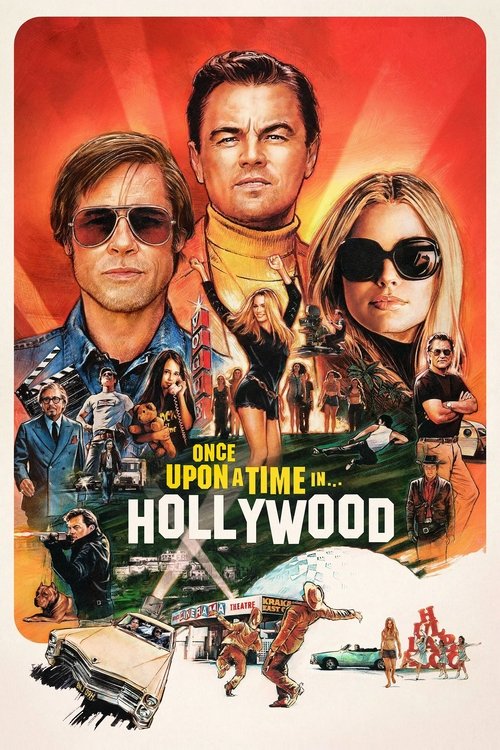
Once Upon a Time... in Hollywood
None or negligible
Tarantino's 1969 Hollywood fable has next to no progressive messaging: its one such line comes from a precocious child actor, and its sympathies lie with two old-Hollywood men against the hippie counterculture.
Quentin Tarantino's film spends a few days in 1969 Los Angeles with Rick Dalton (Leonardo DiCaprio), a fading TV cowboy afraid his career is over, and Cliff Booth (Brad Pitt), his stunt double, driver and friend. Next door live Roman Polanski and Sharon Tate (Margot Robbie), whose star is rising, and on the edge of town the Manson family has moved onto the Spahn Movie Ranch, where Rick and Cliff once shot westerns. Most of the film is a hangout: Rick fighting his nerves on the set of a western pilot, Cliff driving and fixing things, Sharon watching herself in a cinema.
There is almost nothing for the rubric to count. The only progressive line comes from Rick's eight-year-old co-star, a method actor who prefers 'actor' to 'actress', and the film plays her earnestness partly for comedy. Race comes up only as period colour: casual slurs in character and in the western being filmed, a boastful Bruce Lee, and the titles of Rick's Italian films, none of it commented on either way. No interracial couple was seen.
What politics the film has run the other way. The hippies are the threat: the Manson followers sneer at actors and at a TV star they call a fascist, and the film sides with its two old-Hollywood heroes against them. The finale's rewriting of history carries no progressive message. These points are noted, not scored.
What politics the film has run the other way. The hippies are the threat: the Manson followers sneer at actors and at a TV star they call a fascist, and the film sides with its two old-Hollywood heroes against them. The finale rewrites history: the killers go to Rick's house instead of Sharon Tate's, Cliff, his dog and Rick kill them in a gory, comic climax, and Sharon lives. That revision carries no progressive message. These points are noted, not scored.
Score breakdown
Each category is scored 0 to 3: 0 absent or presence only, 1 brief, 2 recurring or plot-relevant, 3 central or dominant. Timestamps refer to the film's running time.
| Category | Score | What we saw |
|---|---|---|
| Content | ||
| A Race and ethnicity | 0 | No message about race, and no interracial couple was seen in the dialogue or frames. Period racial language comes up in character and in the western being filmed, with no comment either way (see zeroed). |
| B Gender and feminism | 1 | One line: Rick's eight-year-old co-star says 'actress' is a nonsensical word. It is a character beat for a precocious child, not taken further.
|
| C Sexuality and gender identity | 0 | No LGBTQ content. The hippies' sexual openness is shown in a sinister light, and Cliff turns down an underage hitchhiker's offer (1:25:13). The narrator's line that Cliff is more than a brother and a little less than a wife to Rick (2:03:25) is about friendship. |
| D Power and systems | 0 | No institution is criticised as oppressive. The only anti-establishment talk comes from the Manson followers (1:24:28, 2:17:34), and the film treats it as the villains' delusion. The talk of how TV networks use fading stars (0:12:10) is about careers. |
| E Cultural and historical revision | 0 | The film portrays real people freely, among them Sharon Tate, Bruce Lee and the Manson followers, and rewrites history in its finalerewrites the Tate murders so that they never happen, but none of this carries a progressive message. |
| F Religion portrayal | 0 | Islam does not come up, and religion plays no part in the story. |
| Treatment | ||
| G Antagonist coding | 0 | The villains are the Manson followers, a real cult, not one of the out-groups the rubric names. If anything the coding is reversed: the threat comes from the counterculture, and the heroes are two white men from old Hollywood. |
| H Didacticism | 0 | No lecture-style dialogue for any progressive point. The one speech with a message is a villain's rantSadie's rant about killing the people who taught them to kill (2:17:22), and the film does not endorse it. |
| I Message over story | 0 | The story leads. It follows Rick's career, Cliff's errands and Sharon's days toward a climax that serves the fable, not a messagea climax that rewrites history as a fairy tale, not as a message. |
| J Left-leaning politics framed as good | 0 | Left-leaning politics are not framed as good. The counterculture is mocked and feared (see notScored), and the Vietnam war is only news on the car radio. |
How the number is reached
- Categories A to J add up to 1 of 30, which gives 0.5 (1 ÷ 30 × 10, rounded to the nearest 0.5).
- Counterweight −0.5: The single progressive line belongs to an eight-year-old whose method-actor seriousness is played partly for comedy (0:55:24, 0:59:27), and the film gives the opposite outlook far more room: its heroes are two old-fashioned men who scorn the hippies (2:15:45).
- Final rating 0.0, none or negligible.
Considered, scored 0
- Period racial language in character: Cliff telling Rick not to cry in front of the Mexicans (0:14:20), Bruce Lee's line about the 'colored boxer' (0:44:56), Rick's improvised slur in the western scene, which the director praises as an alliterative improv (1:30:36, 1:32:05), and a Rick film based on a novel titled The Only Good Indian Is a Dead Indian (2:00:13). Neither endorsed nor rebuked.
- Bruce Lee shown as boastful and thrown into a car by Cliff in a sparring match (0:44:05, 0:49:06), a portrayal of a real person with no message attached.
- Vietnam casualties and the Kennedy assassination trial in radio news (0:14:47, 0:15:00), period backdrop.
- Sharon Tate's scenes, mostly wordless, of a young actress enjoying her career and her audience (1:05:30, 1:06:30), with no comment on women in Hollywood.
Evidence and confidence
Confidence: Medium. Full English subtitles from the file's embedded track, covering the dialogue and the narrator, plus 161 frames sampled once a minute. Several wordless stretches (Sharon Tate's errands, the drives across town, parts of the final night) rest on the frames alone.
Category F definition: As in the rubric: Islam shown as a peaceful and tolerant religion, aligned with human rights, in a way that works as a corrective message.
Noted, not scored: The film's sympathies run against the counterculture: the hitchhiker says actors are phony while real people die in Vietnam (1:24:28), Rick calls the Manson followers dirty hippies (2:15:45), and they call him a fascist and plan to kill the Hollywood rich who 'taught us to kill' (2:17:09, 2:17:47); the heroes then kill them, and the film plays it for gory comedy. The hero Cliff is widely believed to have killed his wife, and the film treats the rumour as dark comedy rather than settling it (0:42:38, 0:42:55, 0:47:30).
Rubric version 1. Reviewed 18 November 2026.