Woke rating
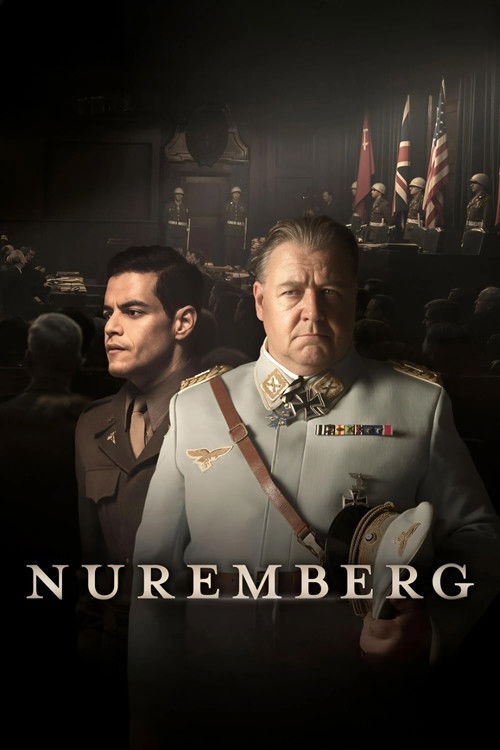
Nuremberg
None or negligible
A Nuremberg trial drama built around a US Army psychiatrist and Hermann Göring that presents Nazi crimes as history; its only pointed touches are a scene about the wartime Church and a late warning that people like the Nazis exist in every country.
James Vanderbilt's drama, based on Jack El-Hai's book The Nazi and the Psychiatrist, follows Douglas Kelley (Rami Malek), the US Army psychiatrist sent in 1945 to keep the captured Nazi leaders sane and alive for trial, and his long sessions with Hermann Göring (Russell Crowe). Alongside, Justice Robert Jackson (Michael Shannon) fights to get the first international war-crimes tribunal off the ground and then has to face Göring in court. Kelley's interpreter, Sergeant Howie Triest (Leo Woodall), is the third lead.
The Holocaust and the Nazi race laws are the film's subject, and it shows them as history: Jackson walks Kelley through the Nuremberg Laws at the old rally grounds, and the court watches the liberation footage from the camps. What the rubric picks up is small. To win papal backing for the trial, Jackson confronts Pius XII over the Church's 1933 Concordat with Hitler and its failure to protect the Jews. And a late speech turns the story outward: Kelley warns that people like the Nazis exist in every country, America included, and that they will not arrive in scary uniforms.
The Holocaust and the Nazi race laws are the film's subject, and it shows them as history: Jackson walks Kelley through the Nuremberg Laws at the old rally grounds, the court watches the liberation footage from the camps, and Howie turns out to be a German Jew whose parents were sent to Auschwitz. What the rubric picks up is small. To win papal backing for the trial, Jackson confronts Pius XII over the Church's 1933 Concordat with Hitler and its failure to protect the Jews. And the film ends on a radio panel after the trial, where Kelley warns that people like the Nazis exist in every country, America included, and a producer tells him that trashing the country will not sell his book; a closing card says no one heeded his warnings and that he took his own life in 1958.
What keeps the score near zero is that none of this is pressed as present-day identity politics. The villains are historical men drawn as individuals, Göring above all, with a backstory, a family and a sharp wit. The heroes are flawed: Jackson gets the Pope's backing by something close to blackmail, and Kelley is vain and has an eye on a book deal. Race, sex and sexuality are not themes beyond the history itself.
Score breakdown
Each category is scored 0 to 3: 0 absent or presence only, 1 brief, 2 recurring or plot-relevant, 3 central or dominant. Timestamps refer to the film's running time.
| Category | Score | What we saw |
|---|---|---|
| Content | ||
| A Race and ethnicity | 0 | No present-day race message. Nazi antisemitism, the Nuremberg Laws and the camp footage are the historical subject, shown as history, and a late revelation about a character's background is told as personal history, and Howie's reveal that he is a German Jew whose parents died at Auschwitz is told as personal history. No interracial couple appears in the dialogue or frames. |
| B Gender and feminism | 0 | Women are few: Elsie, who argues the legal objections with Jackson; a reporter Kelley flirts with; and Göring's wife and daughter. None of it carries comment on gender. |
| C Sexuality and gender identity | 0 | No LGBTQ+ characters or themes. |
| D Power and systems | 1 | One scene: to win papal backing for the trial, Jackson confronts Pius XII over the Church's 1933 Concordat with Hitler and its failure to protect the Jews. It is pointed but brief, and Jackson's tactics are shown as ruthless. The Army's arrest of Göring's wife and child, which Kelley protests, is a humane point about the Allies, not a critique of a system.
|
| E Cultural and historical revision | 0 | Based on the real trial and on Jack El-Hai's nonfiction book about Kelley and Göring. Nothing is recast to carry a message; the casting of Kelley is noted under zeroed. |
| F Religion portrayal | 0 | Islam does not feature. Religion appears only in the scene with the Pope, scored under D. |
| Treatment | ||
| G Antagonist coding | 0 | The villains are the Nazi leaders, historical figures drawn as individuals. Göring gets a childhood story, a wife and daughter he loves, and a sharp intelligence; the film's thesis is that nothing sets him apart from other men. |
| H Didacticism | 1 | Most speeches are ones the story calls for: Jackson's history lesson at the rally grounds, his courtroom opening on 'racial hatred' and the rule of law (1:17:31), and Howie's account of his family. One late speechKelley's closing radio speech states a present-day warning directly.
|
| I Message over story | 0 | The story leads: a legal procedural and a two-hander between Kelley and Göring. A late sceneThe closing radio panel adds a warning but does not bend the plot. |
| J Left-leaning politics framed as good | 1 | Brief: a late speechthe closing scene turns the story into a warning about America and treats the objection to it as complacency. It is set in the 1940s and names no party or policy.
|
How the number is reached
- Categories A to J add up to 3 of 30, which gives 1.0 (3 ÷ 30 × 10, rounded to the nearest 0.5).
- Counterweight −0.5: The film complicates its own side and gives its villain real motives: the Pope's objection that an eye for an eye is not the answer gets a hearing (0:26:09), and a colleague asks Jackson whether he just blackmailed the Pope (0:28:29); Kelley, who delivers the late warning, is drawn as vain and careerist, eyeing a book deal (0:19:37) and passing Göring's confidences to the prosecution (1:13:18) and the press (1:35:21); and Göring is given individual motives, a family and a childhood story rather than ideology alone (0:38:26, 1:03:28).
- Final rating 0.5, none or negligible.
Considered, scored 0
- Rami Malek, an American actor of Egyptian descent, plays the real Douglas Kelley; the casting is not visibly a change of race and the film gives the character no ethnic marker, so it is not counted as a recast.
- Nazi antisemitism, from the defendants' slurs (0:16:05, 0:17:11) to the camp footage shown in court (1:24:42), presented as the historical record.
- The Army's arrest of Göring's wife and young daughter, which Kelley protests (1:22:17) and the commandant later reverses (1:35:46), a humane point about the Allies, not a political one.
- Göring's jabs at Allied hypocrisy over the interned Japanese and Hiroshima (0:57:55, 1:31:39), the defence's arguments, which Kelley answers (1:31:54).
- Jackson's opening statement that the new law must also bind the nations sitting in judgement (1:18:39), a courtroom speech the story calls for.
Evidence and confidence
Confidence: Medium. Full English subtitles from the embedded track, which also render the German dialogue as the interpreter Howie translates it, and 149 frames sampled once a minute. The opening two minutes have no subtitled dialogue, and a few short German lines (greetings, parts of the visit to Göring's family) are left untranslated; neither bears on the score. The closing title cards are covered by the frames.
Category F definition: As in the rubric: Islam shown as a peaceful and tolerant religion, aligned with human rights, in a way that works as a corrective message.
Noted, not scored: The film is a tribute to the American-led tribunal and to trial over summary execution (0:04:17, 0:54:03), and a soldier's account of enlisting and landing on D-DayHowie's account of waiting two years to be drafted and landing on Omaha Beach is plainly patriotic (1:39:49, 1:39:57).
Rubric version 1. Reviewed 18 November 2026.