Woke rating
Nightbitch
Mild
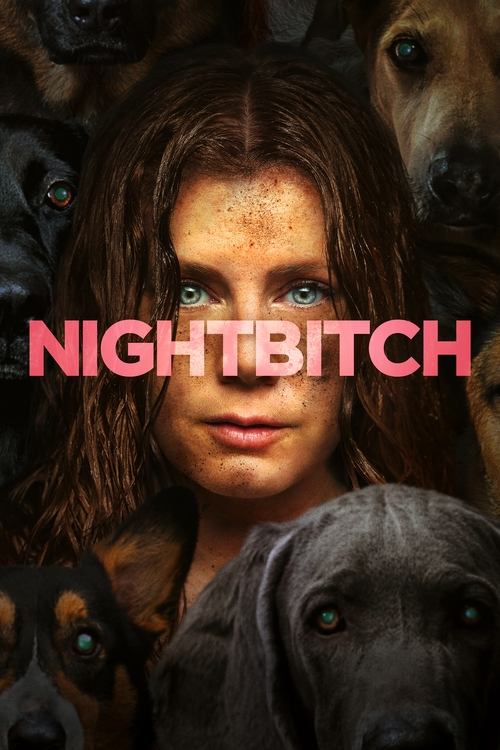
A dark comedy about a stay-at-home mother who suspects she is turning into a dog, built around an openly stated case about the gender expectations placed on mothers, though it gives her husband his say and ends up celebrating motherhood itself.
Marielle Heller's adaptation of Rachel Yoder's novel follows an unnamed artist (Amy Adams) who has left her gallery job to stay home with her two-year-old son while her husband (Scoot McNairy) travels for work. Exhausted and isolated, she notices sharper teeth, new hair and a keener sense of smell, and the film plays her suspicion that she is turning into a dog partly as body horror and partly as comedy.
The film states its subject openly. In the first scene she imagines telling a former colleague that societal norms and gender expectations have turned her into someone she does not recognise, and her narration later asks how many women have put off their greatness while the men around them kept theirs. At a library singalong she tells a pregnant mother that the motherhood women are sold is a lie, with no village, no state support and an industry built on guilt, and that men are terrified of women's power to make life. The marriage scenes run on the unequal split of the work at home, which she calls a 1950s marriage, and the story turns on her husband coming to see what she gave up.
The film states its subject openly. In the first scene she imagines telling a former colleague that societal norms and gender expectations have turned her into someone she does not recognise, and her narration later asks how many women have put off their greatness while the men around them kept theirs. At a library singalong she tells a pregnant mother that the motherhood women are sold is a lie, with no village, no state support and an industry built on guilt, and that men are terrified of women's power to make life. The marriage scenes run on the unequal split of the work at home, which she calls a 1950s marriage. After a blow-up the couple separate, the husband finds solo parenting hard, and at her comeback exhibition he tells her he never saw what she was giving up and should have told her not to quit.
What keeps it in the mild band is that the film makes neither spouse a type. The husband gets a real answer in their fight, pointing out that she agreed to stay home and never told him she was unhappy; she is cruel to him and to the family cat, and her scorn for the other mothers turns into friendship. The complaint is about the division of labour, not about motherhood, which the film ends up celebrating as primal and powerful. Race, sexuality and religion do not come into it.
Score breakdown
Each category is scored 0 to 3: 0 absent or presence only, 1 brief, 2 recurring or plot-relevant, 3 central or dominant. Timestamps refer to the film's running time.
| Category | Score | What we saw |
|---|---|---|
| Content | ||
| A Race and ethnicity | 0 | Race never comes up. The mother and her husband are both white, and no interracial couple was established in the dialogue or the sampled frames. |
| B Gender and feminism | 3 | The cost of motherhood to a woman's identity, and the gendered split of work at home, is the film's dominant theme. It is argued directly in imagined speeches, narration and a marriage fight, and the plot is built on the husband learning what she gave upthe husband's eventual admission that he never saw what she gave up.
|
| C Sexuality and gender identity | 0 | No LGBTQ themes. The couple's sex scene and her crude boasts are about her transformation, not sexual-freedom advocacy. |
| D Power and systems | 1 | One outburst blames the state, popular culture and a baby-products industry for failing mothers, with Germany's paid leave held up as the contrast. It is a single scene, not a recurring thread.
|
| E Cultural and historical revision | 0 | An adaptation of Rachel Yoder's 2021 novel. No established characters or history are recast. |
| F Religion portrayal | 0 | Islam does not feature, and religion appears only as a hymn in her childhood memories. |
| Treatment | ||
| G Antagonist coding | 1 | There is no villain. The nearest thing is the husband, drawn early on as a familiar type of the well-meaning man who does not see the work at home. Scored 1, not higher: he has his own pressures, gets his say in the fight and changeschanges his mind.
|
| H Didacticism | 2 | The message is stated outright several times, mostly in her own narration or in speeches. Scored 2, not 3: the opening speech is a fantasy she swallows, and the library outburst is played as awkward comedy.
|
| I Message over story | 1 | The story mostly leads, and the dog premise is an allegory rather than a bent plot. The last act ties the lesson up neatly: the husband struggles alone with their son, then apologises at her successful show.
|
| J Left-leaning politics framed as good | 2 | The traditional stay-at-home arrangement is framed as a trap inherited from the past, and an equal split of parenting as the answer, with state-funded maternity leave held up approvingly. The film does not turn against motherhood or family.
|
How the number is reached
- Categories A to J add up to 10 of 30, which gives 3.5 (10 ÷ 30 × 10, rounded to the nearest 0.5).
- Counterweight −0.5: The film gives the husband a fair hearing and does not flatter its heroine: he points out that quitting was her idea and that she told him everything was fine (1:11:53, 1:12:51); she threatens to rip his throat out (0:15:40) and keeps her son in a collar and dog bed (0:56:23); and her early contempt for befriending other mothers (0:06:26) gives way to a warm bond with thema warm evening of shared confessions with them (1:19:19).
- Final rating 3.0, mild.
Considered, scored 0
- The Book Babies mothers and the art-world friends include women of several ethnicities (frames 0:06:30, 0:34:30, 1:02:30), shown without comment.
- A mother's aside that she used to be a stripper (0:08:42) and the couple's sex scene (0:57:21): character moments, not advocacy.
- A successful friend credits her nanny for letting her balance art and motherhood (1:02:43), part of the heroine's sense of falling behind rather than an argument.
Evidence and confidence
Confidence: Medium. Full English subtitles from the embedded track, and 99 frames sampled once a minute. Two short bursts of speech in a dream sequence are not translated in the subtitles (0:29:47, 0:30:05), and several night scenes are too dark in the sampled frames to make out much.
Category F definition: As in the rubric: Islam shown as a peaceful and tolerant religion, aligned with human rights, in a way that works as a corrective message.
Noted, not scored: The film's view of motherhood is far from anti-family: she tells her son she loves being his mom (1:26:21) and will always come back (1:27:03), the narration calls a mother's love the most powerful in the universe (1:28:25), and the film ends with the family sleeping together in a blanket fort (1:34:06) and a birth scene (1:35:06).
Rubric version 1. Reviewed 18 November 2026.