Woke rating
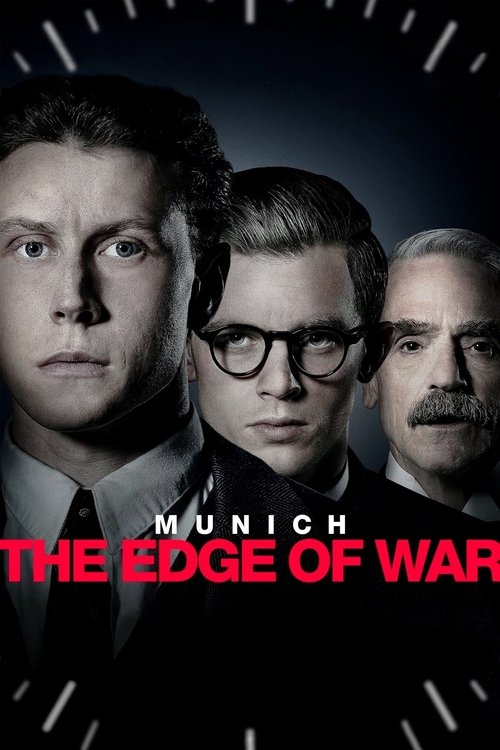
Munich - The Edge of War
None or negligible
A 1938 spy drama whose only modern touch is one pointed line from a typist; Nazi racism is shown as history, and the film's argument is about appeasement, not identity.
Christian Schwochow's adaptation of Robert Harris's novel follows two Oxford friends on opposite sides in September 1938: Hugh Legat (George MacKay), a junior private secretary to Neville Chamberlain (Jeremy Irons), and Paul von Hartmann (Jannis Niewöhner), a German diplomat secretly working against Hitler. Paul holds a document that proves Hitler's plans for conquest, and the two try to get it in front of Chamberlain at the Munich conference. Most of the film is diplomatic procedure and spy-thriller tension, with the German scenes subtitled.
The rubric finds very little. The one modern touch is Joan, a Downing Street typist who appears to be of South Asian heritage and tells Hugh, before he can ask, that she is from Nottingham. The rest is period: Nazi antisemitism is shown plainly, from Jews forced to scrub a Berlin pavement to the Stürmer on a café table, and a 1932 flashback has Paul defending Hitler's promise of national pride while his friend Lena warns that families are fleeing the country.
The rubric finds very little. The one modern touch is Joan, a Downing Street typist who appears to be of South Asian heritage and tells Hugh, before he can ask, that she is from Nottingham; she later turns out to be an MI6 colonel's niece sent to keep an eye on him. The rest is period: Nazi antisemitism is shown plainly, from Jews forced to scrub a Berlin pavement to the Stürmer on a café table, and a 1932 flashback has Paul defending Hitler's promise of national pride while his friend Lena warns that families are fleeing the country. Late in the film Paul shows Hugh what became of Lena, a Jew arrested at a protest and broken in a women's camp, and admits he once thought Hitler's racism could be put to one side.
Nothing here is argued as a present-day message. The villains are Hitler and his circle, drawn as individuals, and the film's real argument is about appeasement: it gives Chamberlain's case a sympathetic hearing and ends by suggesting that Munich bought Britain time. Race, sex and sexuality are otherwise not themes.
Score breakdown
Each category is scored 0 to 3: 0 absent or presence only, 1 brief, 2 recurring or plot-relevant, 3 central or dominant. Timestamps refer to the film's running time.
| Category | Score | What we saw |
|---|---|---|
| Content | ||
| A Race and ethnicity | 1 | One line: Joan, a typist who appears to be of South Asian heritage, heads off the question of where she is from. Nazi antisemitism runs through the film, but as the historical threat, not a present-day message.
|
| B Gender and feminism | 0 | Women have capable roles, from Frau Winter in the German resistance to Lena and Joan, who has been watching over Hugh for MI6, and Hugh's wife complains of his emotional distance (0:20:36) until he admits she was right (1:59:01). All of it is character drama, with no comment on gender. |
| C Sexuality and gender identity | 0 | No LGBTQ+ characters or themes. |
| D Power and systems | 0 | Hugh objects that the Czechs are not at the table while their country is carved up (1:05:20), and MI6 runs him behind the Prime Minister's back (0:47:03), but neither is framed as the oppression of a group; it is the history of the conference. |
| E Cultural and historical revision | 0 | An adaptation of Robert Harris's novel built around the real conference. Its fictional heroes and sympathetic Chamberlain are dramatic choices, not a recasting to carry a progressive message; Joan, a minor character, is noted under A. |
| F Religion portrayal | 0 | Islam does not feature. |
| Treatment | ||
| G Antagonist coding | 0 | The antagonists are Hitler and his circle, historical figures with their own vanity and motives: Hitler sulks that the crowds cheered Chamberlain more than him (1:50:12), and the SS man Franz Sauer has a personal rivalry with Paul (0:58:02). |
| H Didacticism | 0 | No speeches carry a progressive message. Paul's plea that Hitler is a monster who must not be appeased (1:25:41) and Chamberlain's case for peace (0:34:37) argue about war, not identity. |
| I Message over story | 0 | The story follows the conference and the document step by step, and none of its turns bends toward a message. |
| J Left-leaning politics framed as good | 0 | No left-leaning politics are framed as good. The film's argument is about appeasement, and it treats a Conservative Prime Minister's case with sympathy. |
How the number is reached
- Categories A to J add up to 1 of 30, which gives 0.5 (1 ÷ 30 × 10, rounded to the nearest 0.5).
- No counterweight: There is too little progressive messaging to mock or complicate; the one scored element is a single line.
- Final rating 0.5, none or negligible.
Considered, scored 0
- Nazi antisemitism shown as history: Jews forced to scrub a pavement (0:25:23), anti-Jewish graffiti (0:52:30) and the Stürmer (1:13:53), and Lena's fate as a Jewish prisoner (1:35:07).
- The 1932 argument in which Paul says voting for Hitler is not voting against Jews (0:49:18) and a passer-by says Hitler makes Germans proud again (0:49:37). The wording can echo present-day populism, but it stays in period and its target is Nazism, as does Paul's later admission that he thought Hitler's racism could be put to one side (1:35:49).
- Hugh calling the new Germany a bunch of thugs and racists (0:03:40), period comment.
- Capable women, from Frau Winter in the resistance to JoanJoan, revealed as an MI6 colonel's niece (1:54:05), and Pamela's complaint about Hugh's distance (0:20:36), handled as character rather than commentary.
Evidence and confidence
Confidence: Medium. The English dialogue comes from a Whisper transcript of the audio and the German dialogue from the film's English subtitle track, plus 130 frames sampled once a minute. Whisper garbles some names and a few lines, but no stretch of dialogue is missing.
Category F definition: As in the rubric: Islam shown as a peaceful and tolerant religion, aligned with human rights, in a way that works as a corrective message.
Noted, not scored: The film is broadly sympathetic to Chamberlain and appeasement: his grief over the Great War (0:34:37), his lesson in 'political reality' to Paul (1:26:09) and the closing suggestion that Munich bought Britain timeHugh's conclusion that the Prime Minister has given Britain a chance of winning the coming war (1:59:36).
Rubric version 1. Reviewed 18 November 2026.