Woke rating
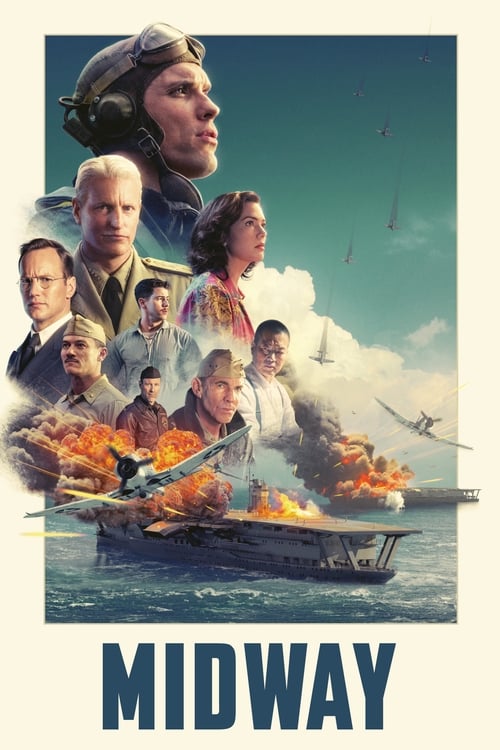
Midway
None or negligible
Roland Emmerich's Pacific War epic about Pearl Harbor, codebreaking and the carrier battle at Midway, with no progressive messaging; it is a straight tribute to the airmen and sailors and treats the Japanese commanders with respect.
Roland Emmerich's war film covers the first six months of the Pacific War, from Pearl Harbor through the Marshall Islands raid and the Doolittle raid to the Battle of Midway in June 1942. It follows dive-bomber pilot Dick Best (Ed Skrein), intelligence officer Edwin Layton (Patrick Wilson) and Admiral Nimitz (Woody Harrelson) on the American side, and Admiral Yamamoto and his commanders on the Japanese side, with codebreaking and carrier battles in roughly equal measure.
There is next to nothing for the rubric to find. American servicemen call the enemy 'Japs' throughout, as men of the period did, while the Japanese commanders are given their own reasoning and dignity: Yamamoto warns before the war that Japan cannot win a long one, and the Japanese side argues its strategy in its own scenes. A Doolittle raider sees the Chinese villagers who helped him attacked in reprisal, a sober note about the raid's cost rather than a political point. Women appear as wives at home, and Ann Best's spirited defence of her husband is character, not commentary.
There is next to nothing for the rubric to find. American servicemen call the enemy 'Japs' throughout, as men of the period did, while the Japanese commanders are given their own reasoning and dignity: Yamamoto warns before the war that Japan cannot win a long one, and Admiral Yamaguchi chooses to go down with his burning carrier. A Doolittle raider sees the Chinese villagers who helped him attacked in reprisal, a sober note about the raid's cost rather than a political point. Women appear as wives at home, and Ann Best's spirited defence of her husband is character, not commentary.
The score is zero because nothing progressive is argued. Complaints about Washington's analysts, untested torpedoes and Navy politics are wartime friction, not a case against an institution. The film's own notes are patriotic: pep talks about duty and being underdogs, and closing cards honouring the real men. Those are listed below but not scored.
Score breakdown
Each category is scored 0 to 3: 0 absent or presence only, 1 brief, 2 recurring or plot-relevant, 3 central or dominant. Timestamps refer to the film's running time.
| Category | Score | What we saw |
|---|---|---|
| Content | ||
| A Race and ethnicity | 0 | No race theme. American servicemen use 'Japs' as period talk (0:17:37, 0:41:54), and the Japanese side is shown through its own commanders (0:26:16, 1:25:38). No interracial couple appears. |
| B Gender and feminism | 0 | No gender message. Ann Best presses McClusky on why her husband is not commanding a squadron (0:43:34), a spirited wife rather than a point about women; women otherwise appear as wives waiting at home (0:22:32, 1:56:19). |
| C Sexuality and gender identity | 0 | No LGBTQ+ content. |
| D Power and systems | 0 | No institution is cast as oppressing a group. Grumbling about Washington's intelligence analysts (1:00:47), untested torpedoes (0:17:58) and Navy politics (0:58:20) is wartime friction, and the Japanese Navy's rivalry with its Army (0:26:52, 0:29:22) is history. |
| E Cultural and historical revision | 0 | A dramatisation of real events and people. Nothing in the material recasts an established figure or bends history to carry a progressive message. |
| F Religion portrayal | 0 | Islam and Muslim characters do not appear. |
| Treatment | ||
| G Antagonist coding | 0 | The enemy is Imperial Japan, the war's actual opponent, and its commanders have individual motives: Yamamoto is the moderate who fears a long war (0:03:59) and is threatened by his own nationalists (0:04:07) and Yamaguchi dies with his ship (1:59:25). Not a progressive out-group. |
| H Didacticism | 0 | No progressive speeches. The pep talks are about courage and duty (1:19:33, 1:50:16) and are listed under notScored. |
| I Message over story | 0 | The story follows the campaign; nothing bends toward a message. |
| J Left-leaning politics framed as good | 0 | No left-leaning cause is framed as good. Roosevelt's speeches at the start and after Pearl Harbor (0:00:19, 0:25:13) are period audio, not partisan framing. |
How the number is reached
- Categories A to J add up to 0 of 30, which gives 0.0 (0 ÷ 30 × 10, rounded to the nearest 0.5).
- No counterweight: None applies: there is no progressive messaging to mock or complicate.
- Final rating 0.0, none or negligible.
Considered, scored 0
- Period slurs: American servicemen call the enemy 'Japs' throughout (0:17:37, 0:41:54, 1:17:00), as historical colour.
- The Japanese commanders shown with dignity and their own reasoning (0:03:59, 0:26:16, 1:59:25), balanced history rather than a corrective message.
- Chinese villagers shelter a Doolittle raider and are then attacked in reprisal (0:54:04, 0:56:49, frame 0:56:30), shown as the cost of the raid without a political point.
- Ann Best questioning McClusky about her husband's career (0:43:34), character rather than a point about women.
- A sailor setting up chairs for a church service says he does not believe in God (0:10:03), a passing character detail.
Evidence and confidence
Confidence: Medium. Full English subtitles (embedded track, which also covers the Japanese and Chinese scenes) and 138 frames sampled once a minute, the last nine on the end credits. Many battle frames are dark or blurred.
Category F definition: As in the rubric: Islam shown as a peaceful and tolerant religion, aligned with human rights, in a way that works as a corrective message.
Noted, not scored: A patriotic, duty-bound tone: Best tells his reluctant gunner that holding the fort till the cavalry arrives is their job (1:50:16), and a pilot says men like Best are why America will win the warand, with Best missing, a pilot says men like him are why America will win the war (1:55:48). Pep talks about being underdogs who can fly with anyone (1:19:33) and Nimitz's faith in the fighting spirit of the men (0:33:45). Closing cards honour the real men (frames 2:04:30 to 2:06:30), and the credits thank the US Department of Defense and the men and women of the Navy and Marine Corps (frame 2:17:30).
Rubric version 1. Reviewed 18 November 2026.