Woke rating
Mayday
None or negligible
A Cold War buddy action-comedy whose politics are broadly patriotic and anti-Soviet; its only progressive notes are one scene urging a father to accept his gay daughter and a late swipe at how the US government treats its own people.
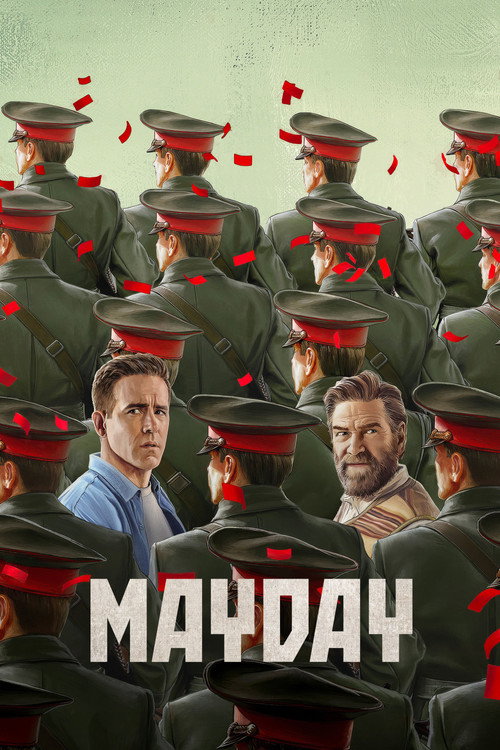
Ryan Reynolds plays Troy Kelly, a US Navy flyer shot down deep inside the Soviet Union in the 1980s while on a CIA spy flight. He is patched up by Nick (Kenneth Branagh), a former KGB officer living alone in the forest who is obsessed with America and Top Gun, and the two set off across the country toward Moscow and a way out.
Most of the film is chases and banter. The messaging comes in two places. In Moscow, Nick's estranged daughter Anna, a human-rights activist, tells Troy she is gay, a crime the KGB enforces; Troy urges Nick to show her she need not hide, and Nick says that law was one reason he quit. The other thread is Troy's dying father, a shipyard worker, and the film's late turn toward Washington's readiness to sacrifice individuals when it suits.
Most of the film is chases and banter. The messaging comes in two places. In Moscow, Nick's estranged daughter Anna, a human-rights activist, tells Troy she is gay, a crime the KGB enforces; Troy urges Nick to show her she need not hide, and Nick says that law was one reason he quit. The other thread is Troy's dying father, a shipyard worker. The KGB hardliner Volkov shows Troy proof that the Navy knew about the asbestos that is killing him, and the film ends with Troy asking Congress to admit it and compensate the workers.
Neither thread is pressed hard, and the film's frame is pro-American: Nick dreams of McDonald's and road trips, and the Soviet state is shown as poor, paranoid and repressive. Troy's hawkish talk is teased but his view of the Soviet system is borne out, and the American officials who stall him are given their reasonsthe State Department grants Nick asylum in the end and Congress thanks Troy for his service.
Score breakdown
Each category is scored 0 to 3: 0 absent or presence only, 1 brief, 2 recurring or plot-relevant, 3 central or dominant. Timestamps refer to the film's running time.
| Category | Score | What we saw |
|---|---|---|
| Content | ||
| A Race and ethnicity | 0 | Race plays no part. No interracial couple was seen in the dialogue or frames. |
| B Gender and feminism | 0 | No gender messaging. Anna is an activist and a woman at the State Department has the final say on asylum, both without comment. |
| C Sexuality and gender identity | 1 | One sequence makes acceptance of a gay child a point, framed as part of Soviet repression. It gives Nick a reason for leaving the KGB but is not revisited.
|
| D Power and systems | 2 | The US government is shown putting diplomacy ahead of its own pilot and his rescuer, and the last act accuses the Navy of knowingly exposing shipyard workers to asbestos to save money. The critique is aimed at official callousness, not framed in identity terms.
|
| E Cultural and historical revision | 0 | An original story set in the late Cold War. No established characters or real history are recast to carry a message. |
| F Religion portrayal | 0 | Islam is not portrayed. |
| Treatment | ||
| G Antagonist coding | 0 | The villain is a KGB hardliner who wants to restore Soviet power and sabotage glasnost, a genre heavy with his own motive rather than a stand-in for a Western out-group. |
| H Didacticism | 1 | A few short speeches state the points directly: Troy's advice to Nick about Anna and Troy's testimony to Congress.
|
| I Message over story | 0 | The story leads. The father's illness is set up early (0:06:09) and paid off at the end, and Anna's subplot feeds Nick's motive without bending the plot. |
| J Left-leaning politics framed as good | 1 | A few left-leaning notes are framed as good, and Troy's Cold War certainties are softened, but the film's politics are broadly patriotic and anti-communist.
|
How the number is reached
- Categories A to J add up to 5 of 30, which gives 1.5 (5 ÷ 30 × 10, rounded to the nearest 0.5).
- Counterweight −0.5: The government critique gets a fair hearing from the other side: the officials who stall Troy explain their reasons (1:15:21), and Troy admits his own selfishness (1:25:49).The government critique gets a fair hearing from the other side: the officials who stall Troy explain their reasons (1:15:21), Troy admits his own selfishness (1:25:49), the Navy welcomes him back (1:34:40), and the State Department grants Nick asylum (1:36:52).
- Final rating 1.0, none or negligible.
Considered, scored 0
- A racially mixed squadron of Navy pilots (frame 0:08:30), shown without comment.
- A woman State Department official (1:36:37), shown without comment.
- Troy's quip 'silence is complicity' (0:08:17), used to back his anti-communist argument rather than any progressive cause.
Evidence and confidence
Confidence: Medium. Full English subtitles plus the forced track for the Russian dialogue, and 110 frames sampled once a minute. A few short Russian lines have no forced subtitle (for example around 1:23:10), but their gist is given in the English that follows.
Category F definition: As in the rubric: Islam shown as a peaceful and tolerant religion, aligned with human rights, in a way that works as a corrective message.
Noted, not scored: The film's frame is patriotic and anti-communist: Troy calls the Soviet system a prison (0:08:07), Nick admires American democracy and culture (0:21:27), villagers struggle to afford food and coal (0:53:31), and the KGB hunts dissidents (1:09:32); the film closes on the Navy's motto and a Big Mac that tastes like America (1:38:27, 1:39:53).
Rubric version 1. Reviewed 18 November 2026.