Woke rating
Lucky Number Slevin
None or negligible
A twisty, wisecracking crime thriller with no progressive messaging; its only scored element is the central romance between a white hero and an Asian American heroine, which the rubric counts on sight.
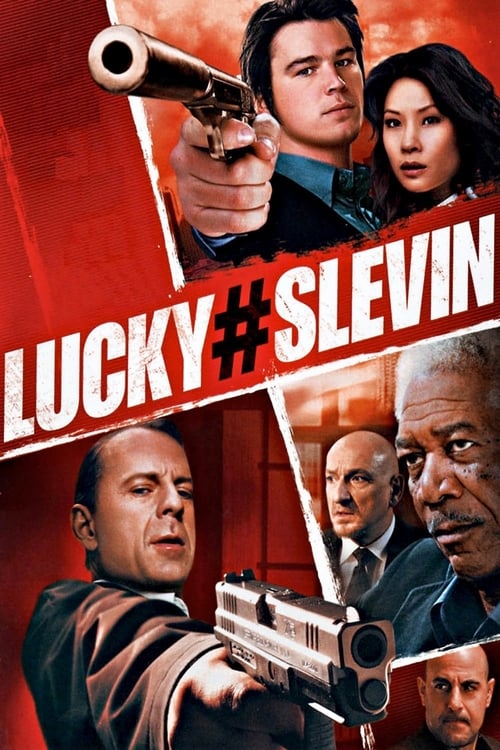
Paul McGuigan's crime thriller opens with a hitman, Mr. Goodkat (Bruce Willis), telling a stranger about a 'Kansas City shuffle', a con in which everyone looks one way while you go the other. It then follows Slevin (Josh Hartnett), a luckless young man staying in his friend Nick's New York apartment, who is taken for Nick by two rival crime lords living in towers across the street from each other: the Boss (Morgan Freeman), who wants Nick's debt paid by killing the Rabbi's son, and the Rabbi (Ben Kingsley), who wants his own money. Lindsey (Lucy Liu), the talkative coroner from across the hall, turns amateur detective and falls for him. The dialogue is quick and stylised, full of wordplay and old-movie references.
The only thing the rubric counts is that romance. Slevin is white and Lindsey Asian American, and theirs is the film's central love story, which the rubric scores on sight although race is never mentioned. Everything else is presence. The Rabbi's son is gay, which the gangsters treat as a joke and the plot uses as a way in; the crime lords are a Black man and a Jewish rabbi, defined by their feud and their crimes; and a detective's slur about 'darkies' and 'skullcaps' is a crude cop's talk, not a point the film makes.
The only thing the rubric counts is that romance. Slevin is white and Lindsey Asian American, and theirs is the film's central love story, which the rubric scores on sight although race is never mentioned. Everything else is presence. The Rabbi's son is gay, which the gangsters treat as a joke and Goodkat plans to exploit by staging the killing as a gay double suicide; the crime lords are a Black man and a Jewish rabbi, defined by their feud and their crimes; and a detective's slur about 'darkies' and 'skullcaps' is a crude cop's talk, not a point the film makes.
What keeps the score at the bottom of the scale is that nothing is argued. The plot runs on a revenge scheme decades in the makingfor the 1979 massacre of a gambler's family over a fixed horse race, the villains have personal motives, and no speech touches politics or identity.
Score breakdown
Each category is scored 0 to 3: 0 absent or presence only, 1 brief, 2 recurring or plot-relevant, 3 central or dominant. Timestamps refer to the film's running time.
| Category | Score | What we saw |
|---|---|---|
| Content | ||
| A Race and ethnicity | 3 | Scored 3 under the rubric's rule for a central interracial couple: Slevin, who is white, and Lindsey, who is Asian American, are the film's only romance. Race itself is never a theme; a detective's slur (0:52:28) is noted below rather than scored.
|
| B Gender and feminism | 0 | Lindsey drives the amateur investigation (0:43:59) and is a coroner (0:53:56), shown as character, not framed through gender. The other women are minor: Max's wife and the girlfriend Slevin catches cheating (0:19:27). |
| C Sexuality and gender identity | 0 | Yitzhak, the Rabbi's son, is gay, and the plot turns on it: the gangsters call him 'the fairy' (0:33:01) and the hitman means to use it as coverGoodkat plans to stage the killing as a gay double suicide (0:50:31). That is plot and gangster banter, with no message either way. |
| D Power and systems | 0 | Corrupt police are crime-genre texture: Slevin says the gangsters buy cops like cops buy donuts (0:55:31), and the detective once signed his paycheques over to the Rabbi (0:54:22). No institution is framed as oppressing a group. |
| E Cultural and historical revision | 0 | An original screenplay; nothing established is recast or revised. |
| F Religion portrayal | 0 | Islam does not feature. Religion appears only as the irony of a rabbi who is a gangster (0:40:35), who cites the Jewish rule against premeditated murder (0:42:13). |
| Treatment | ||
| G Antagonist coding | 0 | The villains are rival crime lords, a Black man and a Jewish rabbi, and their hired men, defined by their feud and their crimes, chiefly the 1979 massacre (1:35:10), with personal motives such as the Boss's murdered son (0:31:51). No demographic or ideological out-group is coded as the enemy. |
| H Didacticism | 0 | The speeches are about luck (0:39:56), revenge (0:32:21) and old films, and none carries a social message. |
| I Message over story | 0 | A puzzle-box revenge plot whose turns serve the twist; none bends toward a message. |
| J Left-leaning politics framed as good | 0 | No politics appear, left or right. |
How the number is reached
- Categories A to J add up to 3 of 30, which gives 1.0 (3 ÷ 30 × 10, rounded to the nearest 0.5).
- No counterweight: None applies: the only scored element is the on-sight interracial couple, which carries no message to complicate or mock.
- Final rating 1.0, none or negligible.
Considered, scored 0
- Yitzhak as a gay character (0:33:19), whose father 'doesn't know' though everybody does (0:33:28), and whom Slevin asks on a date (0:59:37): plot, not commentary.
- The Boss, a Black crime lord, and the Rabbi, a Jewish one, as the two rival gangsters, with a Black gangland crew and Hasidic heavies (frames 0:29:30, 0:37:30); race and religion are never a message.
- Ex-Mossad bodyguards guarding Yitzhak (0:49:17), a plot obstacle.
Evidence and confidence
Confidence: Medium. The file has no English text subtitles, so the dialogue comes from a Whisper transcript of the English audio. It covers the whole film but garbles names (Slevin often comes out as 'Levin', Kelevra as 'Galevra', Goodkat as 'Good Cat', Yitzhak as 'Itzhak' or 'Hisoc', Brikowski as 'Borkowski' or 'Dombroski'), runs some fast exchanges together and mangles the closing song. Two stretches with little dialogue, the shoot-out at Yitzhak's apartment (about 1:10:45 to 1:13:50) and the end of the reveal (about 1:39:00 to 1:41:20), are covered by the frames only. 110 frames sampled once a minute, the last five of them end credits.
Category F definition: As in the rubric: Islam shown as a peaceful and tolerant religion, aligned with human rights, in a way that works as a corrective message.
Noted, not scored: Much of the talk runs against today's sensitivities and is never rebuked: the gangsters call Yitzhak 'the fairy' (0:33:01), a detective says Slevin is playing with 'the darkies' and 'the skullcaps' (0:52:28), and the hitman's plan treats a gay double suicide as an easy cover storyand Goodkat's plan treats a gay double suicide that 'the world doesn't understand' as an easy cover story (0:50:31).
Rubric version 1. Reviewed 18 November 2026.