Woke rating
Little Miss Sunshine
None or negligible
A road-trip family comedy whose satire is aimed at the cult of winning and at child beauty pageants; a gay uncle and a light body-image thread are the only touches of identity themes, and none is argued.
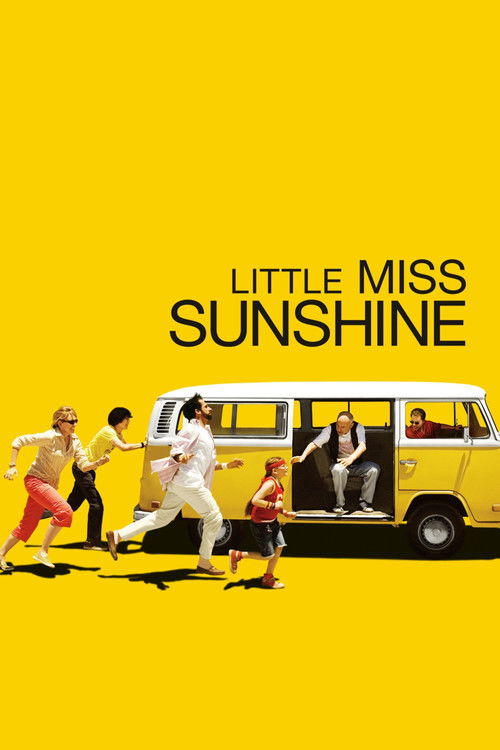
Jonathan Dayton and Valerie Faris's comedy follows the Hoovers of Albuquerque: Richard (Greg Kinnear), a motivational speaker trying to sell his nine-step 'Refuse to Lose' program; his wife Sheryl (Toni Collette); her brother Frank (Steve Carell), a Proust scholar just out of hospital after a suicide attempt; teenage Dwayne (Paul Dano), who has taken a vow of silence; foul-mouthed Grandpa (Alan Arkin); and seven-year-old Olive (Abigail Breslin), who is offered a late place in a children's beauty pageant in California. With no money to fly, the whole family crosses the Southwest in a yellow VW bus with a failing clutch.
Frank is gay, and his unrequited love for a male graduate student, who fell for a rival scholar instead, set off the slide that ended in his suicide attempt; he explains this at the dinner table, and Grandpa needles him with crude jibes along the way. The film is sympathetic to him but makes no case about sexuality. A thread about girls' bodies runs from a breakfast argument over whether ice cream will make Olive fat to the pageant itself, where made-up little girls parade in swimsuits and the family has to decide whether Olive belongs there. The main target of the satire is Richard's winners-and-losers creed and the competitive culture it stands for.
Frank is gay, and his unrequited love for a male graduate student, who fell for a rival scholar instead, set off the slide that ended in his suicide attempt; he explains this at the dinner table, and Grandpa needles him with crude jibes along the way. The film is sympathetic to him but makes no case about sexuality. A thread about girls' bodies runs from a breakfast argument over whether ice cream will make Olive fat to the pageant itself, where made-up little girls parade in swimsuits, Dwayne begs his mother not to let 'these people' judge Olive, and Olive's grandfather-choreographed 'Super Freak' routine scandalises the organisers until the whole family joins her on stage. The main target of the satire is Richard's winners-and-losers creed, which collapses along with his book deal.
What keeps the score at the bottom of the scale is that the film has no political camp in view. Its speeches are about failure, suffering and doing what you love, not identity; its obstacles are a book agent, hospital paperwork and a pageant registrar, not a demographic or ideology; and the story always leads. Frank, the one character an identity reading would centre on, is drawn as vain and self-pitying as well as wounded, and the family's crude jokes at his expense are played for comedy rather than corrected.
Score breakdown
Each category is scored 0 to 3: 0 absent or presence only, 1 brief, 2 recurring or plot-relevant, 3 central or dominant. Timestamps refer to the film's running time.
| Category | Score | What we saw |
|---|---|---|
| Content | ||
| A Race and ethnicity | 0 | No race theme and no interracial couple. A few Black hospital staff and pageant spectators appear without comment. |
| B Gender and feminism | 1 | A body-image thread about a seven-year-old girl recurs and the pageant's grooming of little girls is satirised, but the target is the pageant world and the urge to win, not men or patriarchy. The one explicit body-acceptance line comes in a single scene.
|
| C Sexuality and gender identity | 1 | Frank's homosexuality drives his back story and one later encounter, and the film treats him sympathetically, but it is never argued as a cause. Grandpa's slurs pass without a lecture either way.
|
| D Power and systems | 1 | The film satirises the self-help business and the American cult of winning, and puts petty bureaucracy in the family's way, but none of it is framed as oppression of a group.
|
| E Cultural and historical revision | 0 | Original story. No established characters or history are recast. |
| F Religion portrayal | 0 | Islam does not appear. |
| Treatment | ||
| G Antagonist coding | 0 | There are no villains in the political sense: the antagonists are a book agent, a hospital administrator and pageant staff, each with ordinary motives, and none is coded by race, sex, faith or politics. |
| H Didacticism | 1 | A few heartfelt speeches state the film's theme directly, but the theme is self-acceptance and the value of failure, not identity politics; only Sheryl's body-acceptance line touches a progressive talking point.
|
| I Message over story | 0 | The story leads throughout. Its turns come from a broken-down bus, money trouble and family crises, not from a point being made. |
| J Left-leaning politics framed as good | 0 | No left- or right-wing politics are framed as good or bad. The satire targets self-help success culture and pageants, not a political camp; a news clip naming Secretary Rumsfeld plays on a motel TV (0:43:37) with no comment. |
How the number is reached
- Categories A to J add up to 4 of 30, which gives 1.5 (4 ÷ 30 × 10, rounded to the nearest 0.5).
- Counterweight −0.5: The one character an identity reading would centre on is not idealised: Frank admits he said and did things he should not have after the break-up (0:14:28), lies to his former student about being fired (0:37:22) and is openly self-pitying, while Grandpa's jibes about his sexuality (0:24:46, 0:36:19) are played for laughs and never rebuked.
- Final rating 1.0, none or negligible.
Considered, scored 0
- Black hospital staff and pageant spectators, shown without comment (0:55:30, 1:34:30).
- Grandpa's heroin use, porn and advice to 'fuck a lot of women', played as character comedy that the family objects to, not as sexual-freedom advocacy.
- A highway patrolman who lets Richard off after leafing through Grandpa's porn (1:04:05), a gag rather than a comment on police.
- A blended family with a divorced mother, mentioned without comment.
Evidence and confidence
Confidence: Medium. Full English subtitles (embedded track) and 102 frames sampled once a minute. No gaps found; the subtitles also carry the song lyrics.
Category F definition: As in the rubric: Islam shown as a peaceful and tolerant religion, aligned with human rights, in a way that works as a corrective message.
Noted, not scored: The film's warmest moments are about family loyalty: no one gets left behind (0:32:39), Sheryl's 'whatever happens, we're a family' (0:51:54), and Frank telling Olive he thinks there is a heaven and she will get in (1:01:16).
Rubric version 1. Reviewed 18 November 2026.