Woke rating
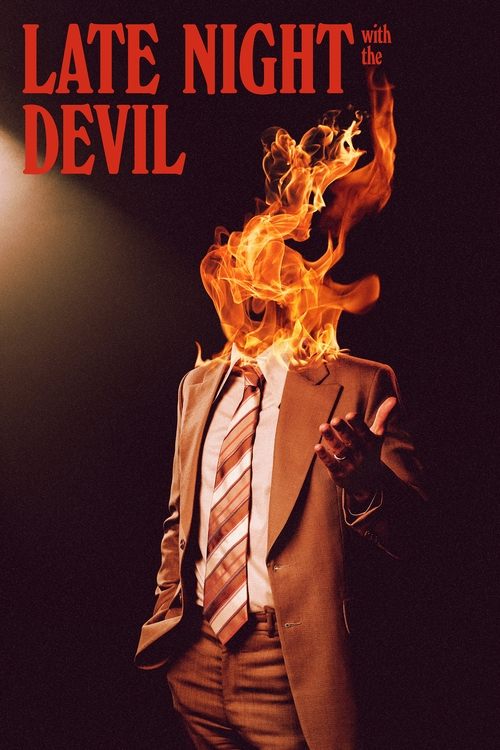
Late Night with the Devil
None or negligible
A 1970s talk-show horror film with next to no messaging: a secret club of the rich and powerful and a ratings-mad TV business are its only targets, used as horror devices rather than politics, and identity never comes up.
Cameron and Colin Cairnes's horror film is presented as the recently found master tape of a 1977 Halloween episode of 'Night Owls', a late-night talk show whose host, Jack Delroy (David Dastmalchian), is grieving his wife and still trailing Johnny Carson. For sweeps week he books a medium, a magician turned professional sceptic, and a parapsychologist with a teenage girl who survived a Satanic cult. Between the live segments, black-and-white backstage footage shows the crew's unease as the night goes wrong.
The one thread that comes close to a message is the film's picture of power. The prologue introduces the Grove, a men-only club of politicians, entertainers and captains of industry rumoured to hold arcane ceremonies and make or break careers, and Jack is a member. The TV business is no better: the producer and host keep the cameras rolling as the night turns dangerous because the switchboard is lit up, and the network owner calls it the biggest TV event since the moon landing. As the night goes on, both threads feed into the horror.
The one thread that comes close to a message is the film's picture of power. The prologue introduces the Grove, a men-only club of politicians, entertainers and captains of industry rumoured to hold arcane ceremonies and make or break careers, and Jack is a member. The TV business is no better: the producer and host keep the cameras rolling after Christou dies because the switchboard is lit up, and the network owner calls it the biggest TV event since the moon landing. The demon tells Jack they met among the tall trees, and the final hallucination shows a hooded ceremony and Madeleine telling Jack his ratings crown was bought with her life and his soul belongs to them.
What keeps the score near zero is that none of this is tied to a group or a cause. The secret club is a stock horror device, and Jack is its willing member, not its victim.The elite cult is an old Faustian device, and Jack is its willing member who paid with his wife, not its victim. The political jokes land on Jimmy Carter and Ronald Reagan alike, race, sex and sexuality are never themes, and the mixed studio audience and the foreign-accented medium are shown without comment.
Score breakdown
Each category is scored 0 to 3: 0 absent or presence only, 1 brief, 2 recurring or plot-relevant, 3 central or dominant. Timestamps refer to the film's running time.
| Category | Score | What we saw |
|---|---|---|
| Content | ||
| A Race and ethnicity | 0 | Race never comes up. The studio audience is mixed and shown without comment, and the only couple, Jack and Madeleine, is not interracial (frame 0:04:30). |
| B Gender and feminism | 0 | No point is made about the sexes. The Grove is described as men-only and Madeleine pays for Jack's ambitionMadeleine is the price of Jack's pact, but the film frames this as his Faustian bargain, not as a story about women (see 'zeroed'). |
| C Sexuality and gender identity | 0 | No LGBTQ+ characters or themes. Sexual jokes (a burlesque gag, rumoured orgies, the possessed girl's crude rhyme) are shock and comedy. |
| D Power and systems | 1 | Power is the hidden menace: a secret club of the rich and powerful, and a TV business that will air anything for ratings, both revealed as complicit in Jack's pact. Scored 1: it is a horror device, not framed as oppression of a group or tied to any politics.
|
| E Cultural and historical revision | 0 | An original story. Real figures (Carson, Carter, Ed and Lorraine Warren) are only name-checked. |
| F Religion portrayal | 0 | Islam and Muslims do not appear. |
| Treatment | ||
| G Antagonist coding | 0 | The villains are a demon and a Satanic cult, with the Grove's wealthy men behind them, but Jack is their willing member rather than their victim, and the plain antagonists on screen (the producer, the sceptic) have personal motives: ratings and money, and pride. |
| H Didacticism | 0 | No lectures on any social or political point. The set-piece arguments are between the sceptic and the believers about the paranormal. |
| I Message over story | 0 | The story leads throughout; the elite conspiracy serves the horror plot, not the other way round. |
| J Left-leaning politics framed as good | 0 | No left-leaning politics are framed as good. The only political jokes cut both ways: one at President Carter's brother, and an end-credits song mocking 'the Gipper' (see 'zeroed'). |
How the number is reached
- Categories A to J add up to 1 of 30, which gives 0.5 (1 ÷ 30 × 10, rounded to the nearest 0.5).
- No counterweight: None applies: the only scored element is a horror conspiracy of the powerful, with no progressive point for the film to mock or balance.
- Final rating 0.5, none or negligible.
Considered, scored 0
- Christou, a medium given a 'Middle Eastern accent' in the subtitles who mixes in Spanish words (0:14:41), is mocked as a charlatan for his act (0:29:30), not for his origin.
- A mixed studio audience, including the two women Christou reads for (0:18:21; frames 0:18:30, 0:19:30), shown without comment.
- Political jokes on both sides: Jack's monologue gag about Billy Carter (0:11:28) and the end-credits song about rolling a joint for the Gipper and electing another jerk to the White House (1:29:00, 1:29:18).
- The Grove described as men-only (0:04:44); Haig's sneers at June ('University of Hogwash', 'dearie') (0:44:21, 0:49:55), which Lilly calls condescending (0:48:02), are part of his abrasive persona, which he turns on Christou and Jack too.
- The producer calls Gus a 'Mick' (1:00:20), period crudeness from an unpleasant character.
Evidence and confidence
Confidence: Medium. Full English SDH subtitles from the embedded track, and 93 frames sampled once a minute. No gaps in the dialogue beyond wordless stretches of music and effects; the last four minutes are end credits.
Category F definition: As in the rubric: Islam shown as a peaceful and tolerant religion, aligned with human rights, in a way that works as a corrective message.
Rubric version 1. Reviewed 18 November 2026.