Woke rating
L'Argent
None or negligible
Bresson's austere parable follows a forged banknote from a schoolboy's pocket to a working man's ruin; its indictment of money spares no class and leaves almost nothing for this scale to measure.
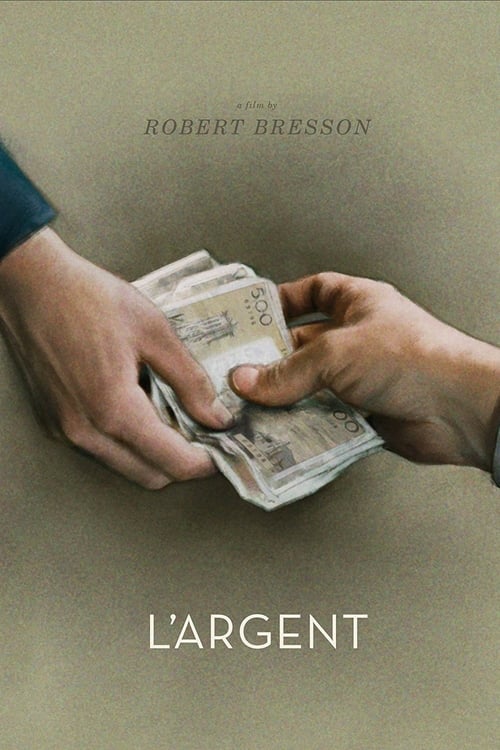
Robert Bresson's crime drama, credited as inspired by Tolstoy's story The Forged Coupon (0:00:54), moves the tale to Paris in the early 1980s. A schoolboy whose father refuses him an advance is handed a forged 500-franc note by a friend and passes it at a photo shop; the shop owners pass their fakes on to Yvon, a fuel deliveryman, and when he tries to spend them he is arrested. The rest of the film follows the consequences, in Bresson's spare style: few words, flat delivery, and many close shots of hands, doors and money changing hands.
The film's only brush with this scale is its picture of money and the respectable people who handle it. The schoolboy's mother pays to keep her son's name out of the affair, the shopkeepers lie, their employee perjures himself in court, and the cost lands on a working man, whose life then comes apart.
The film's only brush with this scale is its picture of money and the respectable people who handle it. The schoolboy's mother pays to keep her son's name out of the affair, the shopkeepers lie, their employee Lucien perjures himself in court, and the cost lands on Yvon. He loses his job, drives the getaway car in a robbery and gets three years; in prison his daughter dies and his wife leaves him, and after his release he kills a pair of hotel owners and then the family of the widow who took him in, before confessing to the police. Lucien becomes a thief who gives money to the poor, but at his own trial the court notes his love of good suits.
What keeps the score at zero is that the film blames greed and lying in everyone rather than a class or a system. No one speaks of class, the court is deceived rather than shown as biased, and the wronged man does not stay innocentYvon ends as a mass murderer. There are no race, gender or sexuality themes.
Score breakdown
Each category is scored 0 to 3: 0 absent or presence only, 1 brief, 2 recurring or plot-relevant, 3 central or dominant. Timestamps refer to the film's running time.
| Category | Score | What we saw |
|---|---|---|
| Content | ||
| A Race and ethnicity | 0 | No race theme. The cast is white and French, and the only couple, Yvon and his wife Elise, are both white. |
| B Gender and feminism | 0 | No gender message. Yvon's wife drops out of his lifeElise leaves Yvon while he is in prison (0:49:34), inmates sneer that wives are all the same (0:47:04), and the widow who shelters Yvon is worn out by her family (1:18:21), but nothing is made of any of it as a statement about women. |
| C Sexuality and gender identity | 0 | No LGBTQ+ or sexual-freedom content. |
| D Power and systems | 1 | Money and the respectable people who handle it drive the plot: a mother buys her son out of trouble, shopkeepers pass on fakes and back a perjured story, and the cost lands on a working man. Scored 1, not 2: the film treats this as a moral fable about greed and lying, never names a class or system as the oppressor, and its victim does not stay innocentits victim becomes a killer.
|
| E Cultural and historical revision | 0 | A loose modern-day adaptation of Tolstoy's story (credited at 0:00:54). Nothing is recast to carry a message. |
| F Religion portrayal | 0 | Islam does not feature. |
| Treatment | ||
| G Antagonist coding | 0 | The wrongdoers are a schoolboy and his mother, shopkeepers, a dishonest employee and othersand finally Yvon himself, each with a plain motive such as a debt, a business to protect or greed. None is defined by class, sex, faith or politics. |
| H Didacticism | 0 | No speech states a progressive message. The one speech-like passage, the prison monologue about obedience and money (0:55:28), is bleak and anti-utopian rather than political, and Lucien's claim that his ideas reject all rules (0:53:52) is cut short by the court. |
| I Message over story | 0 | The story leads; every turn follows from the note and the lies told around it. |
| J Left-leaning politics framed as good | 0 | No political camp is framed as good. Talk of a thief who gives to the poor (0:44:38) is treated with irony at his trial (0:53:33). |
How the number is reached
- Categories A to J add up to 1 of 30, which gives 0.5 (1 ÷ 30 × 10, rounded to the nearest 0.5).
- Counterweight −0.5: the film complicates its own critique. The shop employee rumoured to give money to the poor (0:44:38) is not allowed the pose of a Robin Hoodis shown at his trial to love good suits (0:53:40), and the man the lies ruin turns to crime himselfYvon drives a getaway car (0:24:44) and ends by killing two hotel owners and a whole family (1:23:58).
- Final rating 0.0, none or negligible.
Considered, scored 0
- An all-white French cast, with no comment on race.
- Yvon's wife leaving himElise's decision to leave Yvon while he is in prison (0:49:34), with nothing said about marriage or women.
- The widow who does all the work for her family (1:18:21), shown as a character, not a statement.
- Harsh prison routine, including 40 days of solitary confinement (0:48:14), shown as part of Yvon's story with no argument about the prison system.
Evidence and confidence
Confidence: Medium. Full English subtitles (embedded track), plus 85 frames sampled once a minute. The film has very little dialogue, with long silent stretches (for example 0:32:19 to 0:36:49, 1:00:40 to 1:06:58 and 1:18:49 to 1:22:21) that only the frames cover. The speaker of one prison monologue (0:55:28) is not clear from the subtitles.
Category F definition: As in the rubric: Islam shown as a peaceful and tolerant religion, aligned with human rights, in a way that works as a corrective message.
Rubric version 1. Reviewed 18 November 2026.