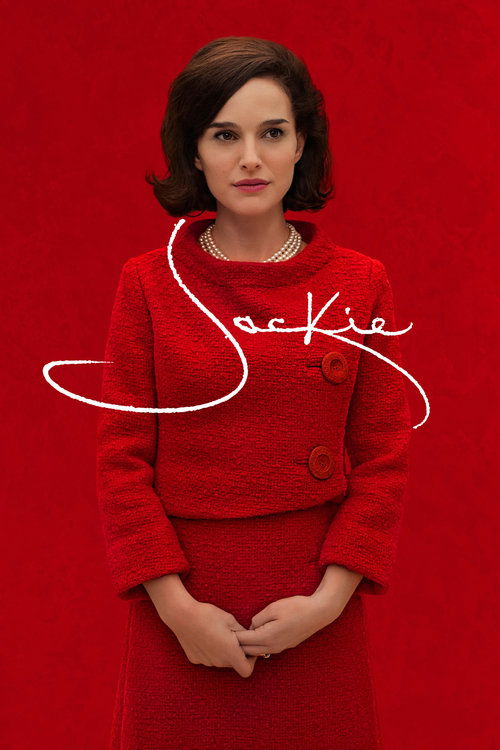
Woke rating
Jackie
None or negligible
A portrait of Jacqueline Kennedy in the week after Dallas that carries no identity messaging and only a few historical swipes at the right, and spends more time questioning the Kennedy legend than promoting any cause.
Pablo Larraín's film follows Jacqueline Kennedy (Natalie Portman) through the days after her husband's assassination, framed by an interview with a journalist at Hyannis Port a week later. It moves between the interview, her televised White House tour, the flight back from Dallas, the planning of the funeral and her talks with a priest.
Politics stays at the edges. On the plane Jackie refuses to leave by the back door because the John Birch Society would love that, and recalls the wanted posters with Jack's face in Dallas; later she wishes he had died for civil rights instead of at the hands of a silly little Communist, and Bobby lists civil rights among the things they will never finish. That is about all, in a film otherwise about grief, faith and how history gets written.
The score stays near zero because there are no identity themes, no villains and no speeches for a cause, and the film keeps puncturing the legend it records: Bobby wonders what they actually achieved, the journalist asks whether the funeral was a spectacle, and Jackie questions her own motives.
The score stays near zero because there are no identity themes, no villains and no speeches for a cause, and the film keeps puncturing the legend it records: Bobby wonders whether they were just 'the beautiful people', the journalist asks whether the funeral was a spectacle, and Jackie admits the pageantry was for herself rather than for Jack, then calls Camelot a fairy tale people like to believe.
Score breakdown
Each category is scored 0 to 3: 0 absent or presence only, 1 brief, 2 recurring or plot-relevant, 3 central or dominant. Timestamps refer to the film's running time.
| Category | Score | What we saw |
|---|---|---|
| Content | ||
| A Race and ethnicity | 0 | Race is not a theme. Lincoln and the end of slavery come up as history (0:27:16, 1:08:32), the civil-rights lines are counted under J, and no interracial couple appears in the dialogue or the sampled frames. |
| B Gender and feminism | 0 | No gender message. Jackie stands up to the men running the funeral (1:03:33, 1:14:09) and speaks bitterly about her marriage (0:52:22), but this is a portrait of one historical widow, not a case about women. |
| C Sexuality and gender identity | 0 | No LGBTQ+ characters or themes. |
| D Power and systems | 0 | The Secret Service, Johnson's aides and the State Department push back on a walking procession for security reasons (0:45:41, 1:12:58). They are cautious officials, not a system oppressing a group. |
| E Cultural and historical revision | 0 | A dramatisation of real events. The journalist and the priest are unnamed and the conversations are imagined, but nothing is recast or rewritten to carry a message. |
| F Religion portrayal | 0 | Islam does not feature. Religion appears as Jackie's Catholic faith and her talks with a priest (see 'not scored'). |
| Treatment | ||
| G Antagonist coding | 0 | No villain is defined by a group. Oswald is seen only on television (0:40:34, 0:56:51), Jackie calls the killer a little Communist (0:24:49), and Johnson's people are obstacles with security reasons, not antagonists. |
| H Didacticism | 0 | No speech states a progressive message. The long speeches are the priest's counsel and Jackie's Camelot story about Jack's ideals (1:26:23), which praise a man rather than a cause. |
| I Message over story | 0 | The story leads: a fragmented study of grief and legacy that bends toward no point. |
| J Left-leaning politics framed as good | 1 | The film's few political lines are the Kennedys' own: a swipe at the John Birch Society, the hostile posters in Dallas, and civil rights named as the cause that would have given his death meaning. They are brief and historical, and the film lets Bobby doubt what they achieved.
|
How the number is reached
- Categories A to J add up to 1 of 30, which gives 0.5 (1 ÷ 30 × 10, rounded to the nearest 0.5).
- Counterweight −0.5: The film keeps questioning the legend it records: Jackie herself says the killer was a communist (0:24:49), Bobby wonders whether they were just 'the beautiful people' and whether Jack created the crisis he solved (1:09:11, 1:09:21), and the journalist challenges the scale of the funeral (1:15:14); Jackie admits the pageantry was for herself, not for Jack (1:17:35), and calls Camelot a fairy tale people like to believe (1:29:34).
- Final rating 0.0, none or negligible.
Considered, scored 0
- Jackie standing up to the men around her and her remarks on Jack's infidelity and 'two kinds of women' (0:52:22 to 0:52:40), character and history rather than a statement about women.
- Jackie's speech in Spanish praising the Spanish tradition in Texas (0:13:06), a historical campaign moment.
- A Black agent among the security men in one frame (1:25:30), shown without comment.
Evidence and confidence
Confidence: Medium. Full English subtitles from the embedded track, plus the forced track for Jackie's short speech in Spanish in Dallas, and 100 frames sampled once a minute. Several stretches play with music and no dialogue, so they were judged from the frames alone.
Category F definition: As in the rubric: Islam shown as a peaceful and tolerant religion, aligned with human rights, in a way that works as a corrective message.
Noted, not scored: Catholic faith gets a serious, respectful hearing: the priest's parable of the blind man (1:04:10) and his counsel that God gives just enough to go on (1:28:32) are among the film's longest speeches.
Rubric version 1. Reviewed 18 November 2026.