Woke rating
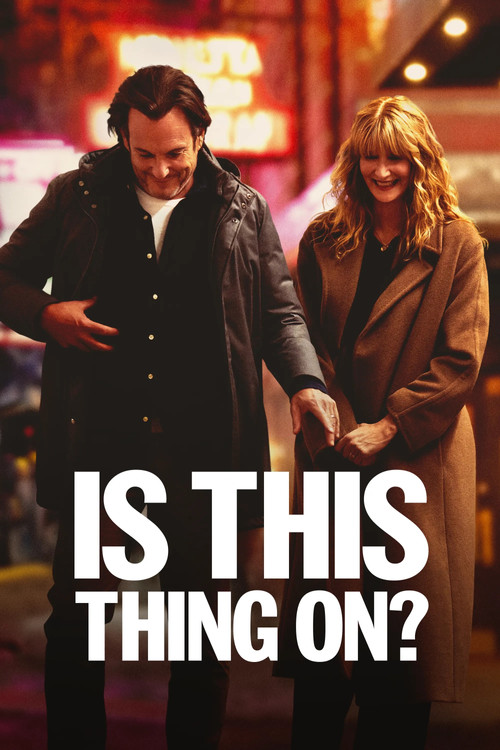
Is This Thing On?
None or negligible
A low-key comedy-drama about a separating couple and a husband who stumbles into stand-up, with no progressive messaging; its only points come from an interracial couple among the friends, which the rubric counts on sight.
Bradley Cooper's comedy-drama follows Alex Novak (Will Arnett), a finance man whose 20-year marriage to Tess (Laura Dern), a former Olympic volleyball player, is ending. Living alone in an apartment, he wanders into a downtown New York comedy club, puts his name on the open-mic list to dodge the cover charge, and finds himself talking about his divorce on stage. Tess, meanwhile, tries to find her way back into volleyball as a coach, and the two share their young sons while their friends, among them Alex's old friend Balls (Cooper) and his wife Christine, look on.
There is almost nothing here for the rubric to count. The only scored element is one the rubric counts on sight: Balls and Christine, a white man and a Black woman, are a recurring supporting couple with a subplot of their owntheir own marriage crisis, and race is never mentioned. Other identity material is comedy-club banter or simply present: a newlywed male couple among the friends, a comic's bit about her and her partner needing to buy sperm or adopt, and racial ribbing among the comics. Tess's account of giving up the sport she loved for motherhood is told as her own story, and both spouses share the blame for what went wrong.
What keeps the rating at the bottom is that the film argues nothing. Its subjects are middle age, a marriage running out of steam, parenting and the grind of open mics. There are no speeches, no villains and no politics, and the conflict comes from the couple's own silences and pride.
What keeps the rating at the bottom is that the film argues nothing. Its subjects are middle age, a marriage running out of steam, parenting and the grind of open mics. There are no speeches, no villains and no politics, and the conflict comes from the couple's own silences and pride. If anything, the story moves toward commitment: Alex and Tess start a secret affair after the separation, and the film ends with Alex asking her to be unhappy together with him, while Balls and Christine talk out their crisis.
Score breakdown
Each category is scored 0 to 3: 0 absent or presence only, 1 brief, 2 recurring or plot-relevant, 3 central or dominant. Timestamps refer to the film's running time.
| Category | Score | What we saw |
|---|---|---|
| Content | ||
| A Race and ethnicity | 2 | Race never comes up, but the rubric counts an interracial couple on sight: Balls, who is white, and his wife Christine, who is Black, are recurring supporting characters with their own storylinetheir own marriage crisis. Scored 2, not 3, because the leads are both white. The comics' racial ribbing is joke material (see zeroed).
|
| B Gender and feminism | 0 | No gender message. Tess's arc, an athlete who stopped playing, went through years of IVF and raised the boys, then returns to the sport as a coach (0:34:29, 1:39:44), is told as a personal story about identity after a career ends, and both spouses take blame for the marriage. Gender jokes come from the comedy-club sets and run both ways. |
| C Sexuality and gender identity | 0 | Same-sex couples are present without comment: Geoffrey and Stephen, newlyweds among the friends, get the best room at Oyster Bay (0:06:20, 1:23:34), and one comic jokes about her and her partner having to buy sperm or adopt (1:08:03). Nothing is argued. |
| D Power and systems | 0 | No institution is criticised. The story stays inside a family, a group of friends and a comedy club. |
| E Cultural and historical revision | 0 | An original story; no established characters or history are recast. |
| F Religion portrayal | 0 | Islam does not come up. Religion appears only as the play about Jesus in which Balls understudies a disciple (0:05:49) and in a breakfast rendition of 'Amazing Grace' (1:30:19). |
| Treatment | ||
| G Antagonist coding | 0 | There are no villains. Friction comes from the separated couple, a prickly friend and an overbearing mother, each with personal motives. |
| H Didacticism | 0 | No lecture-style dialogue. The longest speeches are about marriage and happiness (1:28:46, 1:38:38) and carry no political or identity message. |
| I Message over story | 0 | The story is driven by the characters' marriages and Alex's stand-up; nothing bends toward a message. |
| J Left-leaning politics framed as good | 0 | No political content. The nearest thing is an open-mic comic's line asking people to stop keying his Tesla (0:27:04), a joke about the car falling out of fashion. |
How the number is reached
- Categories A to J add up to 2 of 30, which gives 0.5 (2 ÷ 30 × 10, rounded to the nearest 0.5).
- No counterweight: None applies: the film argues no progressive point, so there is nothing for it to mock or balance. The couple that scores is simply shown.
- Final rating 0.5, none or negligible.
Considered, scored 0
- Geoffrey and Stephen, a newlywed male couple among the friends (0:06:20, 1:23:34), shown without comment.
- Comedy-club material about sexuality: a comic's joke contrasting casual sex with women and men (0:12:21), and Sam Jay's bit about her and her partner needing to buy sperm or adopt (1:08:03).
- Racial ribbing among the comics, one calling Alex his 'white slave' and saying he has been 'scared white' (0:30:00, 0:30:18), and Alex's mother saying she married an immigrant for 'the taste of the exotic' (0:22:03); jokes, not points.
- Tess's return to volleyball and her account of what she gave up for the family (0:34:29, 1:39:44), a personal story rather than a statement about gender roles.
- A mixed cast of comics and club staff, and the children's performance of 'Under Pressure' at the close (1:52:30, 1:53:30), shown without comment.
Evidence and confidence
Confidence: Medium. Full English subtitles from the file's embedded track, from the first line (0:02:03) through the closing song, plus 121 frames sampled once a minute. The wordless opening has no subtitles, and a stretch of overlapping comedy-club sets (0:17:25 to 0:19:08) comes through only in fragments. The HDR frames are dark and washed out, so some faces are hard to make out.
Category F definition: As in the rubric: Islam shown as a peaceful and tolerant religion, aligned with human rights, in a way that works as a corrective message.
Rubric version 1. Reviewed 18 November 2026.