Woke rating
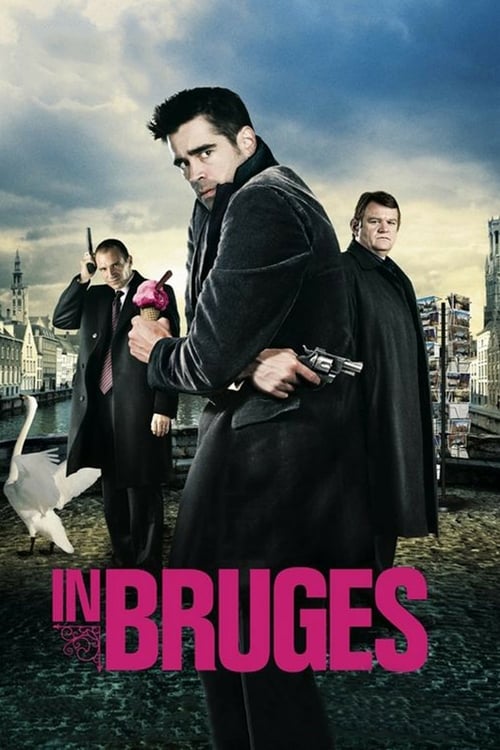
In Bruges
None or negligible
Martin McDonagh's darkly comic hitman film is about guilt, not politics; its jokes about race, dwarves and gay men are character comedy, and its one progressive note is a brief exchange that deflates a coked-up racist rant.
Martin McDonagh's first feature follows two Irish hitmen, Ray (Colin Farrell) and the older Ken (Brendan Gleeson), whom their London boss Harry (Ralph Fiennes) sends to wait out Christmas in Bruges after Ray's first job goes badly wrongleaves a priest and, by accident, a young boy dead. Ken wants to see the churches and canals; Ray hates the town, is sinking under guilt, and chases Chloe, a woman he meets on a Dutch film set, which leads to a night out with the film's American dwarf actor, Jimmy. Then Harry calls with new orders for Ken.Then Harry calls and orders Ken to kill Ray, and the rest of the film follows what Ken does instead.
Race is the only place the rubric finds anything. Late at night in Jimmy's hotel, a coked-up Jimmy predicts a coming war between blacks and whites, Ray needles him about which side the midgets and the Vietnamese would take, and Ken quietly says his wife was black and was murdered by a white man. That one exchange counts. The rest of the humour runs the other way: jokes about dwarves, gay men, Belgians and fat American tourists, none of them rebuked.
The score stays at the bottom because the film argues nothing political. Its subject is sin and atonement, framed in Catholic terms of confession, judgement and purgatory, and Harry is driven by a personal code of honour rather than coded by any group. The story leads throughout, and with almost no messaging there is nothing for a counterweight to offset.
Score breakdown
Each category is scored 0 to 3: 0 absent or presence only, 1 brief, 2 recurring or plot-relevant, 3 central or dominant. Timestamps refer to the film's running time.
| Category | Score | What we saw |
|---|---|---|
| Content | ||
| A Race and ethnicity | 1 | One scene: Jimmy's coked-up prediction of a race war is deflated by Ken, whose black wife was killed by a white man. She is mentioned, not shown, and race is otherwise only joke material.
|
| B Gender and feminism | 0 | No gender message. Ray's insistence that he would never hit a woman, except one swinging a bottle at him (0:36:11), is a comic beat; Chloe turns out to rob tourists (0:44:51), and Marie, the pregnant hotel owner, is shown with courage as a matter of character, not as a point about women. |
| C Sexuality and gender identity | 0 | No LGBTQ theme. Gay jokes and slurs recur but carry no message (see 'not scored'); sex comes up only in Ray's pursuit of Chloe and Jimmy's night with prostitutes (0:47:38). |
| D Power and systems | 0 | No institution is cast as oppressing anyone. Ray's joke about Belgium's child-abuse murders (0:33:42) and his drunken jab about Vietnam at a tourist (0:35:37) are character comedy, not critique. |
| E Cultural and historical revision | 0 | An original screenplay by McDonagh; no established characters or history are recast. |
| F Religion portrayal | 0 | Islam does not feature. Religion appears as Catholic guilt and imagery, from the Basilica of the Holy Blood (0:21:17) to a Last Judgement painting (0:26:23), outside this category's definition. |
| Treatment | ||
| G Antagonist coding | 0 | Harry, the London boss, is a gangster with a personal code of honour and personal reasons; nobody is defined by a demographic or ideological group. |
| H Didacticism | 0 | No speeches carry a social message. Ken's talks with Ray about trying to lead a good life (0:27:34) and making amendssaving the next child (1:02:22) are moral, not political. |
| I Message over story | 0 | The plot runs on Harry's orders, Ray's guilt and a chain of coincidences; nothing bends toward a message. |
| J Left-leaning politics framed as good | 0 | No political positions are argued or framed as good or bad. |
How the number is reached
- Categories A to J add up to 1 of 30, which gives 0.5 (1 ÷ 30 × 10, rounded to the nearest 0.5).
- No counterweight: None applies: the one scored element is a brief, sincere line, and the film's many un-PC jokes are noted below rather than counted against it.
- Final rating 0.5, none or negligible.
Considered, scored 0
- Ray's riff that dwarves kill themselves because people laugh at them (0:13:24) and his complaint that the actor wants to be called a dwarf, not a midget (0:14:08), comedy at Jimmy's expense rather than a point about disability.
- Ray's drunken attack on a couple he takes for Americans, with a jab about the Vietnamese and John Lennon (0:35:37, 0:36:01); he later admits Canadians never killed John Lennon (1:17:49). A belligerent drunk, not a point about American power.
- Ray's sick joke about Belgium's child-abuse murders (0:33:42), which Chloe turns back on him.
- Marie, the pregnant hotel owner, standing her ground in a tense momentwhen Harry comes for Ray (1:33:38), shown as character rather than a point about women.
- Catholic themes of confession, sin and purgatory (0:23:37, 0:26:23) and Ken's urging Ray to do some good with his life (1:02:07), moral rather than political.
Evidence and confidence
Confidence: Medium. The file has no English text subtitles, so the dialogue comes from a Whisper transcript of the English audio, which covers the whole film but garbles some names (Bruges often comes out as 'Bruce', Harry as 'Arlie', the Koningin Astridpark) and runs some lines together, notably Ken's speech in the bell tower (1:21:07 to 1:21:53). The climax (1:30:55 to 1:39:40) is mostly gunfire and music with little dialogue. 107 frames sampled once a minute.
Category F definition: As in the rubric: Islam shown as a peaceful and tolerant religion, aligned with human rights, in a way that works as a corrective message.
Noted, not scored: Much of the humour runs against today's sensitivities and is never rebuked: Ray orders a 'gay beer' for Ken (0:08:26), likens Ken's taste for culture to a fat black girl on a seesaw opposite a dwarf (0:20:10) and dismisses paintings with a disability slur (0:26:15), and Harry turns down an Uzi with a crack about drive-by shootings of black children (1:10:20) and calls the blinded Eric a poof (1:11:57). The film's moral frame is traditional: Ray's guilt is cast in terms of sin, judgement and hell (0:26:32, 1:40:40), and Harry insists that killing a child must be paid forHarry's rule that you cannot kill a kid and get away with it (1:25:48) is one he finally applies to himself (1:39:36).
Rubric version 1. Reviewed 18 November 2026.