Woke rating
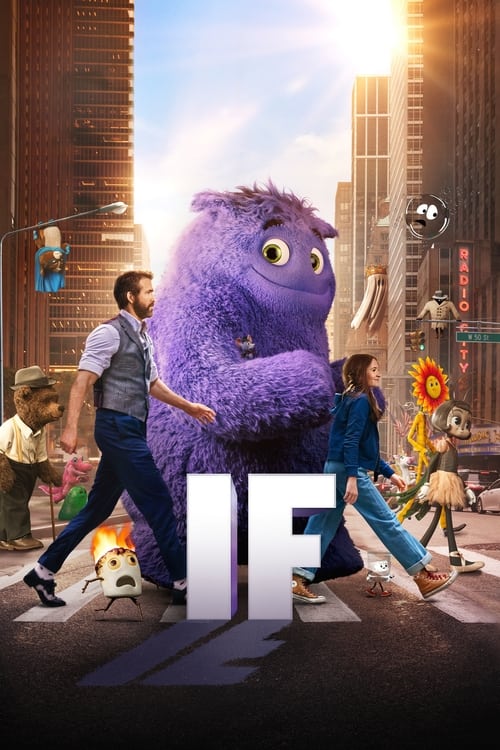
IF
None or negligible
A family fantasy about a grieving girl who can see other children's forgotten imaginary friends, with a mixed cast and no progressive messaging at all.
John Krasinski's family fantasy follows Bea (Cailey Fleming), a 12-year-old who lost her mother and is staying with her grandmother in New York while her father waits for heart surgery. She finds she can see imaginary friends, or IFs, and teams up with Cal (Ryan Reynolds), the grumpy neighbour upstairs, who is trying to find new children for IFs whose own children have grown up and forgotten them, before they fade away.
There is nothing here for the rubric to find. The film is about grief, growing up and memory: an IF support group, a retirement home for imaginary friends on Coney Island, the grandmother's lost dream of being a dancer, and Bea's fear of losing her father the way she lost her mother. A boy on the children's ward and a few nurses and passers-by give the cast some variety, but race, sex and politics never come up.
There is nothing here for the rubric to find. The film is about grief, growing up and memory: an IF support group, a retirement home for imaginary friends on Coney Island, the grandmother's lost dream of being a dancer, and Bea's fear of losing her father the way she lost her mother. Bea learns that Blossom is her grandmother's IF and helps her remember, reunites Blue with his grown-up boy, tells her father a story that brings him round after surgery, and finally realises Cal was her own IF all along. A boy on the children's ward and a few nurses and passers-by give the cast some variety, but race, sex and politics never come up.
With no speeches on social themes, no villain and no politics, the score is zero. The one scene that sounds like a set-up for a message, the imaginary friends' group therapy session, is played for jokes about forgotten IFs, and the film's few speeches are about holding on to childhood memories.
Score breakdown
Each category is scored 0 to 3: 0 absent or presence only, 1 brief, 2 recurring or plot-relevant, 3 central or dominant. Timestamps refer to the film's running time.
| Category | Score | What we saw |
|---|---|---|
| Content | ||
| A Race and ethnicity | 0 | Race is never mentioned. Bea's family is white; Benjamin on the children's ward (0:16:11) and some of the hospital staff are not, shown without comment. No interracial couple appears in the dialogue or the sampled frames. |
| B Gender and feminism | 0 | Bea is a determined girl who takes charge of the IF placements (0:36:44), but her sex is never a point. The grandmother's line that no one wants to see an old woman dance (1:06:56) is about growing old, not about women's roles. |
| C Sexuality and gender identity | 0 | No LGBTQ+ characters or themes. |
| D Power and systems | 0 | No institutions are criticised. The hospital is a place of care (0:07:14). |
| E Cultural and historical revision | 0 | An original story. The old film Harvey, about an invisible friend, plays on a television (0:10:34), but no established characters or history are recast. |
| F Religion portrayal | 0 | Religion plays no part. |
| Treatment | ||
| G Antagonist coding | 0 | There is no antagonist. The only friction comes from Cal's reluctance and Bea's grief. |
| H Didacticism | 0 | The film's speeches are about memory and growing up: Lewis tells Bea that nothing you love is ever forgotten (1:01:07), and Bea tells her unconscious father a story about a girl who tried too hard to grow up (1:25:09). None carries a social message. |
| I Message over story | 0 | The story leads throughout. |
| J Left-leaning politics framed as good | 0 | No political positions appear. |
How the number is reached
- Categories A to J add up to 0 of 30, which gives 0.0 (0 ÷ 30 × 10, rounded to the nearest 0.5).
- No counterweight: There is no progressive messaging to mock or complicate.
- Final rating 0.0, none or negligible.
Considered, scored 0
- Benjamin, a boy on the children's ward (0:16:11, 0:52:34), and a mixed background cast at the hospital, shown without comment.
- The imaginary friends' group therapy session (0:40:39), played as comedy about forgotten IFs rather than as a social point.
- Bea as the girl who runs the IF auditions (0:54:14), character rather than a point about gender.
- The grandmother's remark that no one wants to see an old woman dance (1:06:56), about age and lost dreams, not a point about women.
Evidence and confidence
Confidence: Medium. Full English subtitles from the embedded track, and 107 frames sampled once a minute. Several stretches are music or action with no dialogue (for example 1:09:05 to 1:12:07 and 1:17:09 to 1:18:48); the sampled frames cover them.
Category F definition: As in the rubric: Islam shown as a peaceful and tolerant religion, aligned with human rights, in a way that works as a corrective message.
Rubric version 1. Reviewed 18 November 2026.