Woke rating
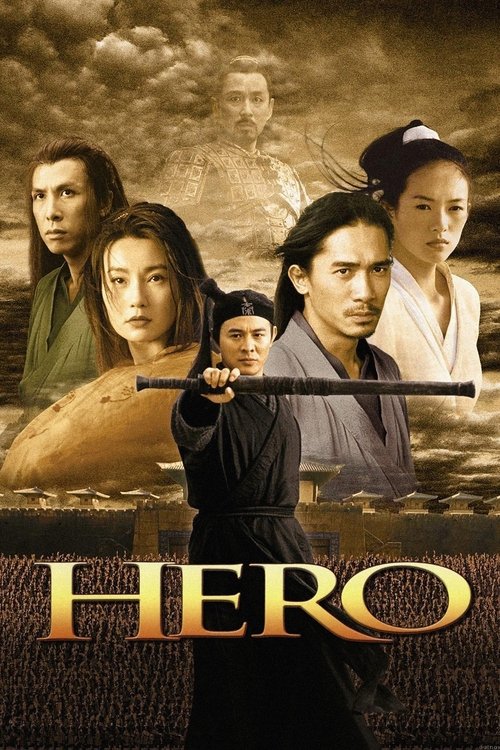
Hero
None or negligible
Zhang Yimou's lavish wuxia epic about the assassins who sought the King of Qin's life carries no progressive messaging; its own argument, about peace and the greater good, is of a different kind.
Zhang Yimou's martial-arts epic is set in China's Warring States period. Nameless (Jet Li), a minor county prefect, is summoned to the palace of the King of Qin (Chen Daoming), the future First Emperor, to tell how he killed the three assassins who had threatened the King for years: Sky (Donnie Yen), Flying Snow (Maggie Cheung) and Broken Sword (Tony Leung). Each kill earns him the right to sit closer to the King, and his story is told and retold in colour-coded versions as the King questions it.
Nothing in it touches the rubric's themes. A Zhao calligraphy master tells his students that Qin's arrows may destroy their kingdom but never their culture; Flying Snow is avenging a father killed fighting Qin; and Flying Snow and Broken Sword's servant Moon fight as ably as any man. The film's own argument, which comes to a head at the end, is about peace and a unified China under one ruler, and it is stated in speeches.
Nothing in it touches the rubric's themes. A Zhao calligraphy master tells his students that Qin's arrows may destroy their kingdom but never their culture; Nameless, it emerges, is a man of Zhao whose family Qin's soldiers killed, and Flying Snow is avenging a father killed fighting Qin; and Flying Snow and Broken Sword's servant Moon fight as ably as any man. The film's own argument is that the King must not be killed: Broken Sword persuades Nameless that only Qin can end the wars by uniting 'all under Heaven' and that one person's suffering counts for little against that of many, so Nameless spares the King and is executed, and the closing titles credit the Emperor with founding China's first dynasty and building the Great Wall.
That argument is not progressive in the rubric's sense: it putssides with the conqueror and puts the greater good of a unified state above individual and local loyalties, so it is noted rather than scored. With no progressive messaging to count, every category is zero and there is nothing for a counterweight to offset.
Score breakdown
Each category is scored 0 to 3: 0 absent or presence only, 1 brief, 2 recurring or plot-relevant, 3 central or dominant. Timestamps refer to the film's running time.
| Category | Score | What we saw |
|---|---|---|
| Content | ||
| A Race and ethnicity | 0 | Race and ethnicity never come up; the cast is entirely Chinese and the conflict is between kingdoms. The only couple, Broken Sword and Flying Snow, is not interracial. |
| B Gender and feminism | 0 | Flying Snow, a general's daughter who inherited his sword (1:15:04), and Moon fight as equals to the men, a convention of the genre, but gender is never argued. |
| C Sexuality and gender identity | 0 | No LGBTQ+ content. The love story is Broken Sword and Flying Snow's, with jealousy and a rival affair in one of the retold versions (0:34:47). |
| D Power and systems | 0 | The King of Qin's wars are the backdrop and the assassins' motives come from what Qin did to their families (1:15:04), but the film does not frame this as a system oppressing a groupends up siding with the King's unification; there is no critique of an institution as oppressor. |
| E Cultural and historical revision | 0 | A retelling of the legendary attempts on the life of the King of Qin, the future First Emperor. The film shapes the legend toward its own theme (noted below), but nothing is recast or revised to carry a progressive message. |
| F Religion portrayal | 0 | Islam does not feature. |
| Treatment | ||
| G Antagonist coding | 0 | The King is the assassins' target, but he is given his own reasons and becomes a complex figurethe film's most understood figure, with a stated motive of ending the wars (1:25:42); no one is coded by group. |
| H Didacticism | 0 | There are speeches with a message, Broken Sword's case for unity under one ruler (1:24:57) and Nameless's account of the swordsman's highest ideal of peace (1:29:38), but the message is not a progressive one; see notScored. |
| I Message over story | 0 | The story is built to deliver the film's theme, but that theme is not progressive messaging. |
| J Left-leaning politics framed as good | 0 | No left-leaning politics. The King's plan to impose one style of writing across his empire (0:24:56) and the film's case for unity under one strong ruler sit closer to statism and nationalism than to the rubric's left; see notScored. |
How the number is reached
- Categories A to J add up to 0 of 30, which gives 0.0 (0 ÷ 30 × 10, rounded to the nearest 0.5).
- No counterweight: There is no progressive messaging to mock or complicate.
- Final rating 0.0, none or negligible.
Considered, scored 0
- The Zhao calligraphy master telling his students that Qin's arrows may topple their kingdom but can never obliterate their culture (0:23:08), a moment of defiance the film does not build into a message about oppression.
- Flying Snow and Moon as warriors the equal of the men (frames 0:40:30, 0:41:30), a convention of the genre.
- The assassins' grievances against QinNameless's and Flying Snow's grievances against Qin, which killed his family (1:05:17) and her father (1:15:04), personal motives in the plot.
Evidence and confidence
Confidence: Medium. Full English subtitles from a sidecar file, and 109 frames sampled once a minute, the last five of them end credits. The subtitles are terse and slightly garbled in places (two lines run together at 1:33:21), and the long wordless fight scenes are known from the frames only. The file runs about 1 h 49 min with credits, longer than the 99 minutes listed, so timestamps may not match other releases.
Category F definition: As in the rubric: Islam shown as a peaceful and tolerant religion, aligned with human rights, in a way that works as a corrective message.
Noted, not scored: The film's closing argument puts peace and a unified state under one strong ruler above individual and local loyaltiesBroken Sword persuades Nameless that only the King of Qin can end the wars by uniting 'all under Heaven' and that one person's suffering is nothing against the suffering of many (1:24:57); Nameless spares the King for the sake of peace (1:30:19), and the closing titles praise the First Emperor for founding China's first dynasty and building the Great Wall (1:43:19). This is political messaging of its own, but not progressive, so it is noted rather than scored.
Rubric version 1. Reviewed 18 November 2026.