Woke rating
Hamnet
None or negligible
A grief-filled period drama about Shakespeare's wife and children with no political messaging; only its sympathetic portrait of an unconventional woman registers on the scale, and only lightly.
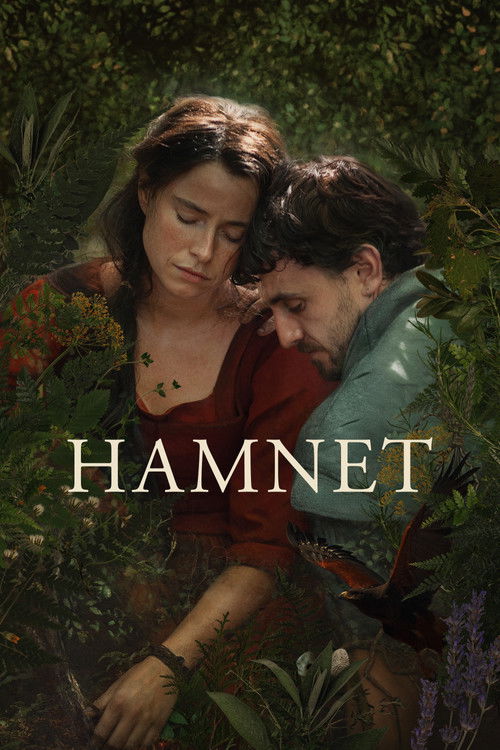
Chloé Zhao's adaptation of Maggie O'Farrell's novel imagines the family life behind Hamlet. A shy Latin tutor (Paul Mescal), named as William Shakespeare only late in the film (1:36:35), falls for Agnes (Jessie Buckley), who keeps a hawk, knows her herbs and is whispered about in Stratford as a forest witch's daughter. They marry over both families' objections and have three children, and he goes to London to write while she stays behind with them.
The second half turns on the pestilence reaching the family and on the grief that follows, which the film carries through to a performance at the Globe. The only thing the rubric picks up is the portrait of Agnes: a free, nature-bound woman with a female line of second sight (0:20:08), mistrusted by the town and by Will's family, beside a father-in-law who silences his wife and beats his son (0:22:48, 0:30:41). The film is on her side, but it never makes a point about women.
The second half turns on the pestilence: Judith falls ill, Hamnet offers his life for hers and dies (1:07:51, 1:14:21), and Agnes's grief and Will's absence nearly break the marriage, until she watches Hamlet at the Globe and sees their son in it (1:45:30). The only thing the rubric picks up is the portrait of Agnes: a free, nature-bound woman with a female line of second sight (0:20:08), mistrusted by the town and by Will's family, beside a father-in-law who silences his wife and beats his son (0:22:48, 0:30:41). The film is on her side, but it never makes a point about women.
Nothing else registers. The pregnancy before the wedding, the twins' clothes-swapping game and Agnes's vow to stay silent in church are period story told without comment. There are no villains, no speeches about society and no politics, so the score rests on one light point.
Score breakdown
Each category is scored 0 to 3: 0 absent or presence only, 1 brief, 2 recurring or plot-relevant, 3 central or dominant. Timestamps refer to the film's running time.
| Category | Score | What we saw |
|---|---|---|
| Content | ||
| A Race and ethnicity | 0 | Race never comes up. The families and townspeople are English villagers, and no interracial couple appears in the dialogue or the sampled frames. |
| B Gender and feminism | 1 | The story is told largely from the wife's side, and Agnes is drawn as an independent woman with knowledge handed down from mother to daughter, gossiped about as a witch's child and vindicated by the film. Will's father hushes his wife while he bargains over the marriage (0:22:48). Kept at 1: it is background characterisation, never argued as a point about men or women.
|
| C Sexuality and gender identity | 0 | No LGBTQ theme and no argument about sex. Agnes is pregnant before the wedding and Will says there is no sin in it because they are handfasted (0:22:18), a single line in a family row; the twins' swapping of clothes is a children's trick (see 'zeroed'). |
| D Power and systems | 0 | No institution is criticised. The bawdy court is mentioned once, as a threat used to settle the marriage (0:23:00). |
| E Cultural and historical revision | 0 | Adapted from Maggie O'Farrell's 2020 novel, which imagines the Shakespeares' family life. Shakespeare's wife is called Agnes, as in the book; no established character is recast with another sex or ethnicity, and the speculation carries no identity message. |
| F Religion portrayal | 0 | Islam does not appear. Religion shows only as Agnes's old herb charm and her vow to attend church without speaking there (0:15:37, 0:43:12). |
| Treatment | ||
| G Antagonist coding | 0 | There are no villains. Will's father is harsh and violent (0:30:41) but drawn as a man with debts and pride, and the stepmother's hostility is personal. |
| H Didacticism | 0 | No speeches carry a social message. The longest speeches are the Orpheus story (0:12:59), Will's mother on the children she lost (1:04:03) and passages from Hamlet. |
| I Message over story | 0 | The story leads throughout, and nothing bends toward a message. |
| J Left-leaning politics framed as good | 0 | No political positions appear. |
How the number is reached
- Categories A to J add up to 1 of 30, which gives 0.5 (1 ÷ 30 × 10, rounded to the nearest 0.5).
- No counterweight: There is too little messaging to mock or complicate.
- Final rating 0.5, none or negligible.
Considered, scored 0
- Agnes's pregnancy before the wedding, defended once as no sin under a handfast (0:22:18), period story with no advocacy.
- Hamnet and Judith swapping clothes to fool their father (0:46:20, 0:47:03), a twins' game that returns when Judith says Hamnet changed places with her and tricked death (1:16:26).
- Will's father's violence toward his son (0:30:41) and Will's warning to Hamnet to keep away from him (0:51:36), family conflict rather than a point about men.
- Agnes's herb charm and her vow to stay silent in church (0:15:37, 0:43:12), a character's grief and upbringing, not an argument against the Church.
Evidence and confidence
Confidence: Medium. Full English subtitles from the embedded track, and 126 frames sampled once a minute. Several stretches have no dialogue (0:25:04 to 0:27:24, 0:57:00 to 0:59:53, 1:37:35 to 1:39:34, and the closing minutes after 1:55:45) and were seen only through the frames; the first frame is a studio logo and the last seven are end credits.
Category F definition: As in the rubric: Islam shown as a peaceful and tolerant religion, aligned with human rights, in a way that works as a corrective message.
Rubric version 1. Reviewed 18 November 2026.