Woke rating
Full Metal Jacket
Mild
Stanley Kubrick's Vietnam War film satirises how the Marine Corps turns recruits into killers and how the war was sold, but it argues for no cause and mocks its peace-button hero as freely as the brass.
Stanley Kubrick's adaptation of Gustav Hasford's novel The Short-Timers comes in two halves. The first is boot camp on Parris Island, where Gunnery Sergeant Hartman (R. Lee Ermey) abuses his recruits into Marines and singles out the overweight, slow Leonard Lawrence (Vincent D'Onofrio), whom he renames Gomer Pyle. The second follows Joker (Matthew Modine), now a correspondent for the military paper Stars and Stripes, through the Tet Offensive and into the street fighting in Hue with the squad of his boot-camp friend Cowboy.
The film's target is the machine that makes and uses killers. Hartman fuses manhood, sex, God and country into killing, and holds up Charles Whitman and Lee Harvey Oswald as what a motivated Marine can do with a rifle; the boot-camp half ends in a breakdown. In Vietnam the military paper invents kills and renames search and destroy, a helicopter gunner boasts of shooting women and children, a colonel says that inside every Vietnamese is an American trying to get out, and a Marine scoffs that the war is a slaughter, not a fight for freedom.
The film's target is the machine that makes and uses killers. Hartman fuses manhood, sex, God and country into killing, and holds up Charles Whitman and Lee Harvey Oswald as what a motivated Marine can do with a rifle; Pyle, by graduation the platoon's best shot, turns his rifle on Hartman and then himself. In Vietnam the military paper invents kills and renames search and destroy, a helicopter gunner boasts of shooting women and children, a colonel says that inside every Vietnamese is an American trying to get out, and a Marine scoffs that the war is a slaughter, not a fight for freedom. The sniper who picks off the squad turns out to be a teenage girl, and Joker finishes her off at her own plea.
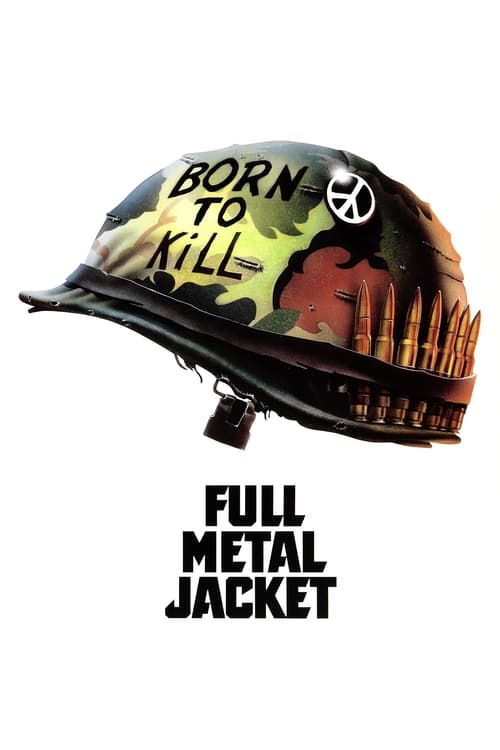
What keeps the score mild is that none of it is identity politics and very little is argued. The constant racial and homophobic slurs are the Marines' own language, not the film's message; nobody gives a speech for a cause; and the satire cuts every way. Joker's peace button sits beside 'Born to Kill' on his helmet, the Marines interviewed for television range from doubting the war to wanting to bomb the North, and the enemy's own massacre of civilians in Hue is shown.
Score breakdown
Each category is scored 0 to 3: 0 absent or presence only, 1 brief, 2 recurring or plot-relevant, 3 central or dominant. Timestamps refer to the film's running time.
| Category | Score | What we saw |
|---|---|---|
| Content | ||
| A Race and ethnicity | 0 | Racial slurs and jokes run through the film, from Hartman's 'no racial bigotry' roll call of slurs (0:02:27) to racial jibes among squadmates (1:08:55, 1:30:50), and 'gook' for every Vietnamese. They are the characters' language, shown as part of the brutality and never argued. No interracial couple is shown; the prostitutes' haggling with the Marines is a transaction, not a couple. |
| B Gender and feminism | 1 | Boot camp ties manhood and sex to killing: recruits are called ladies, rifles get girls' names, and the Corps promises to make indestructible men. It is a satire of how the military makes men, not a gender argument, and women appear mostly as prostitutes and as the enemy sniper.
|
| C Sexuality and gender identity | 0 | No LGBTQ+ theme. Hartman's homophobic insults (0:05:22, 0:06:09) are abuse in character, not a message. |
| D Power and systems | 2 | The military machine is the film's recurring target: the Corps is shown manufacturing killers with fatal results, its newspaper spinning the war, and its officers condescending to the Vietnamese they claim to help. It is carried by satire and irony rather than argued, it is not framed as the oppression of a group, and the enemy's own atrocities are shown, so 2, not 3.
|
| E Cultural and historical revision | 0 | An adaptation of Gustav Hasford's novel, set in the Tet Offensive and the battle for Hue. No established characters or history are recast to carry a message. |
| F Religion portrayal | 0 | Islam does not appear. Religion is the Corps' Christmas sermon and Hartman's Virgin Mary demands, scored under J. |
| Treatment | ||
| G Antagonist coding | 1 | The figures of folly are the military establishment, from Hartman to the gung-ho colonel and the newsroom editor. But they are individuals rather than ideological strawmen: Hartman is cruel yet fair by his own lights and gets results, and the real enemy is the North Vietnamese army, whose sniper kills three Marines.
|
| H Didacticism | 1 | There are no speeches for a cause. A few on-the-nose lines state the film's themes, chiefly Joker's 'duality of man' and one Marine's scorn for fighting for freedom.
|
| I Message over story | 1 | The story leads, but the Vietnam half is episodic and several set pieces exist mainly to land a satirical point: the newsroom, the colonel's peace-button scene and the to-camera interviews.
|
| J Left-leaning politics framed as good | 1 | The Corps' fusion of God, country and anti-communism is mocked, and 'freedom' as a war aim is scorned. But no left-leaning cause is framed as good: the peace button is a pose Joker cannot explain and he ends the film a killer.
|
How the number is reached
- Categories A to J add up to 7 of 30, which gives 2.5 (7 ÷ 30 × 10, rounded to the nearest 0.5).
- Counterweight −0.5: The satire cuts every way: Joker's peace button sits beside 'Born to Kill' and he cannot explain it (1:04:38), the Marines interviewed for television range from doubting the war to wanting to bomb the North and win (1:21:16, 1:22:18, 1:22:34), and the North Vietnamese army's mass execution of civilians in Hue is shown (1:03:32, 1:04:13).Joker's peace button sits beside 'Born to Kill' and he cannot explain it (1:04:38), and he ends the film having killed (1:50:18); the Marines interviewed for television range from doubting the war to wanting to bomb the North and win (1:21:16, 1:22:18, 1:22:34); and the North Vietnamese army's mass execution of civilians in Hue is shown (1:03:32, 1:04:13).
- Final rating 2.0, mild.
Considered, scored 0
- Hartman's slurs against every group in his opening speech (0:02:29) and the Marines' 'gooks' and 'zipperheads' throughout (0:49:38, 1:09:43), the characters' language.
- Racial jibes among squadmates: a racist joke in the press office (0:54:13), 'jungle bunny' (1:08:55), the prostitute's refusal of Eightball and the taunts around it (1:24:25 to 1:25:20), and a slur as Eightball is sent on point (1:30:50); banter, not argument.
- Hartman's homophobic insults (0:05:22, 0:06:09), abuse in character.
- Vietnamese prostitutes haggling with Joker and Rafterman (0:46:13) and with the squad (1:23:30); no couple is shown.
- Black Marines in the platoon, the press office and the squad (frames 0:32:30, 0:53:30, 1:21:30), shown without comment.
- The sniper's identityThe sniper being a teenage girl (frame 1:47:30), a twist about the enemy, not a point about women.
Evidence and confidence
Confidence: Medium. A Whisper transcript of the English audio (the file has no English text subtitles) and 116 frames sampled once a minute; the last three are end credits and the HDR frames look washed out. Whisper garbles some words and names (Tet, Hue, Corps) and runs several drill-scene lines together, and the Vietnamese exchanges, chiefly the pimp and prostitute (1:24:20) and the sniper's last words (1:47:03), are not translated.
Category F definition: As in the rubric: Islam shown as a peaceful and tolerant religion, aligned with human rights, in a way that works as a corrective message.
Noted, not scored: Some points cut the other way: the North Vietnamese army's execution of civilians in Hue (1:04:13), Marines in the interviews saying they should win, that they are the best, and that the North should be bombed (1:20:41, 1:22:18, 1:22:34), and Hartman's graduation speech on the brotherhood of Marines (0:38:32).
Rubric version 1. Reviewed 18 November 2026.