Woke rating
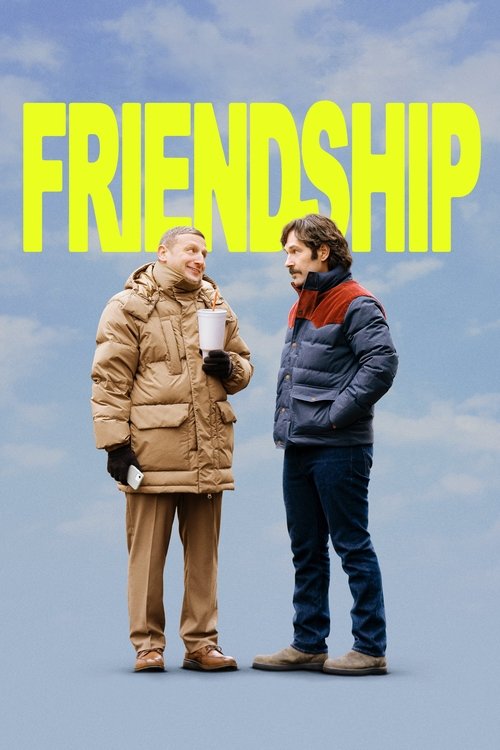
Friendship
None or negligible
A cringe comedy about a lonely suburban dad's obsession with his cool new neighbour; its only scored point is a light running jab at manipulative tech work, and it carries no identity or political messaging.
Andrew DeYoung's comedy follows Craig Waterman (Tim Robinson), a suburban dad who designs habit-forming apps and whose wife Tami (Kate Mara) is a year past cancer. A misdelivered package brings him to his new neighbour Austin (Paul Rudd), a local TV weatherman with a band and a taste for urban exploring. Craig is smitten with the friendship, and his clumsy efforts to keep it alive start wrecking his job, his marriage and Austin's patience.
There is little to score. Craig's job, making apps addictive and later pitching a mayor's campaign on giving people 'the illusion of self-expression', is a recurring jab at manipulative tech, and Austin likes to call bankers criminals and the police pigs. The film's real subject is male loneliness and the awkwardness of making friends as an adult, played for discomfort rather than argued. Women, race and sexuality carry no message; Tami's decision to leave Craig is a personal turn, not a gender point, and the cast is mixed without comment.
What keeps the score at the bottom of the scale: there are no speeches, no villains defined by identity and no politics beyond a band named for hating the mayor. Austin's rebel pose is itself a joke: he quits the band when his bosses call it a bad look and poses happily with police officers for a selfie.
Score breakdown
Each category is scored 0 to 3: 0 absent or presence only, 1 brief, 2 recurring or plot-relevant, 3 central or dominant. Timestamps refer to the film's running time.
| Category | Score | What we saw |
|---|---|---|
| Content | ||
| A Race and ethnicity | 0 | No race theme. The cast is mixed, and no interracial couple appears in the dialogue or the sampled frames. |
| B Gender and feminism | 0 | The film is about male friendship and loneliness, played for awkward comedy rather than as a statement about masculinity or women. Tami's arc is personalTami leaves Craig, citing her mother's failure to leave a narcissistic father (1:12:38), but as a personal decision, not a gender message. |
| C Sexuality and gender identity | 0 | No LGBTQ content. Craig's crush-like devotion to Austin is played as platonic male friendship, and Tami's frank talk about sex after cancer is character detail. |
| D Power and systems | 1 | A light, recurring jab at the attention economy through Craig's job, and Austin's throwaway digs at banks, police and the mayor. None of it is framed as oppression of a group, and the police on screen simply do their jobs.
|
| E Cultural and historical revision | 0 | An original story. No established characters or history are recast. |
| F Religion portrayal | 0 | Islam does not feature, and religion plays no part in the story. |
| Treatment | ||
| G Antagonist coding | 0 | There are no ideological villains. Austin and his friends are simply the cool crowd Craig wants into, and the conflict comes from Craig's own behaviour. |
| H Didacticism | 0 | No speeches state a message. Lines such as 'people need rules' (0:33:43) are deadpan comedy, not lectures. |
| I Message over story | 0 | The story is driven by Craig's escalating awkwardness, and nothing in it bends toward a message. |
| J Left-leaning politics framed as good | 0 | No politics are argued. The mayor is a punchline, and a party guest's aside about Afghanistan (1:06:17) is an awkward non sequitur. |
How the number is reached
- Categories A to J add up to 1 of 30, which gives 0.5 (1 ÷ 30 × 10, rounded to the nearest 0.5).
- No counterweight: None needed. The film does mock Austin's anti-establishment pose: he quits his band because his bosses call it a bad look (0:54:53) and poses for a selfie with the officers he once called pigs (0:55:36). But that is already why D stays at 1, and the tech satire has no other side to weigh.
- Final rating 0.5, none or negligible.
Considered, scored 0
- A racially mixed cast, including several of Austin's friends and the people at the mayor's campaign meeting (0:25:30, 0:58:30), shown without comment.
- Craig's crush-like attachment to Austin and their closing exchange of 'I love you' (1:33:58), played as platonic friendship.
- Boys'-night rituals such as basement boxing (0:25:00), the film's comic subject rather than a statement about masculinity.
- Tami's growing independenceTami leaving Craig and citing her mother's failure to leave a narcissistic father (1:12:38), a personal turn, not a gender message.
- Tami's frank talk about cancer and sex at a support group (0:02:11), character detail.
Evidence and confidence
Confidence: Medium. Full English subtitles from the embedded track and 100 frames sampled once a minute. Many frames are dark (night, basement and tunnel scenes), which makes background detail hard to check in places.
Category F definition: As in the rubric: Islam shown as a peaceful and tolerant religion, aligned with human rights, in a way that works as a corrective message.
Rubric version 1. Reviewed 17 November 2026.