Woke rating
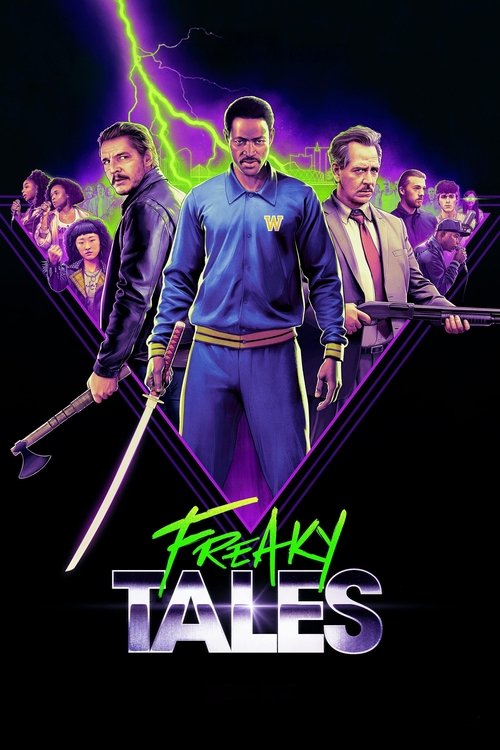
Freaky Tales
Mild
A pulpy anthology set in 1987 Oakland whose underdog heroes take on Nazi skinheads, a leering lawman and a racist crime boss, giving it a clear anti-racist and feminist edge that rides on genre action rather than speeches.
Ryan Fleck and Anna Boden's anthology is set in Oakland in 1987, where a mysterious green force touches four linked tales. Teenage punks at the Gilman Street club defend it from Nazi skinheads; two girls in a rap duo, Danger Zone, get a shot at battling Too $hort; a weary debt collector, Clint, tries to quit; and Warriors guard Sleepy Floyd plays the game of his life against the Lakers. It is a loud, comic-book mash-up of punk, hip-hop, crime film and kung-fu revenge.
Its heroes are Oakland's underdogs and its villains are racists. The skinheads hurl racial and homophobic slurs, and the punks debate whether to meet them with violence before voting to fight. The rap duo are leered at by a man with a badge and then win over a crowd with a verse that mocks Too $hort's attitude to women. The last tale's crime boss is openly racist. A few lines tie all this to Oakland's history, from the Black Panthers to the skinheads.
Its heroes are Oakland's underdogs and its villains are racists. The skinheads hurl racial and homophobic slurs, and the punks debate whether to meet them with violence before voting to fight. The rap duo are leered at by a man with a badge and then win over a crowd with a verse that mocks Too $hort's attitude to women. That same lawman is the last tale's crime boss: he spares the Warriors' one white player when his crews rob the team's homes, cheers on his skinhead son, and one of his crews kills Sleepy's girlfriend, so Sleepy cuts down the boss and his men with a sword. A few lines tie all this to Oakland's history, from the Black Panthers to the skinheads.
What keeps the score in the mild band is that the film mostly shows rather than tells. Its message lines are short and in character, the club's debate gives the pacifists and the member who wants to hire police a hearing, and the heroes are no saints: Clint is a hired fist with a violent pastwho once killed a man in front of his son, and Too $hort takes his drubbing in good humour. The anti-racist and feminist edge is clear, but it is carried by the genre plot, not by lectures.
Score breakdown
Each category is scored 0 to 3: 0 absent or presence only, 1 brief, 2 recurring or plot-relevant, 3 central or dominant. Timestamps refer to the film's running time.
| Category | Score | What we saw |
|---|---|---|
| Content | ||
| A Race and ethnicity | 2 | Racism marks the villains in every tale: skinheads' slurs, a lawman's racial come-ons to two Black girls, a poker player's sneer at Asians, and a crime boss who resents Black playersa crime boss who spares the one white player on the team he robs. A couple of lines tie it to Oakland's history. Chapter one's budding romance between Lu, who is white, and Tina, who is Asian, is also interracial. Scored 2: recurring, but the film does not argue about race beyond a few lines.
|
| B Gender and feminism | 2 | The second tale is about two Black teenage girls pushing into a male scene: they are leered at, taken for groupies, and then win over Too $hort's crowd with a rap that skewers his lyrics about women. It is one chapter of four, and the closing-credits song returns to the theme.
|
| C Sexuality and gender identity | 1 | Homophobia is a villain trait: the skinheads' slurs, the club's rule against it, and a father's approval of his son's plan to attack gay menthe crime boss's approval of his skinhead son's plan to attack gay men. There is no LGBTQ+ character or storyline.
|
| D Power and systems | 2 | The police offer no protection. The punks reject hiring off-duty cops, with a jibe that Oakland's police gave rise to the Black Panthers, the rap duo's rhymes say 'they don't protect us', and the most prominent lawman is a predatorthe badge-carrying man who leers at the two Black girls turns out to be the racist crime boss behind the burglaries. It is one corrupt officer rather than an argument about policing, but he drives the plot.
|
| E Cultural and historical revision | 0 | Real people and places (the Gilman club, Too $hort, Sleepy Floyd's record playoff quarter) are folded into an openly tall tale, but nothing is recast to carry a message; the narrator presents the last chapter as legend. |
| F Religion portrayal | 0 | Islam does not feature. |
| Treatment | ||
| G Antagonist coding | 2 | The main villains are Nazi skinheads, defined by nothing but hate, and a racist crime bossa racist lawman-turned-crime-boss whose son is one of the skinheads, while the heroes are the people they target. The boss does have a plain profit motive, and the third tale's antagonists act from debt and revenge.
|
| H Didacticism | 1 | A few lines state the message outright, short and in character: the club's debate about meeting Nazis with violence, Lenny G's reminder that being a Nazi is not cool, and a closing joke ad inviting racists to a mind-blowing seminar.
|
| I Message over story | 0 | The story leads. The links between chapters are anthology plotting, and the revenge fantasy is the genre's own logic rather than the plot bending to make a point. |
| J Left-leaning politics framed as good | 1 | The punks' house rules against racism, sexism and homophobia, and their vote to fight the Nazis, are framed as the heroic side, and the Black Panthers get an approving nod. There is no party politics or wider cause.
|
How the number is reached
- Categories A to J add up to 11 of 30, which gives 3.5 (11 ÷ 30 × 10, rounded to the nearest 0.5).
- Counterweight −0.5: The film complicates its heroes and gives the other side of its one debate a hearing: the pacifist and the member who wants to hire police argue their case before being outvoted (0:12:10, 0:12:56); Clint, the most sympathetic lead, maims a gambler's hand to settle a debt (0:51:36) and has a killing in his pastand once killed a young man's father, who comes back for revenge (0:55:27); and Too $hort, the target of the women's rap, is a good sport who dares them to top him (0:38:30).
- Final rating 3.0, mild.
Considered, scored 0
- A racially mixed Oakland cast across all four tales, shown as the city's mix without comment beyond the villains' slurs.
- Clint and his pregnant wife (0:43:11), a couple shown without comment; their banter is about movies and punk music.
- Too $hort's explicit lyrics and the chapter's sex jokes (0:30:15, 0:35:03), period colour rather than sexual-freedom advocacy.
- Sleepy Floyd's real 1987 playoff game spun into a tall taleSleepy Floyd's real record quarter against the Lakers turned into a sword-swinging revenge tale, openly told as legend (1:17:43): genre fantasy, not history revised to carry a message.
- The video-store owner steering Clint from Big Trouble in Little China to Chan Is Missing as a more nuanced portrait of Chinatown (0:47:22), a film-buff aside.
- The Psytopics school and its cosmic green force (0:27:45, 0:33:15), a running joke rather than a statement about religion.
Evidence and confidence
Confidence: Medium. Full English subtitles (the embedded track, read by OCR, which came out clean) and 107 frames sampled once a minute; the last seven or so are end credits. Several action stretches have no dialogue (for example 1:23:28 to 1:25:10 and 1:35:21 to 1:36:37) and were judged from the frames, which are dark in the last chapter.
Category F definition: As in the rubric: Islam shown as a peaceful and tolerant religion, aligned with human rights, in a way that works as a corrective message.
Rubric version 1. Reviewed 18 November 2026.