Woke rating
Fly Me to the Moon
None or negligible
A breezy Apollo 11 romantic comedy with a few period jokes about 1960s sexism and Richard Nixon. It plays patriotism and faith straight, and its messaging is negligible.
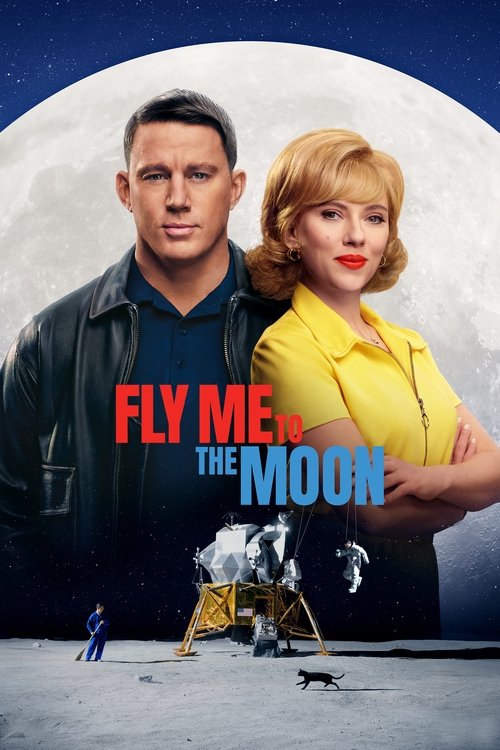
Greg Berlanti's period romantic comedy follows Kelly Jones (Scarlett Johansson), a New York advertising executive with a murky past. At the end of 1968 a White House fixer, Moe Berkus (Woody Harrelson), sends her to Cape Canaveral to sell the Apollo program to a tired public and a stingy Congress. She clashes with, and falls for, launch director Cole Davis (Channing Tatum), a decorated Korean War pilot kept out of the astronaut corps by a heart condition. Along the way she lands tie-ins with Omega and Tang, works on wavering senators and, on Moe's orders, secretly stages a fake moon landing as a backup.
The messaging comes as a handful of period jokes. Ford executives mistake Kelly for a stenographer and boast that their firm is progressive because it employs women in the steno pool (0:06:00, 0:06:11). Her assistant Ruby calls herself a card-carrying feminist and does not want to work for Nixon (0:13:52). Kelly needles Cole about women engineers at NASA he has never heard of (0:31:49) and calls 1968 a year of assassinations and a heinous war (0:27:13). The schemer behind the fake landing is the Nixon White House's man.
The messaging comes as a handful of period jokes. Ford executives mistake Kelly for a stenographer and boast that their firm is progressive because it employs women in the steno pool (0:06:00, 0:06:11). Her assistant Ruby calls herself a card-carrying feminist and does not want to work for Nixon (0:13:52). Kelly needles Cole about women engineers at NASA he has never heard of (0:31:49) and calls 1968 a year of assassinations and a heinous war (0:27:13). The schemer is the Nixon White House's man: Moe secretly decides to air the fake landing no matter what, so the world will not live under a communist moon (1:25:14, 1:25:56), and Ruby sums it up as what happens when you work for Richard Nixon (1:29:58).
The score stays near zero because none of this is argued. The jabs are one-liners, and the plot runs on the romance and the fake-landing caper. Kelly herself mocks Ruby's activism (0:08:53, 0:09:01). Cole's patriotism and Christian faith get a sincere hearing and win the day: he tells Kelly what it means to be American (0:40:13), wins over a religious senator by saying science has brought him closer to God (1:15:34), and closes the film on the idea that the truth stays true even if nobody believes it (2:05:35). Moe has a plain Cold War motive and is played for comedy.
Score breakdown
Each category is scored 0 to 3: 0 absent or presence only, 1 brief, 2 recurring or plot-relevant, 3 central or dominant. Timestamps refer to the film's running time.
| Category | Score | What we saw |
|---|---|---|
| Content | ||
| A Race and ethnicity | 0 | Race never comes up. Cole's engineering team includes a Black engineer, shown without comment (frames 0:03:30, 1:32:30, 1:48:30). The central couple and the other couples seen are not interracial. |
| B Gender and feminism | 1 | Sexism in the 1960s workplace is played for a few laughs and one pointed exchange, and Kelly outsmarts the men around her. Women's place is not a theme of the film.
|
| C Sexuality and gender identity | 0 | No LGBTQ theme. The commercials director Lance is told to buy his boyfriend a Christmas present (0:10:47), a passing detail with no comment. |
| D Power and systems | 1 | The government, through a White House fixer, is behind the fake-landing scheme and quietly decides to air it, and the Vietnam War is called heinous once. The target is Cold War image-making, played for comedy, not oppression of a group.
|
| E Cultural and historical revision | 0 | An original story built around the real Apollo 11 mission. The fake-landing backup is a comic invention, and the real astronauts and NASA staff who are named are not recast to make a point. |
| F Religion portrayal | 0 | Islam does not come up. Religion appears only as a Christian senator's faith and Cole's, both treated with respect. |
| Treatment | ||
| G Antagonist coding | 1 | The antagonist is the Nixon White House's fixer, and the scheme is pinned on Nixon, and a Cold War conservative senator is the butt of a joke. Moe has a clear Cold War motive and is played as a comic figure, and the other senators are drawn as individuals.
|
| H Didacticism | 0 | No speeches carry a social message. The most pointed lines are one-liners (0:27:13, 0:31:49). The longest speeches are about duty, country and faith (0:40:13, 1:15:34, 1:36:02). |
| I Message over story | 0 | The story leads. The romance and the fake-landing caper drive everything, and nothing bends toward a social point. |
| J Left-leaning politics framed as good | 1 | The sympathetic assistant makes mild jokes against Nixon, and the war is called heinous once. The film presents patriotism and faith sincerely, and Kelly teases Ruby's activism.
|
How the number is reached
- Categories A to J add up to 4 of 30, which gives 1.5 (4 ÷ 30 × 10, rounded to the nearest 0.5).
- Counterweight −0.5: Kelly pokes fun at Ruby's call to boycott Dow and her save-the-world idealism (0:08:53, 0:09:01). Cole's patriotism and Christian faith get a sincere hearing (0:40:13, 1:15:34), and his faith wins the religious senator's vote (1:18:48). The heroine is a con artist who finally confesses her lies (1:42:01), and Moe has a real Cold War motive and ends by calling her an American hero (2:00:54).
- Final rating 1.0, none or negligible.
Considered, scored 0
- A Black engineer on Cole's team, shown without comment (frames 0:03:30, 1:32:30, 1:48:30).
- Lance, the commercials director, has a boyfriend (0:10:47), mentioned once in passing.
- A crowd of mostly female office staff, white and Black, watching the broadcast (frame 1:51:30), shown without comment.
- Kelly as a successful woman in a male industry, which drives the plot without comment beyond the moments scored under B.
- The fake-landing backup itself, a comic premise rather than a reworking of history to carry a message.
Evidence and confidence
Confidence: Medium. Full English subtitles from the embedded track, which cover the whole film, and 132 frames sampled once a minute; the last five frames are end credits. No gaps in the dialogue were found.
Category F definition: As in the rubric: Islam shown as a peaceful and tolerant religion, aligned with human rights, in a way that works as a corrective message.
Noted, not scored: Patriotism, faith and personal responsibility are presented favourably. Cole tells Kelly what it means to be American (0:40:13) and tells a sceptical senator that science has brought him closer to God (1:15:34). When Kelly suggests he blame NASA and the system over Apollo 1, he tells her to try the truth (1:10:42, 1:10:52), and the film ends on the truth staying true even if nobody believes it (2:05:35).
Rubric version 1. Reviewed 18 November 2026.