Woke rating
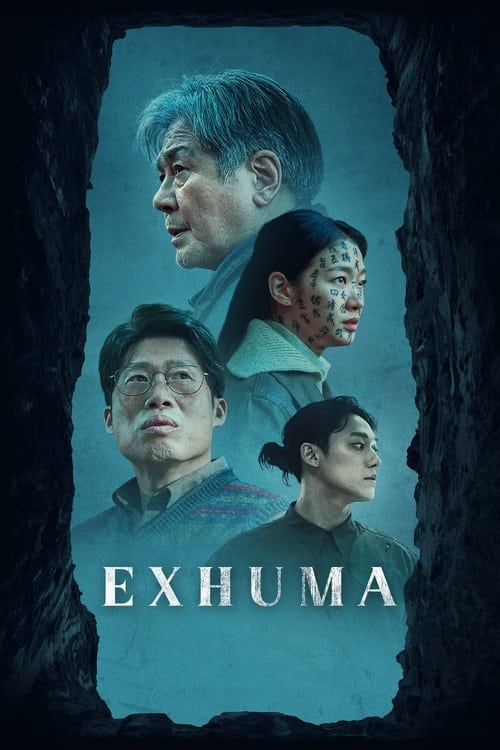
Exhuma
None or negligible
A Korean occult horror about a cursed grave whose later turn toward Korea's pastturn toward the Japanese colonial era carries a patriotic charge rather than a progressive one, leaving almost nothing for this scale to score.
Jang Jae-hyun's horror film follows a young shaman, Hwa-rim (Kim Go-eun), her apprentice Bong-gil, the veteran geomancer Kim Sang-duk (Choi Min-sik) and the mortician Ko Young-geun. A rich Korean family in America hires them because its firstborn sons are haunted, and the cause seems to be the grandfather's nameless grave on a remote mountain peak. Most of the film is the exhumation itself: rituals, coffins, omens and what comes out of the ground.
Messaging is thin. The client family is teased as filthy rich, and Kim grumbles that his daughter, who is marrying abroad, will give him a blonde grandchild. In the second half the mystery turns toward Korea's twentieth-century history, which gives the last act a national, patriotic charge.
Messaging is thin. The client family is teased as filthy rich, and Kim grumbles that his daughter, who is marrying abroad, will give him a blonde grandchild. Halfway through, the grandfather turns out to have been a collaborator with the Japanese colonial regime, buried by a Japanese 'fox diviner' on top of a second, upright coffin. It holds the ghost of a samurai general bound to an iron stake driven into the 'waist' of the peninsula, the grave robbers who once circled the site were independence fighters, and Kim decides to pull the stake out for the sake of the land his grandchild will live on.
What keeps the score near zero is that none of this is progressive identity politics. The historicalcolonial thread is told as national memory and folk belief, earns one point under power and systems, and is otherwise noted rather than scored; the mixed couple earns one point because the rubric counts such couples on sight, though they stay in the background. Women lead the rituals without comment, shamanism, Buddhism and Christianity are all treated with respect, and the story never stops for a lecture.
Score breakdown
Each category is scored 0 to 3: 0 absent or presence only, 1 brief, 2 recurring or plot-relevant, 3 central or dominant. Timestamps refer to the film's running time.
| Category | Score | What we saw |
|---|---|---|
| Content | ||
| A Race and ethnicity | 1 | Kim's daughter is marrying a man whose child, Kim complains, will be blonde and blue-eyed, a background couple that is talked about rather than shown at length. Race is not otherwise raised.
|
| B Gender and feminism | 0 | Hwa-rim is the most capable member of the team and her mentors are older women shamans, but nothing is said about their sex and the men are equally competent. |
| C Sexuality and gender identity | 0 | No LGBTQ characters or themes. |
| D Power and systems | 1 | The curse turns out to be rooted in the country's pastJapanese colonial rule is the buried cause of the curse: a collaborator's grave placed over a stake meant to cut the peninsula's spine. Scored 1, not more: it is told through the plot as national folklore and history, not argued as a social-justice point, and no present-day institution is criticised.
|
| E Cultural and historical revision | 0 | An original story. It uses the folk legend of iron stakes driven into Korean mountains as supernatural fact, but Ko points out that most such stakes are said to be fake (1:41:47), and no established characters are recast. |
| F Religion portrayal | 0 | Islam does not appear. Shamanism, Buddhism and Christianity sit side by side: Ko quotes Ecclesiastes (1:48:01) and a hymn is sung near the end (2:07:55), with no commentary on any faith. |
| Treatment | ||
| G Antagonist coding | 0 | The antagonists are supernaturalantagonists are a resentful ancestor's ghost and the ghost of a Japanese general, which is not the out-group coding the category measures.; the Japanese villains belong to the historical colonial power, and the collaborator's living descendants are treated with sympathy. |
| H Didacticism | 0 | No speech states a progressive message. The long explanations are genre exposition about geomancy and shamanism, and Kim's one impassioned speech late in the filmabout the land his grandchild will live on (1:42:19) is patriotic, noted below. |
| I Message over story | 0 | The story leads: the exhumation, the rituals and the mystery of the grave drive every turn, and the historicalcolonial theme is the answer to the mystery rather than a detour from it. |
| J Left-leaning politics framed as good | 0 | No left-leaning politics are framed as good. The jokes about rich clients are professional banter, and the film's national feeling is not a left-or-right position in its own terms. |
How the number is reached
- Categories A to J add up to 2 of 30, which gives 0.5 (2 ÷ 30 × 10, rounded to the nearest 0.5).
- No counterweight: None applies: there is little progressive messaging to complicate, and the one sceptical voiceKo's doubt about the iron stakes (1:41:47) is overruled by the plot.
- Final rating 0.5, none or negligible.
Considered, scored 0
- Hwa-rim, a young woman, leading the team's rituals, and her circle of older women shamans (1:34:31), shown without comment on their sex.
- Hwa-rim telling a flight attendant that she is Korean (0:01:24), a passing moment.
- The client family teased as filthy rich (0:02:02, also 0:14:19), and Kim's admission that he got rich selling land to rich people (1:42:21), banter and self-reproach rather than a class argument.
- A warning about the ghostWarnings that Japanese ghosts kill anything near them without reason (1:39:01, also 1:43:29), genre lore about a vengeful spirit rather than a point about ethnicity.
- A local monk and a migrant labourer among the victims in a news report (1:28:33), with no comment.
- Ko's churchgoing and Bible verses (0:16:38, also 1:07:54, 1:48:01) and a hymn near the end (2:07:55), shown alongside shamanism and Buddhism without comment.
Evidence and confidence
Confidence: Medium. Full English subtitles from the embedded dialogue track, plus the forced track for on-screen signs and songs, and 134 frames sampled once a minute. The Japanese spoken late in the filmby the ghost in the last act is covered by the subtitles. The rituals run for minutes with chanting and drums but no dialogue (for example 0:28:45 to 0:30:44), and those stretches were judged from the frames. The groom at the closing wedding does not appear in the sampled frames, so the couple scored under A rests on the dialogue.
Category F definition: As in the rubric: Islam shown as a peaceful and tolerant religion, aligned with human rights, in a way that works as a corrective message.
Noted, not scored: Patriotism and national memory drive the last act.: the grave robbers' leftover tools belong to an 'Iron Blood Alliance' whose members' names are read out (1:32:34, 1:33:36), and Kim resolves to pull the stake for the land his unborn grandchild and future generations will live on (1:42:28). Ancestral graves and rituals are treated as real forces throughout.
Rubric version 1. Reviewed 18 November 2026.