Woke rating
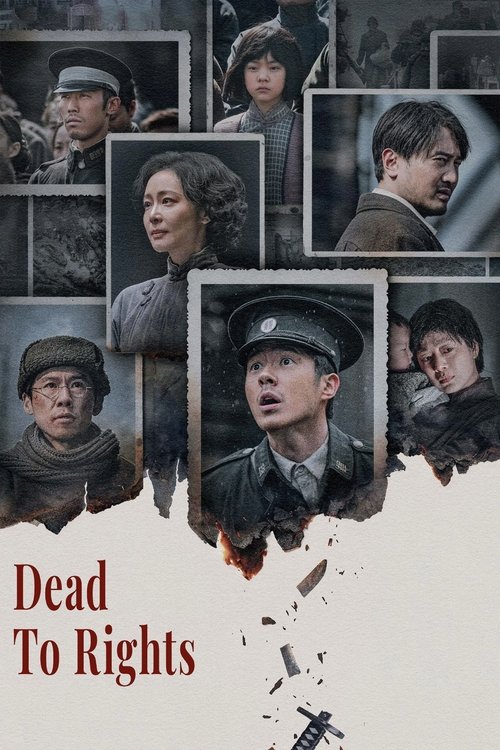
Dead to Rights
None or negligible
A Chinese drama about civilians hiding in a Nanjing photo studio during the 1937 massacre, whose message is national remembrance and patriotism rather than anything this scale measures.
Shen Ao's drama is set in Nanjing in December 1937, as the city falls to the Japanese army. Su Liuchang, a young postman, escapes a round-up by passing himself off as a photo-studio apprentice, and Ito Hideo, an army photographer, puts him to work developing the army's film. Hiding in the studio with the owner's family, an opera singer and a wounded soldier, Su finds himself printing pictures of the killings in the streets, and the group has to decide whether to risk their lives to keep the negatives.
Very little here is what the rubric measures. The film's subject is the atrocity itself: prisoners shot for the camera, officers racing to kill 150 people, a river running red, and refugees ordered to smile for staged propaganda photographs. The Japanese army is the villain as the perpetrator of that history, not as a stand-in for a group the rubric tracks, and Ito is drawn as an individual with a family in Tokyo and a dream of making films. The Chinese side is not idealised either: a collaborating interpreter insists he is no traitor, and the studio family at first looks down on the opera singer. Race, gender and sexuality are never framed as issues.
What the film does argue is remembrance and national pride. A father teaches his children that not an inch of the land may be given up, and the closing cardsA father teaches his children that not an inch of the land may be given up, the photographs end up as evidence at a war-crimes tribunal, and the closing cards give the death toll and dedicate the film to the 80th anniversary of victory in China's war against Japan and the world anti-fascist war. That patriotic framing is noted below but not scored, so the film scores zero.
Score breakdown
Each category is scored 0 to 3: 0 absent or presence only, 1 brief, 2 recurring or plot-relevant, 3 central or dominant. Timestamps refer to the film's running time.
| Category | Score | What we saw |
|---|---|---|
| Content | ||
| A Race and ethnicity | 0 | Ethnicity appears only as the war between China and Japan, presented as history rather than identity politics. One character's bitter claim that the Chinese are 'a sheet of loose sand' who cannot unite (1:33:27) is wartime defeatism the film rejects, not a race message. No interracial couple appears in the dialogue or the frames. |
| B Gender and feminism | 0 | Women are among the victims and the survivors, but nothing is framed through gender. The opera singer Lin Yuxiu recalls playing the woman generals Mu Guiying and Liang Hongyu (1:33:56), and she later makes a selfless choice, and she later gives away her own pass (1:43:58), but the men in the studio take the same risks, and the point is loyalty to the nation, not to women. |
| C Sexuality and gender identity | 0 | No LGBTQ characters or themes. Lin Yuxiu's life as a performer and kept woman is part of her character, not sexual-freedom advocacy. |
| D Power and systems | 0 | The institution on trial is the wartime Japanese army, shown killing prisoners and civilians and staging propaganda photographs to sway international opinion (1:01:07, frame 1:01:30). That is an enemy's war crime presented as history, not a system framed as oppressing a group in the rubric's sense. Lin Yuxiu's list of Japan's earlier aggressions against China (1:33:07) is national history told to justify collaboration, and is noted below with the film's patriotism. |
| E Cultural and historical revision | 0 | An original story built around a historical event and the real use of photographs as evidence. No established characters or history are recast to carry a message. |
| F Religion portrayal | 0 | Religion plays no part in the film, and Islam is not portrayed. |
| Treatment | ||
| G Antagonist coding | 0 | The villains are the Japanese army, the historical perpetrators of the massacre, which is not the out-group coding the category measures. Ito, the Japanese character at the centre of the plot, is given individual motives: he keeps calling Su his friend (0:34:48, 0:53:11), thinks of his wife and daughter in Tokyo (1:09:31), was sent to war by his father for the family's honour (1:10:05) and hopes to make a film after the war (0:44:34). |
| H Didacticism | 0 | No speech states a progressive message. The speeches that state anything directly are patriotic: a father's lesson to his children (1:40:30), Su's defiance of Ito (2:07:02) and the tribunal's verdict listing the crimes and the death toll (2:10:35). They are noted below. |
| I Message over story | 0 | The story is a tense hide-and-survive drama built around the darkroom, the passes and the negatives; nothing bends to a progressive point. |
| J Left-leaning politics framed as good | 0 | No left-leaning politics appear. The closing dedication's 'world anti-fascist war' (frame 2:13:30) is the standard Chinese name for the Second World War, not a present-day left-or-right position, and the film's patriotic framing is noted below. |
How the number is reached
- Categories A to J add up to 0 of 30, which gives 0.0 (0 ÷ 30 × 10, rounded to the nearest 0.5).
- No counterweight: None applies: there is no progressive messaging to complicate.
- Final rating 0.0, none or negligible.
Considered, scored 0
- The Japanese army as the villains: prisoners shot while an army photographer is called over to capture it (0:10:08, 0:10:25), two lieutenants racing to kill 150 people (0:38:28, frame 0:38:30) and a river running red (frame 1:20:30), the massacre presented as the historical record.
- Refugees ordered to smile for staged propaganda photographs, which an officer calls the important role of propaganda in war (1:04:54, frames 1:01:30 and 1:06:30), shown as one of the occupation's crimes.
- Chinese officers ordering their men to fire on their own retreating soldiers at the city gate (0:08:53, 0:09:20), shown as the chaos of the defeat, not argued.
- Western staff at the safety-zone hospital protesting a raid by Japanese soldiers (0:56:24, 0:57:42, 0:59:07), period detail with no wider message.
- Lin Yuxiu, an opera singer the studio family looks down on for her background (0:47:32), a character arc rather than a point about class or gender.
- The interpreter Wang Guanghai, who insists he is an interpreter and not a traitor (0:42:17), a collaborator drawn with his own motives.
- Women among the victims, including a girl hiding under a quilt (frame 0:39:30), shown as part of the atrocity rather than as a gender argument.
- A Chinese and Japanese cast with a few Westerners, shown without comment.
Evidence and confidence
Confidence: Medium. A Whisper transcript of the Mandarin audio, translated while reading, and 137 frames sampled once a minute, whose burned-in Chinese and English subtitles were used to check key lines and the closing cards. The transcript is rough: dialect lines are often garbled, some Japanese dialogue comes through only as approximate Chinese or is mislabelled, and several stretches are lost to repeated loops (for example 0:15:51 to 0:16:16, 0:44:45 to 0:45:02, 1:10:44 to 1:11:04, 1:53:01 to 1:53:31). Those gaps were judged from the frames; none of them looks likely to change the score.
Category F definition: As in the rubric: Islam shown as a peaceful and tolerant religion, aligned with human rights, in a way that works as a corrective message.
Noted, not scored: The film is framed as national remembrance and patriotism: Lin Yuxiu recites Japan's earlier humiliations of China, from Taiwan to the Eight-Nation Alliance and the indemnities (1:33:07); a father shows his children pictures of China's landmarks and teaches them that not an inch of the land may be given up (1:39:36, 1:40:30); a closing card says the dead included prisoners of war and large numbers of innocent civilians (frame 1:59:30); and the last card dedicates the film to the 80th anniversary of victory in the Chinese People's War of Resistance against Japanese Aggression and the World Anti-Fascist War (frame 2:13:30).. Su tells Ito that they are not friends (2:07:29), and the photographs end up before the Ministry of National Defence war-crimes tribunal, where the defence's attempt to blame the Chinese army for the civilian deaths (2:09:43) is answered by the photographs as evidence, a toll of more than 300,000 and a death sentence (2:10:05, 2:11:02, 2:11:17).
Rubric version 1. Reviewed 18 November 2026.