Woke rating
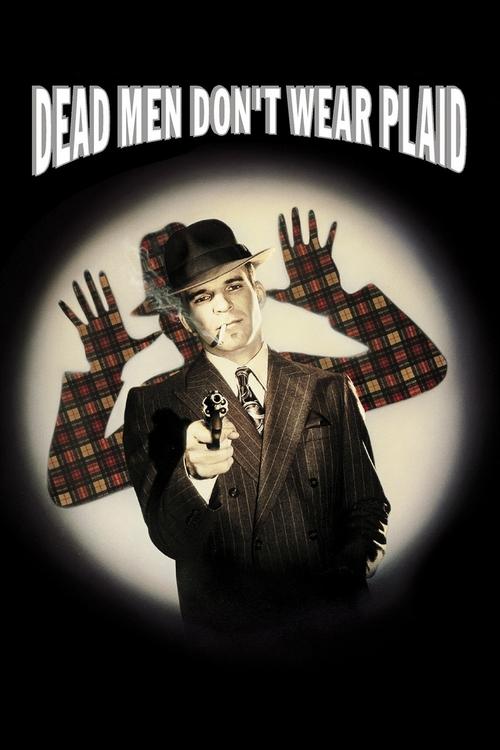
Dead Men Don't Wear Plaid
None or negligible
A black-and-white spoof of 1940s film noir in which Steve Martin trades lines with classic stars through spliced-in clips, with no progressive messaging: its drag and innuendo gags are slapstick, not statements.
Carl Reiner's comedy stars Steve Martin as private eye Rigby Reardon, hired by Juliet Forrest (Rachel Ward) to prove that her father, a scientist and cheese maker, did not die in an accident. A list of the 'friends and enemies of Carlotta' sends Rigby through a chain of suspects, and the film's gimmick is that many of them are played by real stars in clips from 1940s films, cut in so that Martin trades lines with James Cagney, Ava Gardner and others.
The places where the rubric might look are all gags. Rigby dresses as a blonde to seduce a suspect and as an old woman to visit a prisoner, and Juliet teases him that he is starting to enjoy it. A Latin American officer keeps offering to take care of his pajamas. The film opens with Rigby 'adjusting' a fainting Juliet's breasts, and his narration leers at women and rants that all dames are alike in the hard-boiled manner of the films it imitates.
The places where the rubric might look are all gags. Rigby dresses as a blonde to seduce a suspect and as an old woman to visit a prisoner, and Juliet teases him that he is starting to enjoy it. A Latin American officer keeps offering to take care of his pajamas. The film opens with Rigby 'adjusting' a fainting Juliet's breasts and ends with her returning the favour, and his narration leers at women and rants that all dames are alike in the hard-boiled manner of the films it imitates. The conspiracy turns out to be a band of German officers, with Juliet's father held captive, plotting to dissolve the United States with cheese-mould bombs.
The score stays at zero because none of it carries a message. The drag, the innuendo and the leering are jokes at Rigby's expense and at the genre's, not points about sex, gender or race, and the villainsNazi villains are the stock enemies of the 1940s pictures the film borrows from. Since there is no messaging, there is nothing for a counterweight to offset.
Score breakdown
Each category is scored 0 to 3: 0 absent or presence only, 1 brief, 2 recurring or plot-relevant, 3 central or dominant. Timestamps refer to the film's running time.
| Category | Score | What we saw |
|---|---|---|
| Content | ||
| A Race and ethnicity | 0 | Race never comes up as a theme. The comic Latin American types in Carlotta are period pastiche, and no interracial couple appears in the dialogue or the sampled frames; the romance is between Rigby and Juliet. |
| B Gender and feminism | 0 | The narration is full of hard-boiled leering (0:07:30, 0:39:03) and one rant about women (1:03:32), and Juliet is resourceful, but both are genre jokes and gender is never argued. |
| C Sexuality and gender identity | 0 | No LGBTQ theme. Rigby's drag disguises and Carlos's pajama innuendo are slapstick, and Rigby insists he does not enjoy dressing as a woman (0:56:02). |
| D Power and systems | 0 | No institutional critique. A prison warden helps Rigby go undercover (0:59:06), and the police and government barely appear. |
| E Cultural and historical revision | 0 | An original story. The 1940s stars appear in clips from their own films, credited at the end with the films they come from (1:25:30); nothing is recast. |
| F Religion portrayal | 0 | Islam does not feature. Religion comes up only in a joke about a nun who taught lepers to sing (0:19:33). |
| Treatment | ||
| G Antagonist coding | 0 | The killers behind the conspiracy are comic-book villains with a scheme of their ownThe killers are German officers led by a former Field Marshal who plan to destroy America and win the next war (1:18:00, 1:19:54), borrowed from the films the movie parodies and not coded by any present-day group. |
| H Didacticism | 0 | No speeches carry a social message. The longest explanation in the film is the villain's account of his scheme, played as a squabble over who gets to tell it (1:18:48, 1:18:54). |
| I Message over story | 0 | The plot is a deliberately convoluted noir mystery built around the clips, and nothing in it bends toward a message. |
| J Left-leaning politics framed as good | 0 | No political positions are argued. |
How the number is reached
- Categories A to J add up to 0 of 30, which gives 0.0 (0 ÷ 30 × 10, rounded to the nearest 0.5).
- No counterweight: There is no progressive messaging to mock or complicate.
- Final rating 0.0, none or negligible.
Considered, scored 0
- Rigby's drag disguises, as a blonde to seduce Neff (0:51:44, 0:53:24) and as Cody Jarrett's mother (0:56:04, 0:57:30), with Juliet's teasing that he is starting to enjoy it (0:56:00), played as slapstick.
- Carlos's running offer to take care of Rigby's pajamas (1:14:16, 1:22:52), an innuendo gag.
- The opening gag of Rigby adjusting Juliet's breasts (0:04:16), reversed at the end (1:23:28), a comic bookend rather than a point about roles.
- Rigby's leering narration (0:07:30) and his rant that all dames are alike (1:03:32), hard-boiled clichés played for laughs.
- The joke that Carlotta spells trouble 'T-R-U-B-I-L' and kills anyone who corrects it (1:06:16), period pastiche with no message about race.
- Juliet's resourcefulness, sucking out a bullet after Rigby is shot (0:11:39) and tricking the villain into saying the words that set Rigby off (1:20:40, 1:21:26), shown, not argued.
Evidence and confidence
Confidence: Medium. The file has no English text subtitles, so the dialogue comes from a Whisper transcript of the English audio, which garbles some names (Reardon often comes out as 'Redden', Swede as 'Sweet') and a few lines but covers the whole film. 88 frames sampled once a minute.
Category F definition: As in the rubric: Islam shown as a peaceful and tolerant religion, aligned with human rights, in a way that works as a corrective message.
Rubric version 1. Reviewed 17 November 2026.