Woke rating
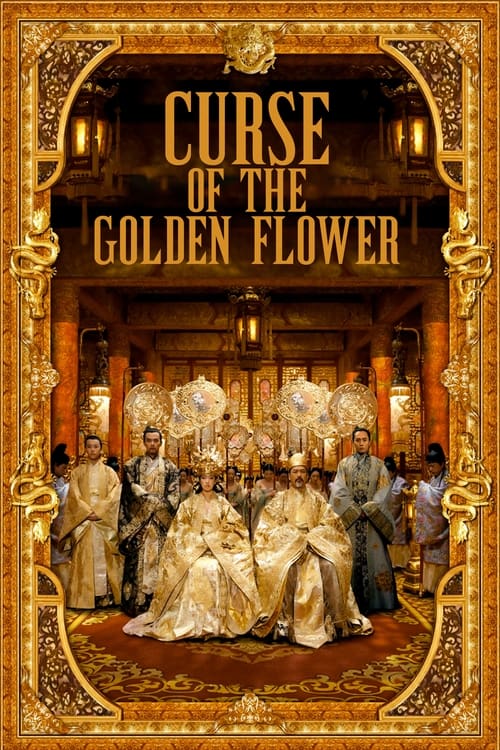
Curse of the Golden Flower
None or negligible
Zhang Yimou's opulent palace tragedy about an emperor, his empress and their sons carries next to no progressive messaging; its target is tyranny inside one family, and those who resist it are compromised too.
Zhang Yimou's palace epic, adapted from Cao Yu's play Thunderstorm, is set in a Tang-era imperial court on the eve of the Chongyang (Double Ninth) festival. The Emperor (Chow Yun-fat) brings his second son, Prince Jai (Jay Chou), home from the border and finds the Empress (Gong Li) embroidering chrysanthemums by the thousand. She is made to take a medicine every two hours on the Emperor's orders, the Crown Prince Wan (Liu Ye) wants to leave the palace with the court physician's daughter, and the whole household runs on a rigid order of rules that the Emperor enforces down to the last mouthful.
The film's subject is tyranny inside a family. The Emperor lectures his sons that each has a fixed place, ruler and subject, father and son, and that the rules must not be broken; he tells the Empress she is treated with courtesy only for her father's sake; and the medicine turns out to be a slow poison. The Empress answers with a plot of her own, and the festival brings the family's secrets into the open. Where the rubric might look, at a wife in the power of an all-powerful husband, the film tells a family tragedy rather than making a point about women: the sons are crushed by the same order, and the Empress has secrets of her own.
The film's subject is tyranny inside a family. The Emperor lectures his sons that each has a fixed place, ruler and subject, father and son, and that the rules must not be broken; he tells the Empress she is treated with courtesy only for her father's sake; and the medicine is a slow poison meant to drive her mad. The Empress, who has had an affair with her stepson Wan, plans a coup with Jai, her rebels marked by the chrysanthemums. The festival brings it all out: the physician's wife is the Emperor's first wife and Wan's mother, whose family he framed to marry the princess of Liang, so the girl Wan loves is his half-sister. She and her mother die, the youngest prince Yu kills Wan and is killed by his father, Jai's rebels are massacred, and the court gathers at midnight as if nothing had happened. Offered a pardon if he will serve his mother her poison every day, Jai kills himself.
The one point is for the picture of absolute power: the Emperor's speeches about rules and place are the creed the film turns against him, and the closing image of order restored over the dead is pointed. But it is a critique of tyranny and its hypocrisy, set in a medieval court and tied to no modern cause or group, and the film complicates it by making the Emperor's opponents compromised toono better: an adulterous Empress, a resentful youngest son and a rebellion that ends in slaughter. That counterweight brings the rating to zero.
Score breakdown
Each category is scored 0 to 3: 0 absent or presence only, 1 brief, 2 recurring or plot-relevant, 3 central or dominant. Timestamps refer to the film's running time.
| Category | Score | What we saw |
|---|---|---|
| Content | ||
| A Race and ethnicity | 0 | Race never comes up. The cast is entirely Chinese and no interracial couple appears in the dialogue or the sampled frames; the Empress being a princess of the neighbouring kingdom of Liang (0:26:34) is dynastic politics. |
| B Gender and feminism | 0 | The Emperor's control of the Empress drives the plot, but it is told as a tyrant's hold over his whole family rather than a point about women: his sons are made to kneel when she refuses her dose (0:22:55) and suffer as badly as she does, and the Empress is no simple victimno simple victim, having had an affair with her stepson and planned a coup. |
| C Sexuality and gender identity | 0 | No LGBTQ+ content. The palace's secrets are incestuousincestuous: the Empress's affair with her stepson Wan, and Wan's love for a girl who turns out to be his half-sister, and they are shown as shame and ruin, not as sexual freedom. |
| D Power and systems | 1 | The Emperor's rule over his family and court is shown as tyranny dressed up as ritual and order, and the festival goes on as planned over the dead. It is a critique of absolute power and its hypocrisy, not of a system oppressing a group, so it scores 1.
|
| E Cultural and historical revision | 0 | An adaptation of Cao Yu's play Thunderstorm, moved from a wealthy household of the 1920s to an imperial palace. The story is restaged, not revised to carry a progressive message, and no established character is recast. |
| F Religion portrayal | 0 | Islam does not feature. |
| Treatment | ||
| G Antagonist coding | 0 | The Emperor is the film's tyrant, but he has his own reasons: he has long known of the Empress's affair with Wan (1:08:35), and nothing about him stands for a group. |
| H Didacticism | 0 | The Emperor's lectures on order and rules (0:20:40, 0:25:40) state his own creed, which the film turns against him. No one lectures on a progressive theme. |
| I Message over story | 0 | The melodrama drives the film from start to finish, and none of its turns bends to make a point. |
| J Left-leaning politics framed as good | 0 | The Emperor's language of order, loyalty and filial piety is shown as a cover for cruelty, but the conflict is a tyrant against his own family, not left against right, and the rebellion is a family cause, not a political oneJai says he rebelled not to seize the throne but for his mother (1:43:23). |
How the number is reached
- Categories A to J add up to 1 of 30, which gives 0.5 (1 ÷ 30 × 10, rounded to the nearest 0.5).
- Counterweight −0.5: The film complicates its picture of tyranny: those who resist the Emperor are compromised too. Jai's first answer to his mother's plan is that he cannot raise a blade against his father (0:49:14), and the Emperor is given personal reasons of his own.; the Empress has had an affair with her stepson Wan, which the Emperor has long known of (1:08:35, 1:08:54); Yu turns on his brother and father out of resentment (1:23:55 to 1:24:14); and the Empress's coup sends her rebels into a massacre (frames 1:33:30, 1:36:30).
- Final rating 0.0, none or negligible.
Considered, scored 0
- The Empress as the victim of a husband who doses her against her will and reminds her she is respected only for her father's sake (0:26:34), and her account to Jai of drinking the poison calmly every day (0:47:48), told as a family tragedy, not a point about women.
- The palace's incestuous secretsThe Empress's affair with her stepson Wan, and Wan's love for Jiang Chan, who turns out to be his half-sister (1:19:41), shown as shame rather than as sexual freedom.
- A woman the Emperor wronged long agoThe Emperor's first wife, whose family he framed and threw into prison to marry the princess of Liang (0:41:30), a personal betrayal rather than a comment on class or gender.
- Court ladies in low-cut gowns (frames 0:06:30, 0:27:30), part of the film's opulent look.
- An entirely Chinese cast, with no interracial couple.
Evidence and confidence
Confidence: Medium. The file has no English text subtitles, so the dialogue comes from a Whisper transcript of the Mandarin audio, translated while reading. The transcript is rough: many words are misheard, and several stretches come out as repeated loops or filler that do not match the scene (for example 0:02:02 to 0:02:24, 0:04:07 to 0:04:25, 0:27:45 to 0:28:14, 0:42:38 to 0:42:58, 0:50:47 to 0:51:13, 0:54:13 to 0:55:10, 1:22:30 to 1:22:51 and 1:49:07 to 1:51:55). The battle and its aftermath (about 1:24:20 to 1:42:20) yield almost no usable dialogue and are known from the frames. 114 frames sampled once a minute, the last four of them end credits; none of the gaps looks likely to change the score.
Category F definition: As in the rubric: Islam shown as a peaceful and tolerant religion, aligned with human rights, in a way that works as a corrective message.
Rubric version 1. Reviewed 18 November 2026.